

Strengthening applied research to address phytosanitary challenges in the forestry industry was the focus of the visit by INIA's National Director, Carlos Furche, to Los Ángeles, where he met with the General Manager of the Phytosanitary and Forestry Protection Consortium (CPF), Claudio Goycoolea.
Accompanied by INIA Quilamapu's Regional Director, Rodrigo Avilés, and other institutional executives, Furche learned about the initiatives both entities have carried out for over 20 years, focusing on managing pests that affect forest plantations in the Ñuble and Biobío regions, leveraging INIA's expertise in biological control and chemical ecology of agricultural and forest pests.
During the meeting, the scope of a new research project was analyzed. Funded by the Fondef program of the National Research and Development Agency (ANID), it will be led by INIA Quilamapu researcher Dr. Ricardo Ceballos for the management ofHylurgus ligniperda,known as the bark beetle, which, in addition to causing physical damage, acts as a vector for fungi that compromise the wood.
The initiative aims to optimize, validate, and mass-produce a highly specific bait based on chemical ecology tools, with the goal of reducing the insect's presence and sustainably mitigating the phytosanitary problem it poses for the international trade of forest products.
"Forestry activity is at the heart of the economic development of the Ñuble, Biobío, and La Araucanía regions. Often, it is not fully realized that forest plantations constitute the main crop grown in Chile and, like any production system, they face significant phytosanitary challenges," stated Furche.
He added that the experience accumulated by INIA in plant protection has allowed the transfer of scientific capabilities developed for agriculture to the forestry sector. "INIA is the main institution providing the forestry industry with tools to efficiently address its phytosanitary challenges. This is applied research, aimed at solving concrete problems that affect the sector's productivity and competitiveness," he emphasized. Regarding the relationship with CPF, he stressed that "this close collaboration is precisely the type of public-private partnership that the country needs to continue strengthening," he concluded.
Certified seeds for agriculture
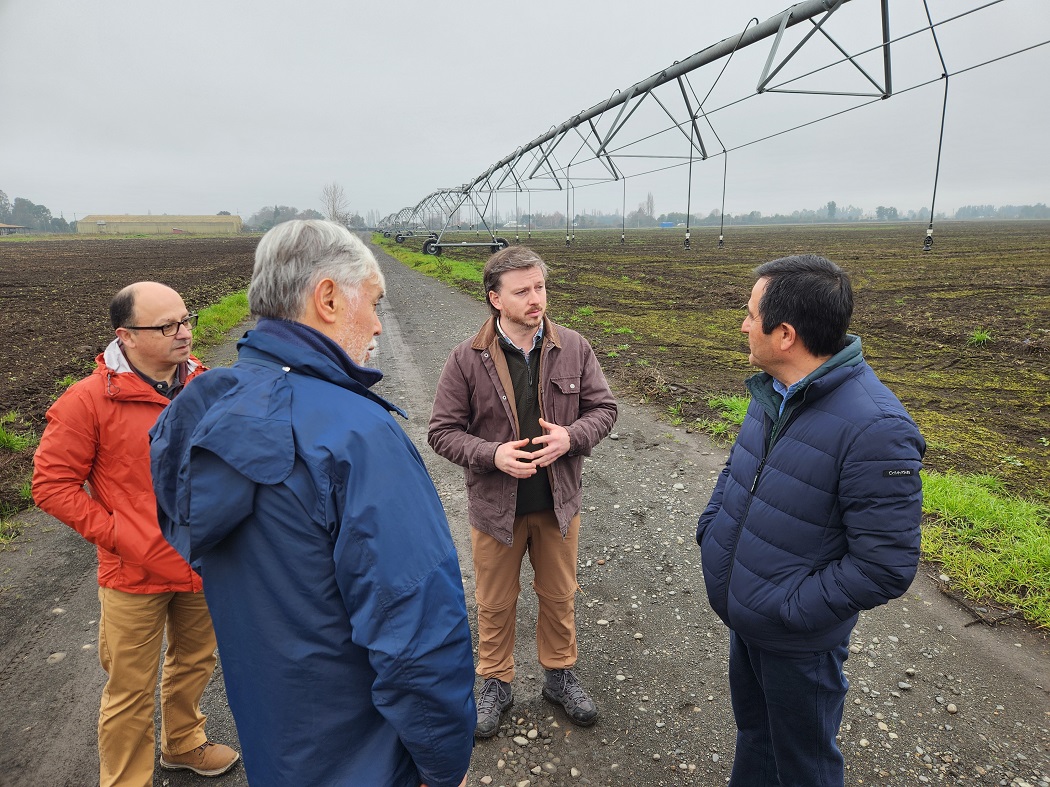
The national director's agenda also included a visit to the INIA Humán Experimental Center, on the road to Antuco, a property dedicated to the production of certified seeds, especially durum wheat, as well as corn, chicory, and legumes.
During the tour, he highlighted the investments made in irrigation technologies, mechanization, and production management, with the aim of transforming the center into a demonstration platform for regional agriculture.
"This is the most productive field that INIA has in the country, and we want it to progressively incorporate all the technological developments generated by our researchers. The challenge is to have more efficient irrigation systems, more precise planting processes, and higher productivity levels, making it a benchmark for agriculture in the Biobío Region," he noted.
Furche also emphasized INIA's contribution to the supply of durum wheat seeds, a crop whose demand maintains a growing trend due to increased pasta consumption. "We are close to making a new durum wheat variety available to farmers, which will allow INIA to maintain its leadership as the main seed supplier for this crop in Chile and respond to a demand that will continue to grow in the coming years," he stated.






Comments (0)
No comments yet. Be the first to comment!
Leave a comment