

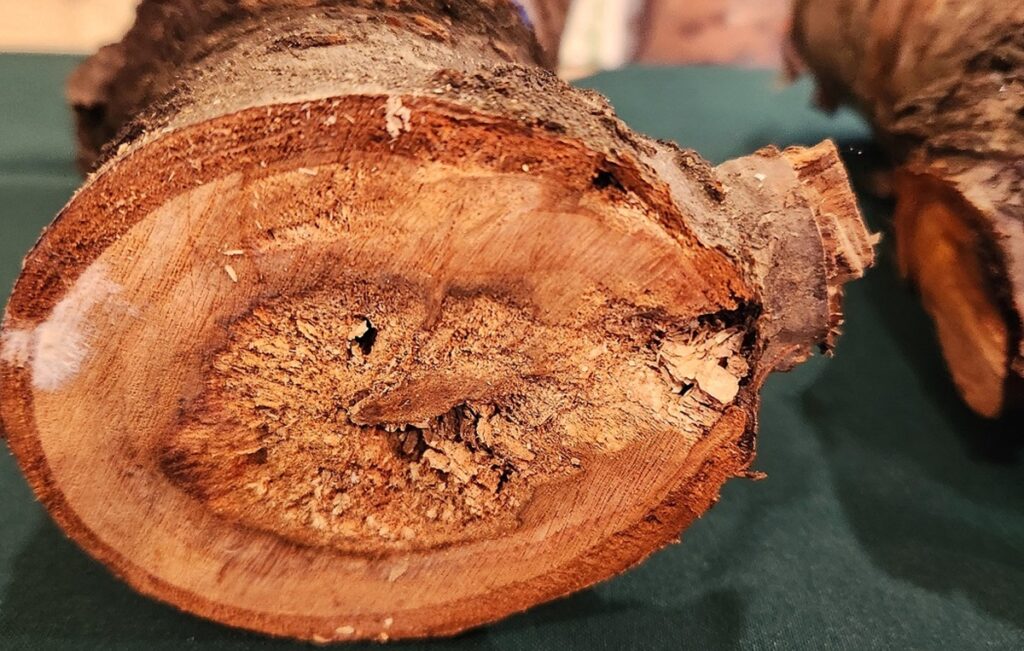
Wood fungi continue to be one of the main threats to the productivity and lifespan of fruit orchards, as they remain hidden inside the trees and often go unnoticed during the first years of infection.
Faced with this challenge, researchers from INIA Quilamapu in Chile presented the results of the Trunkguard project, a bio-immunizer developed for the control of these diseases in fruit trees.
Yield losses of up to 66%
The project coordinator and phytopathologist at INIA Quilamapu, Daina Grinbergs, explained that wood diseases often receive less attention than those affecting leaves or fruits, because the fungi remain inside the woody tissue and do not always show visible symptoms. However, she warned that their productive impact is significant.
"We have observed yield reductions of up to 65% in European hazelnut, 45% in cherry, 66% in apple, and 40% in blueberry, all affected by wood fungi," she stated.
The researcher added that these diseases also reduce fruit size and quality, decrease orchard lifespan, and force early replanting, increasing production costs.
Grinbergs explained that Trunkguard emerged after detecting apple trees in orchards that, after showing silver leaf symptoms, spontaneously recovered their productive capacity.
Analyses revealed that these specimens had a more diverse and abundant microbiota than diseased trees. From those microorganisms, the team developed the biological formulation that gave rise to Trunkguard.
Research showed that these microorganisms inhibit the growth of important wood fungi, including Chondrostereum —the cause of silver leaf—, Cytospora, Callosphaeria, Eutypa, and Nectria. Additionally, they produce volatile metabolites capable of limiting the development of these pathogens.
Promising results across different species
The researchers also verified that Trunkguard not only acts directly on the fungi but also stimulates the defense mechanisms of species such as cherry, apple, blueberry, and plum, activating genes related to the plants' immune response.
Evaluations carried out in greenhouses showed that the formulation reduces fungal development and wood discoloration in cherry plants, in addition to inducing immune responses.
Despite the results obtained, Grinbergs indicated that further research is still required before moving toward its commercialization.
"Due to the importance that European hazelnut has acquired in Chile, we are evaluating the product's effectiveness against the fungi affecting this crop, with very interesting results," she commented.
The next step of the project will be to validate Trunkguard's performance in a greater number of fruit species, as well as in nurseries and commercial orchards, with the aim of consolidating it as a biological tool for the sustainable management of wood fungi and contributing to extending orchard lifespan.
The initiative was funded by the National Agency for Research and Development (ANID) through Fondef.




Comments (0)
No comments yet. Be the first to comment!
Leave a comment