

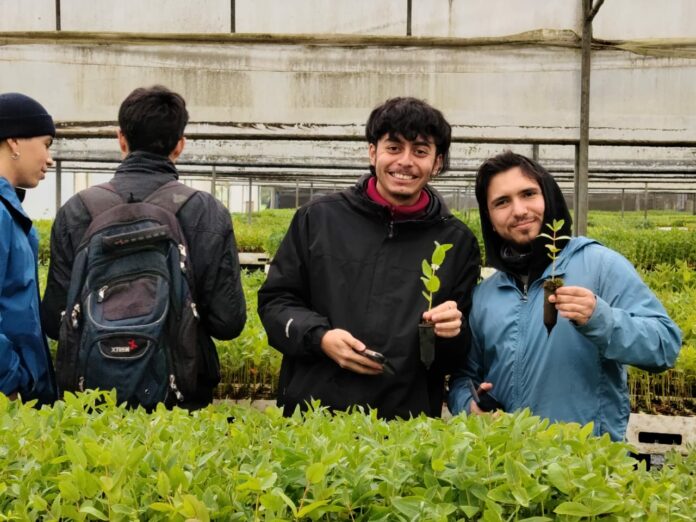
Learning firsthand how the plants that will later be established in different areas of the country are produced was the main objective of an academic visit made by Forestry Engineering students from the Universidad Austral de Chile (UACh) to the La Cabaña nursery, linked to Forestal Anchile.
The activity, carried out within the framework of the Nurseries and Plantations course, allowed students to observe the different stages involved in the production of Eucalyptus nitens plants in containers, from seed preparation and germination to propagation, handling, and acclimatization prior to their establishment in the field.
The academic from the Faculty of Forest Sciences and Natural Resources at UACh, Dr. Óscar Thiers, highlighted the importance of complementing theoretical training with experiences developed directly in production facilities.
As he explained, this type of activity allows students to analyze processes that operate on a real scale and, at the same time, strengthen the link between the university and the forestry sector, bringing them closer to the demands and challenges they will later face in their professional careers.
Technology applied to production
During the tour, students learned about the systems used to optimize plant growth conditions, including greenhouse infrastructure, automated sensors to control temperature and humidity, irrigation systems, and mechanisms designed to promote plant acclimatization before their transfer to the field.
The visit also allowed them to learn about the work carried out by the nursery alongside companies in the sector, including Arauco, particularly in the production of the GLONI hybrid, obtained from Eucalyptus globulus and Eucalyptus nitens.
In this way, future professionals were able to learn not only about the characteristics of the different species and materials used in nursery production, but also the technical and management requirements involved in producing plants destined for forest plantations.
An experience from the students' perspective
For the students, the experience allowed them to grasp the complexity that exists behind a plant before it reaches the field.
Maira Luna, a Forestry Engineering student, valued the opportunity to directly observe the application of the content reviewed during the course and to learn about the economic relevance of seeds and plants within nursery activity.
For his part, Gustavo Stevenson highlighted the possibility of visiting a larger-scale nursery, where factors such as planning, costs, production volumes, and control of environmental conditions take on special importance.
The student especially emphasized the germination, vegetative propagation, and acclimatization stages, a process through which plants are prepared to face the environmental conditions they will later encounter in the field.
Connection with restoration and professional training
Another aspect addressed during the visit was the work the nursery maintains with CONAF for the production of native species such as roble, raulí, coigüe, and laurel. These plants contribute to supplying programs linked to afforestation, restoration, and ecosystem recovery.
For UACh, this link also represents an opportunity for its students to learn about different areas of professional practice.
Dr. Thiers noted that several students have completed their professional internships at the nursery and that some graduates currently work at Forestal Anchile as forestry engineers and natural resource conservation engineers.
Finally, the academic thanked Rafael Arai, from Forestal Anchile, and Guido Catalán, production manager, for facilitating the visit and contributing to the development of an experience that connects university training with the productive reality of the forestry sector.



Comments (0)
No comments yet. Be the first to comment!
Leave a comment