

Although the frost warning issued by the Chilean Meteorological Directorate (DMC) for Biobío between the early mornings of Sunday and Monday has already ended, the feeling of cold will continue.
That Meteorological Warning contemplated temperatures between -3 °C and -1 °C in the valley and the foothills, along with the probability of frost formation during both days. And, indeed, the episode ended yesterday with a cold morning in various points of the area.
But that drop in temperatures does not seem to be something isolated. From the DMC, they explained that the entry of a polar air mass will continue to affect the region over the coming days, with valley sectors that could still record temperatures below zero.
At the same time, according to different forecasts, in high mountain sectors temperatures could drop even below -10 °C.
DMC meteorologist Alonso Guajardo warned that the cold could be even greater at surface level, especially in sectors where solar radiation does not reach directly.
"That polar mass reached the Biobío Region and will continue to affect us. Not only today, tomorrow, and the day after do we continue with the temperatures, and in some valley sectors still below zero," he explained.
Added to this is the continuation of the Blue Code due to temperatures of 0 °C or less in Los Ángeles, a measure that will remain active until Wednesday and that includes on-the-ground deployment to provide clothing, hot meals, and referral to shelters for people experiencing homelessness.
As if that were not enough, there will be partial cloudiness and rain in almost all communes over the coming days, although far from the intensity of previous fronts, such as those in July and early this month.
That said, a new frontal system is expected for Friday, although with liquid precipitation and no snow in the valley sectors. In this way, mornings and nights continue to be marked by the feeling of cold and freezing winds, maintaining the need for heating.
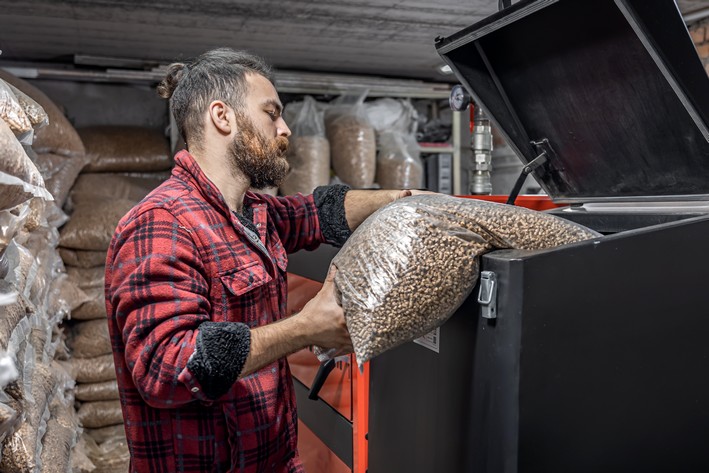
With winter still far from over, added to the usual and slow climatic transition in the first weeks of spring, the scenario brings a more everyday question into focus: is there enough firewood and pellet to keep stoves burning?
Biomass stock
The pellet scenario began to become strained in different points of southern Chile. In Valdivia, for example, neighborhood groups reported difficulties finding the product during the weekend, while in recent weeks consumers have also reported availability problems in supermarkets and distributors, especially during periods of higher demand associated with low temperatures.
The industry, however, rules out widespread national shortages. In recent statements to El Mercurio, the manager of the Chilean Biomass Association (AChbiom), Daniela Espinoza, played down that perception, attributing it specifically to logistical difficulties, the seasonality of consumption, and concrete challenges at some distribution points.
Despite the above, the scenario takes on a particular dimension in Biobío, the country's main pellet-producing hub.
Consulted by Diario Concepción, the union leader and former Biobío Energy Seremi reaffirmed that, in general terms, companies in the region are operating and producing as planned for this season.
Espinoza explained that naturally "the logistical challenge becomes more evident during weeks of higher demand," adding that, while the greatest production occurs in the regions of Maule, Biobío, and La Araucanía, "the main consumption centers are further south."
"The further the consumption points are from the production centers, the greater the effort required to promptly replenish stocks," she continued, explaining that the Los Lagos Region is the one that "concentrates about 30% of national consumption."
Finally, regarding whether pellet companies have had to resort to raw materials from other regions in the face of potential supply difficulties in Biobío, Espinoza explained that all of them freely choose which supplier to work with.
"Each company has its own supply network, defined according to its needs and production capacity, so the origin of the raw material can be within or outside the region," she concluded.
Logistics chain
Amid inquiries about the supply of biomass for heating during winter, there was also an effort to learn how the recent rains had impacted the forestry chain, particularly how well or poorly positioned the industry was to ensure the supply of raw materials to producers and distributors in the wholesale and retail biomass market.
From the Chilean Wood Corporation (Corma), its general manager, Antonio Minte, asserted that the rainfall did not have a significant impact on industrial wood production or on the biomass supply logistics of its member companies.
"Although winter always imposes greater logistical challenges, the industry remains operational and prepared to respond to demand," he stated.
Regarding pellet, Minte clarified that Corma's technical counterpart is AChbiom, from where—according to him—they have been informed that "their companies are operating at maximum capacity, making all logistical efforts to reach families who have chosen this fuel."
Finally, regarding firewood, the executive clarified that although Corma does not directly monitor that market, "it is urgent and necessary to advance in its formal oversight following the enactment of the Solid Biofuels Law," in order to ensure "a safe, sustainable, and quality standard for the population."
Source:Diario Concepción



Comments (0)
No comments yet. Be the first to comment!
Leave a comment