

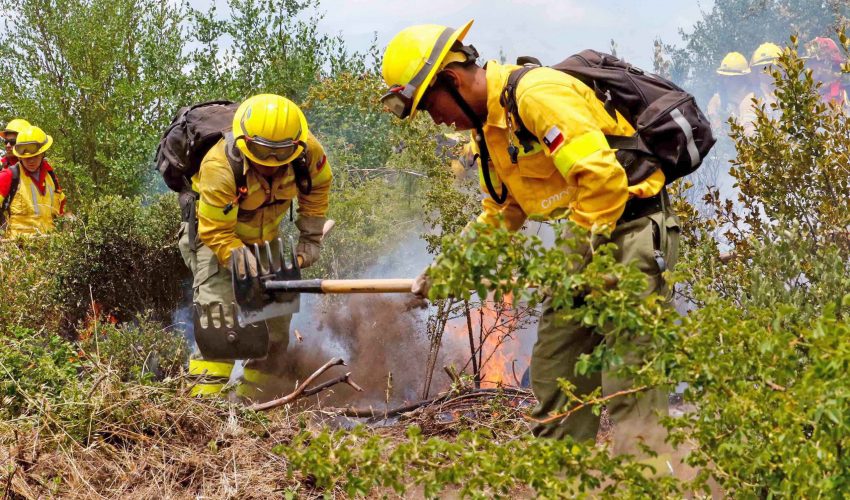
Following a previous summer marked by large-scale fires in the area, including the Penco-Lirquén megafire and the incidents that reached Nonguén National Park, various actors in the prevention and combat system are already preparing for the next period of higher occurrence.
The recent intense and prolonged rains could favor greater vegetation accumulation and, with it, a greater availability of fine fuel during the summer, in addition to the presence of Super El Niño. Added to this are the lessons left by the fires that affected the region and engulfed Greater Concepción during January, once again highlighting the complexity of these emergencies.
Therefore, preparation for the 2026-2027 season is already underway. While forestry companies detail part of their reinforcements and new tools for detecting and fighting fire, the National Forestry Corporation (Conaf) is working on defining the plan that will establish operational capabilities and resource distribution for the upcoming period.
Selection of brigade members
Consulted by Diario Concepción, Conaf stated that the preparation process for the 2026-2027 season has already begun, with one of its first focuses on hiring brigade members. Applicants must go through different evaluation stages before their incorporation and subsequent training.
"Conaf has already begun the preparation process for the next season of higher occurrence of forest fires," explained the institution's regional director, Álvaro González, who added that "applications to join the forest brigades are now open."
Regarding operational capacity for the new season, Conaf is still defining a significant part of its deployment. "Work is currently underway on defining the Action Plan for the 2026-2027 season, which will establish operational capabilities and resource distribution according to the needs and characteristics of the territory," he specified.
Therefore, the corporation is not yet in a position to provide definitive figures regarding the number of brigades, aircraft, or other resources that will be available during the period of higher occurrence.
The planning, he explained, "seeks for the system to detect fires in a timely manner, carry out a rapid initial attack, and increase the response when necessary," detailing that resources can be redistributed and reinforced according to the evolution and magnitude of each fire.
However, regarding the level of risk that Biobío could face, he stated that "at this moment, it is not appropriate to anticipate a specific risk level for the entire season." Nevertheless, he emphasized that preparation is carried out considering the area's permanent exposure: "Biobío is a region highly exposed to forest fires, so CONAF works under a permanent scenario."
In this context, the aim is to strengthen both preventive actions and response capabilities for different scenarios, especially in the face of fires that may require a progressive increase in available resources.
Reinforcement in the private sector
While the public deployment is being defined, the main forestry companies operating in Biobío are already anticipating part of the resources and technologies they will use to fight fires. At the company Arauco, one of the main emphases will be on improving early detection and reducing response times.
In a conversation with this media outlet, Arauco's Fire Prevention and Protection Sub-Manager, Ramón Figueroa, explained that the company has been working for almost a decade with 160 robotic cameras with artificial intelligence, but this season it will incorporate new technology to improve their accuracy.
"We are bringing in and will test multispectral cameras, which have optical and thermal sensors, and that will allow us to reduce false positives," he stated, also recounting that such cameras will improve detection at night, particularly of hot spots. The technology will be tested this season together with two companies.
Added to this capability is a deployment of more than 130 brigades, of which approximately one third corresponds to night brigades, in addition to machinery for fighting larger-scale fires.
But one of the main reinforcements announced by the company Arauco will be in the aerial component. Figueroa confirmed the incorporation of four semi-heavy Black Hawk helicopters, of American origin, with the capacity to transport and release up to 8,000 liters of water, which will join the company's combat fleet.
The executive estimated the forestry company's program for fire prevention and combat at approximately US$60 million. The figure considers the brigades, detection and dispatch systems, runways, helipads, and other capabilities deployed by the company.
Within that infrastructure, there are also 1,800 water sources distributed across its landholdings, which must be maintained and supplied annually to mainly facilitate helicopter operations.
Early response and proactive saturation
For CMPC, meanwhile, its planning aims to reduce response times and anticipate the most complex days.
In statements to Diario Concepción, CMPC's Protection Analysis and Planning Sub-Manager, Cristian Obreque, explained that the company is working on a prevention plan based on "active and proactive saturation" of the territory during the most complex days and times.
"A more complex season is expected regarding meteorological conditions," he stated, detailing that the new scheme seeks to focus resources on "being able to arrive in a very short time, to handle any situation that arises within 60 minutes."
Despite the method, Obreque emphasized that the deployment must be compatible with safety and "the protection of brigade members within operations."
In technological matters, CMPC currently maintains cameras that allow detecting any fire that occurs in 70% to 80% of its landholdings, to which AI and "drones with the capacity to check premature fire hotspots day and night" will be added.
Added to this is aerial work using aircraft capable of dropping retardant water, in addition to transported brigades that allow rapid mobilization of personnel within the regions where CMPC owns landholdings.
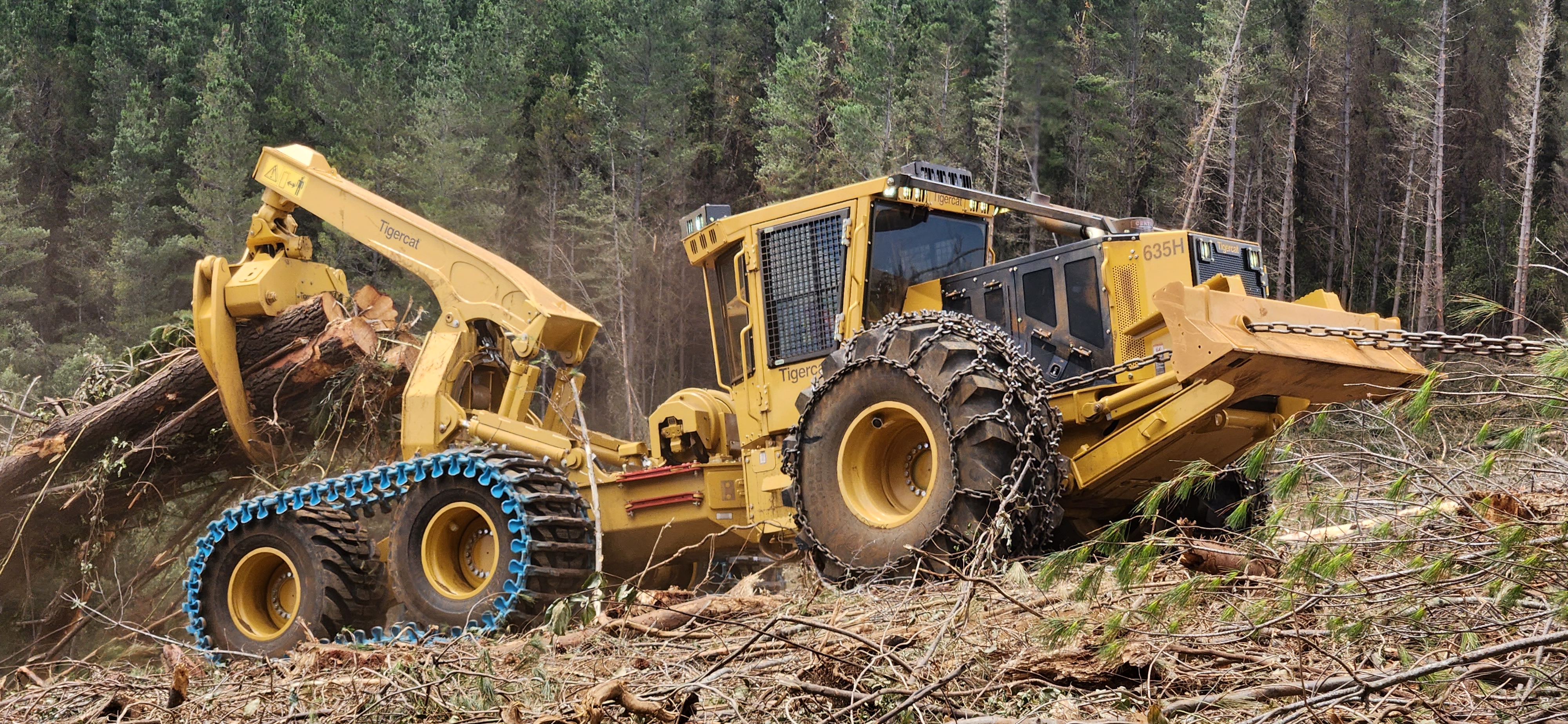
Additionally, they have mechanized equipment for firefighting, both in forestry operations and through specialized units.
Obreque explained that the latter have been trained and certified to carry out mechanized operations both day and night, complementing the ground and aerial response.
Expansion of the community model
Returning to the strategy of the company Arauco, it also seeks to expand its preventive work program with communities through the Community Prevention Network.
Figueroa announced that the company intends to extend this model to around 25 municipalities in Biobío, Ñuble, Los Ríos, and Los Lagos. In the case of Biobío, he preliminarily mentioned Penco, Hualqui, Florida, and Los Álamos, among other municipalities under evaluation.
The experience used as a reference was a pilot developed last year in five municipalities in Maule. According to the executive, the intervention reduced the occurrence of fires in those municipalities by 30%. "The system already works and is proven," he asserted.
In closing, he explained that the objective is to prevent an initial hotspot from escalating quickly, expressing that what is sought "is that fires, upon detection, do not grow and we can fight them quickly and they remain as statistics, as a small incident, and do not turn into a large fire (...). The best fire is the one that does not occur."
Source:Diario Concepción



Comments (0)
No comments yet. Be the first to comment!
Leave a comment