

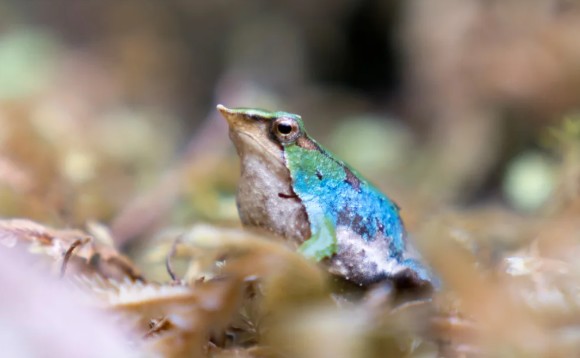
More than 20 public and private institutions from Chile, Argentina, the United Kingdom, and Germany renewed their commitment to the conservation of Darwin's Frogs through the second edition of a binational strategy that establishes a roadmap to protect these species between 2026 and 2040.
The initiative brings together government agencies, universities, non-governmental organizations, zoological institutions, and representatives from the private sector, consolidating more than a decade of collaborative work to address the threats affecting these small amphibians of the temperate forests of Chile and Argentina.
The protagonists of this strategy are the northern Darwin's frog or vaquero toad (Rhinoderma rufum) and the southern Darwin's frog (Rhinoderma darwinii). Both possess an extraordinary reproductive characteristic: males are responsible for raising the tadpoles inside their vocal sac, a unique parental care behavior among the more than 9,000 known amphibian species in the world.
The situation of both species is concerning. The northern Darwin's frog has not been observed since 1981 and is classified as Critically Endangered and Possibly Extinct. The southern species, meanwhile, is listed as Endangered and survives in highly isolated populations.
Threats to their survival
Both species depend on native forests, ecosystems facing increasing pressure due to habitat loss and degradation, climate change, forest fires, and chytridiomycosis, an infectious disease that has caused significant declines in amphibian populations in different parts of the planet.
The update of the strategy aims precisely to strengthen actions designed to address these threats and improve coordination among the different actors involved in their conservation.
Since the creation of the Binational Strategy in 2018, extensive work has been developed among institutions from both countries. However, an evaluation conducted in 2024 showed that only about half of the actions related to threat mitigation and control were being implemented, while initiatives related to scientific research showed a higher level of progress.
Among the main difficulties identified were the impact of the COVID-19 pandemic, funding limitations, difficult access to some areas where the species inhabit, and changes in government authorities.
Faced with this scenario, the new version incorporates modifications aimed at more concretely measuring the results of conservation actions and strengthening the link between scientific research and measures implemented in the field.
Research in service of conservation
One of the main changes consists of giving scientific research a more direct role in mitigating and controlling threats. The intention is that the studies developed will help guide conservation decisions based on the best available evidence.
Dr. Andrés Valenzuela Sánchez, president of the Governance Committee of the Binational Strategy, president of the NGO Ranita de Darwin, and permanent researcher at the Zoological Society of London, highlighted that this update constitutes a new step in the international effort to prevent the disappearance of the species.
The strategy also contemplates greater articulation with official conservation instruments. One of the main advances in this area was the initiative's contribution to the approval of the Darwin's Frogs Recovery Plan, an instrument of Chile's Ministry of the Environment.
The plan emerged from collaborative work promoted by the NGO Ranita de Darwin and provides a state framework to strengthen and project actions aimed at protecting these species. The new Binational Strategy is aligned with this instrument, seeking to improve coordination among public agencies, scientists, environmental organizations, and other actors.
A collaboration that crosses borders
The protection of Darwin's Frogs has also sparked international interest due to their unique characteristics and their own history. Both species were collected by Charles Darwin during his voyage through Chile aboard the H.M.S. Beagle, a fact that contributed to their scientific recognition beyond South America.
For more than a decade, institutions such as the Zoological Society of London, from the United Kingdom, and Zoo Leipzig, from Germany, have joined the efforts developed by organizations and institutions from Chile and Argentina.
In this way, the Binational Strategy has become an example of international collaboration to address the conservation of threatened species, combining scientific knowledge, public management, fieldwork, and the participation of civil society organizations.
The second edition of the strategy will be officially presented during a webinar open to the public on August 26, between 11:00 and 13:00 hours. From that date, the publication will be freely available in Spanish and English, with information on the actions and objectives defined for the 2026-2040 period.
The initiative seeks to ensure that the conservation of Darwin's Frogs does not depend solely on isolated efforts, but on joint, long-term planning capable of responding to the threats that put the survival of these unique amphibians of the native forests of Chile and Argentina at risk.







Comments (0)
No comments yet. Be the first to comment!
Leave a comment