

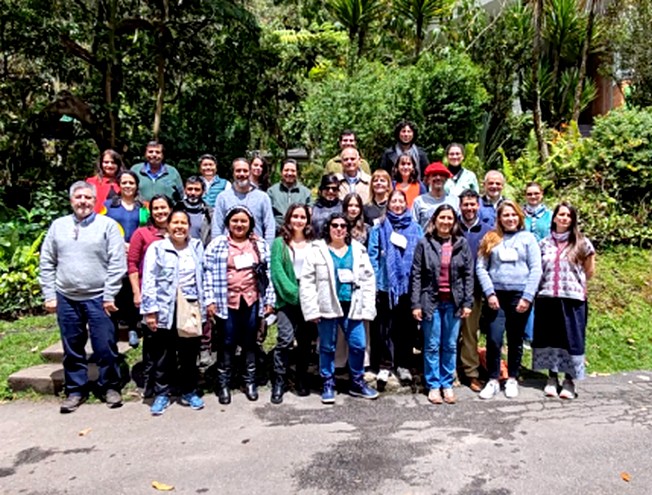
The Faculty of Forest Sciences and Nature Conservation is part of GENFOMEC (Conservation of forest genetic diversity for the sustainable management of OECM areas), an international project funded by the Ibero-American Program of Science and Technology for Development (CYTED) that brings together researchers and institutions from more than twenty countries in Latin America and the Caribbean to address one of the region's most urgent environmental challenges: the loss of forest biodiversity in the face of advancing climate change.
The project is framed within the Latin American Network of Forest Genetic Resources (LACFORGEN), a platform for scientific and technical cooperation that integrates universities, public institutions, and organizations from the region with the purpose of promoting the conservation, sustainable use, and improvement of genetic resources in Latin American forests. GENFOMEC has a duration of three years —2024 to 2027— and articulates research efforts in countries such as Argentina, Bolivia, Brazil, Chile, Colombia, Costa Rica, Cuba, Ecuador, Spain, Guatemala, Honduras, Mexico, Paraguay, Peru, the Dominican Republic, and Uruguay, among others.
A commitment to in situ genetic conservation
The central axis of GENFOMEC is the incorporation of genetic criteria into the long-term conservation of forest ecosystems, with an emphasis on a type of area that until recently received no formal recognition: Other Effective Area-based Conservation Measures (OECMs). This designation, promoted by the Convention on Biological Diversity, recognizes territories that —without being traditional protected areas— contribute effectively and sustainably to biodiversity conservation.
OECMs represent an innovative approach because they highlight the role played by indigenous communities, local communities, private landowners, and public institutions in protecting ecosystems and forest genetic resources. Through GENFOMEC, these areas are identified, systematized, and mapped, and their selection is validated in a participatory manner with communities and government authorities, integrating the exchange of knowledge as a fundamental part of the process.
Among the project's objectives are the development of methods and tools to assess genetic diversity in these areas, the strengthening of forest genetic improvement programs, the promotion of ecological restoration, and the training of specialized human capital through courses, academic exchanges, and knowledge transfer among participating countries.
Participating in these instances, meetings, and presentations are the academic and director of CESAF, Dr. Carlos Magni, and the forest engineer and CESAF researcher, Nicole Toro.
Conferences, science, and the Latin American community
One of the most notable products of GENFOMEC has been the development of the LACFORGEN International Conference Cycle, a space that brings together specialists from different countries to share advances in forest genetics, genomic selection, biotechnology, ecological restoration, conservation of native species, and adaptation to climate change. These activities have strengthened ties among Latin American institutions and contributed to the consolidation of an active scientific community around forest genetic resources.






Comments (0)
No comments yet. Be the first to comment!
Leave a comment