

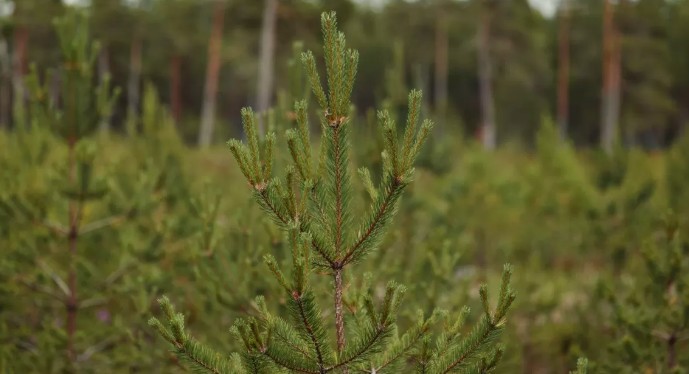
When forest plantations and their nature as monocultures are discussed, a reference that does not distinguish them from irrigated monocultures that demand water, they tend to be demonized and pointed out as disastrous and for the impacts they generate on the environment, referred to as "drying soils, acidifying soils, and generating erosion of those same soils."
Plantations do not respond to the concept of a forest, due to the presence of trees of the same species in a systematic spatial order, which is also valid for plantations of native species, since these do not possess the random expression of species found in native forests.
Nevertheless, Chile was forced to promote forest planting with exotic species, because from the first third of the 19th century until the mid-20th century, massive deforestation of native forests occurred, with fires lasting several years and dantesque destruction, in order to enable hundreds of thousands of hectares for agriculture and to obtain timber for various uses, defining major erosive processes on steeply sloped soils.
The above took place in Chile for more than a century. Thus, in 1836 the scientist Claudio Gay warned Minister Diego Portales about the Coquimbo Region and its frightful vegetational nakedness, which foreshadows for this beautiful province a "lamentable future," for which he suggested bringing fast-growing species from Europe, which proves that this was not a recent idea.
Balocchi and Fernández (2026) state that "from the late 19th century to the early 20th century, the expansion of agricultural lands destined for wheat cultivation resulted in considerable degradation of native forests in Chile." And citing Schneider, 1904, they note that between 1845 and 1887 wheat exports increased 27 times in volume, and between 1880 and 1930 livestock numbers tripled (Schneider, 1904). "The hills, above all, were left bare."
In this scenario of massive environmental degradation, a forestry possibility emerged at the beginning of the 20th century, expressed in the Pinus radiata or insignis pine tree, introduced from California and which developed very well in central Chile, to such a degree that even today it can be seen growing in soils no more than 20 centimeters deep (which initially were more than two meters deep and supported the Chilean native forest). This was followed by Eucalyptus globulus, introduced from Australia and with which the notable German naturalist Federico Albert stopped the Chanco dunes, within a framework of forestry engineering very remarkable for its time.
From the above arose the Forest Law, under the government of Carlos Ibáñez del Campo, which made possible the first massive forestations with a view to halting desertification in south-central Chile. This determined that Chile could have more than 350,000 hectares forested by the end of the 1960s.
During the government of President Frei Montalva, there was a call to care for the pines and not cut them down at Christmas, to which was added the call from the government of President Salvador Allende for us to "make timber a second salary for Chile."
And this is important, because the generation of the forestry sector for the country is attributed to the military dictatorship, and this is the product of a State bet that emerged at the beginning of the 20th century. Furthermore, in the mid-20th century, university schools for the training of Forest Engineers were created; plans for the construction of cellulose plants emerged, guided by Corfo, and the Arauco cellulose plant was inaugurated by President Allende in 1972; in 1968 the Reforestation Corporation was created and in 1972 it became the National Forest Corporation, among other aspects. In other words, the generation of a forestry sector in Chile is a clear bet of the State itself and predates the establishment of the military dictatorship and is not a product of it.
At the beginning of the military dictatorship in 1974, a subsidy for forest plantations was established, which can be debated as to whom it favored, but it is clear that this fact defined an acceleration of reforestation works in various territories.
On the other hand, forest ecosystems play an important role in the conservation of water and soil, and this is a function of the role played by the soil-vegetation complex. This system is a valuable natural alliance, where the aerial cover of trees mitigates the kinetic energy of rain, preventing raindrops from impacting the soil with erosive force. At ground level, leaf litter and trunks act as mechanical obstacles that slow the water, giving it time to infiltrate. Finally, roots improve soil porosity, allowing water to penetrate toward aquifers. In essence, this complex is a natural sponge that protects life and underground reserves.
The role of the complex is verifiable especially in Mediterranean zones, when precipitation occurs during the winter period, a lapse in which vegetation is dormant, which defines very low or nonexistent consumption. It is during this period that nature stores water for use in the summer period, and it does so in the natural reservoirs that are aquifers.
Now then, the connection to the aquifer is made from channels, but it can also be made from hillsides; however, for it to occur from hillsides, the water must be retained to promote infiltration into the soil, and then pass to percolation or deep infiltration, if the connection points with the aquifer can be found.
And that is why the soil-vegetation complex is so relevant in Mediterranean zones, since the recharge of aquifers from hillside areas and helping the surface water-groundwater connection depend on it.
Thus, if one must choose between having desertified territories or territories forested with monoculture plantations, from a hydrological point of view there is no room for doubt. Retaining soil and its hydrological role is vital for any future plan, understanding that 1 cm of soil takes between 100 and 200 years to form. Let us see then how long it will take for a soil 2 meters deep to form, and the answer is too much time, which we do not have. Thus, it is preferable to have forestations on degraded soils (not on lands generated as a product of native forest logging), in order to protect and maintain the little soil that still exists.
Within the framework described, plantations on desertified lands, where the original vegetation cover was savagely destroyed, with extremely thin soil that in many cases was nothing more than a weathered regolith, constituted the only spatial and temporal option to give value to soils mutilated for decades. The photograph illustrating the Malleco viaduct during its construction in the years 1886 to 1889, and the comparison with what can be seen today at the same place, is clear evidence of the change brought about, where environmental conditions are infinitely better than the destruction that occurred in the country until the mid-20th century.
On the other hand, the claim that plantations dry out soils cannot be verified because in Mediterranean climates rains fall in winter, while vegetation consumes water in summer. So, where do forest plantations get water from if they are not irrigated?
It is said that they get it from the water tables or aquifers, but these are tens of meters deep and pine roots are at two to four meters at most. Likewise, where do plants get water from in Mediterranean climates?
Renée Brooks in Nature Geoscience, 2010, explains it as the miracle of vegetation in Mediterranean zones. During the dry summer, the large pores that contained water drain, emptying the preferential and mobile flow paths. The remaining soil water remains strongly bound within the small pores, of nanometric dimensions, which is used by plants for transpiration. If any summer rain falls, it will be welcomed by the vegetation, but plants living in Mediterranean climates know that the water will come out of the soil micropores where it was stored with a very strong chemical bond, a mechanism that only adapted plants will be capable of extracting and that allows the survival of species such as Pinus radiata during periods of prolonged water stress. In fact, pines subjected to flooding do not survive, since they do not withstand water flooding in their roots, disproving the claim that they are desiccators of vast territories.
On the other hand, the claim that pines erode soils is false. The presence of any type of vegetation will always be a positive factor for retaining soil in high areas, and this has been proven in the country by various investigations. Thus, a study in the Purapel basin, Maule, determined that after the forestation of the basin, the discharge curves relating the circulating flow to water height were more stable over time, which demonstrates greater stability of the hydraulic configuration of the riverbed, derived from a lower emission of sediments downstream due to reduced erosion.
Regarding the claim that pines acidify the soil, this is highly debatable, since acidity in itself does not represent a value per se. There are soils with pristine native forests that possess greater acidity than that evidenced by pine plantations, and this is not negative in itself. Now then, pine needles possess resins that define greater acidity, which is not so desirable when comparing the leaf litter of forest plantations with the leaf litter of native forests. But this fact forgets that plantations must be located on soils where nutrient poverty is so high that any incorporation of organic matter is welcome to restore situations of extremely high soil degradation.
Another interesting aspect to highlight is that some components of Chilean flora and fauna have learned to settle and live in plantations, as demonstrated by the study by Uribe et al (2020), which determined that 3 out of every 4 rayaditos, a Chilean bird species, live and develop in radiata pine forest plantations.
The above is not intended to constitute an apology for forest plantations, which possess critical elements, such as constituting a broad continuous fuel load in the territory, with a greater risk of wildfire impact; or the fact of territorially occupying large areas, which limits a broader expression of biodiversity. But plantations can be an opportunity for Chile, and this is so for the following reasons:
a) Chile possesses more than 2 million hectares with environmental degradation, which can be destined for productive plantations, giving those areas an option for economic development and better conditions for the hydrological-environmental restoration of these territories.
b) It is possible to produce quality timber to accelerate the construction of homes and buildings, with the advantages provided by a material that offers speed of construction, a fact that could help reduce Chile's housing deficit of 650,000 homes.
c) Wood construction is more sustainable than construction with steel and masonry, where the latter represents between 17% and 30% of carbon emissions, a fact that not only does not occur with wood, but wood fixes carbon in scenarios of global climate change.
d) It is necessary to strengthen the small and medium-sized timber industry, which generates employment and foreign currency, and in a context of value aggregation and circular economy, in such a way that, for example, sawmill waste becomes input for the pellet industry, thereby tending toward a reduction in city pollution levels caused by the use of firewood for heating.
e) The forestation of broad territories, considering mosaics to mitigate fire impacts and other aspects, will determine a lower emission of sediments downstream, thus defining a process of gradual restoration of the role of the soil-vegetation complex; a lower environmental impact of sediments and the consequences of those movements related to the affectation of civil works and, above all, human lives. One millimeter of soil emitted from high areas represents at least 12 tons of soil per hectare per year.
Dr. Roberto Pizarro Tapia
Full Professor U. de Chile – U. de Talca
Vice President Colegio de Ing. Forestales.
Dra. Claudia Sangüesa Pool
Researcher UNESCO Chair, U. de Talca.
Dr. Pablo García-Chevesich
Academic Colorado School of Mines, United States.
Column appearing inBiobioChile




Comments (0)
No comments yet. Be the first to comment!
Leave a comment