

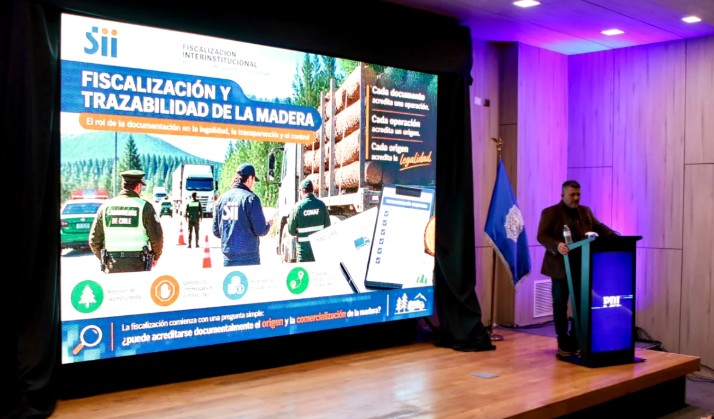
The prevention and prosecution of crimes associated with timber theft and illegal logging of native forest were the focus of the National Seminar "Timber Theft, Illegal Logging of Native Forest and Its Effects on the Environment," organized by the Policía de Investigaciones de Chile (PDI) in Valdivia.
The event was held at the Valdivia Police Complex and was organized by the Los Ríos Police Region together with the PDI's National Headquarters for Crimes against the Environment and Cultural Heritage.
Over the two days, specialists and investigators analyzed different dimensions of these crimes, from prevention and oversight mechanisms to the tools used for criminal investigation and prosecution. The meeting also allowed for the incorporation of experiences from the public, private, and academic sectors.
The head of the PDI Los Ríos, prefect inspector José Miguel Cea Lara, highlighted the importance of creating spaces for coordination among the institutions linked to this issue.
"For us it was an excellent opportunity to analyze different aspects of a matter so characteristic of southern Chile, incorporating the perspective of legislators, regional authorities, public services, and private actors involved in this field," he said.
Investigation and coordination
From the PDI's National Headquarters for Crimes against the Environment and Cultural Heritage, its head, prefect Patricio Rojas Carreño, emphasized that Valdivia is a relevant place to address a problem that is present in different areas of the country.
"We are in a territory where this type of event occurs, so, as a headquarters, we have the objective of strengthening coordination and collaborative work among the different institutions," he stated.
The officer explained that environmental crimes present a level of complexity that requires the participation of different agencies. In that sense, he raised the need to integrate public and private institutions and the academic world to improve investigative capabilities.
Rojas also valued the results of the meeting and noted that the PDI hopes to replicate this type of seminar in other regions, with the aim of sharing experiences and knowledge related to the investigation of environmental crimes.
A problem with different dimensions
Senator Alfonso de Urresti also participated in the instance and emphasized that timber theft and illegal logging present different expressions depending on the territory, including situations related to native forest, plantations, protected areas, and commercialization.
Meanwhile, Corma's general manager, Antonio Minte, valued that the seminar addressed the problem from a national perspective, but considering the particularities of the southern regions. In his view, timber theft is not a phenomenon that affects only the forestry activity, but also has economic consequences and consequences for the country's development.
Among the matters analyzed were the legislative challenges associated with illegal logging, the use of remote sensors and geographic information systems for ecosystem monitoring, forensic techniques applied to protected flora, and forestry oversight tools.
The seminar was attended by representatives and specialists from the PDI, Congress, the Public Prosecutor's Office, Conaf, Carabineros, the Internal Revenue Service, Ciren, the Institute of Ecology and Biodiversity, and Corma, among other institutions.
The event closed with a call to strengthen interinstitutional coordination as a tool to improve the prevention, detection, and investigation of crimes that affect the country's forest resources and natural heritage.





Comments (0)
No comments yet. Be the first to comment!
Leave a comment