

Concentrating in a single tree the best attributes of two native species, oak and raulí, was the main objective of a project supported by the Foundation for Agrarian Innovation (FIA), executed by the Faculty of Forest Sciences and Natural Resources of the Universidad Austral de Chile (UACh), whose second stage has just concluded.
The closing seminar of the project entitled "Generation of a new afforestation option using Oak x Raulí Hybrids, as an alternative of high productivity and sustainable adaptation to Climate Change scenarios. Stage II," was held at the facilities of the former Forest Experimental Center and counted on the participation of UACh authorities, CONAF and FIA officials, nursery managers and key actors from the forestry sector.
Fernando Droppelmann, researcher, project director and executive director of the Forest Genetic Improvement Cooperative, explained that in this project "hybrids resulting from the natural cross between raulí and oak were developed to seek a species that is an operational option that contributes to recovering the value of native forest so that it also allows the generation of plantations at an operational scale, in a wide distribution in Chile. The idea is to develop a material that possesses the best attributes of the parental species."
In the case of oak, its qualities are related to its good growth rate and wide territorial distribution; raulí, meanwhile, possesses very good straightness and wood quality that from an industrial point of view is highly valued. Additionally, it has no health problems. "Therefore, the hybrids we are seeking and developing are those that will be able to grow in environments where oak grows, but with form and wood characteristics of raulí and, consequently, it is a very significant contribution to forest diversification," highlighted the researcher.
Another important factor that the hybrids possess is related to the contribution to genetic variation and the consequent possibilities of adaptation to adverse effects, such as climate change.
During the seminar, Dr. Gonzalo Tampier, Director of Development and Innovation VIDCA UACh, expressed that "for us it is a great pride to see this type of project that, in addition to carrying out high-level research, has this tremendous potential to transfer to the socio-productive system, to have an application in the real world and generate an impact on our productive matrix."
For his part, Dr. Óscar Thiers E., Dean of the Faculty of Forest Sciences and Natural Resources and co-researcher of this project, noted that "as a Faculty, we are convinced that this type of initiative generates a contribution to the socio-productive system of the region and the country, a contribution with innovation, new ideas and alternatives not only for companies, but also for medium and small landowners who seek options to diversify their productive matrix."
Nursery plant production
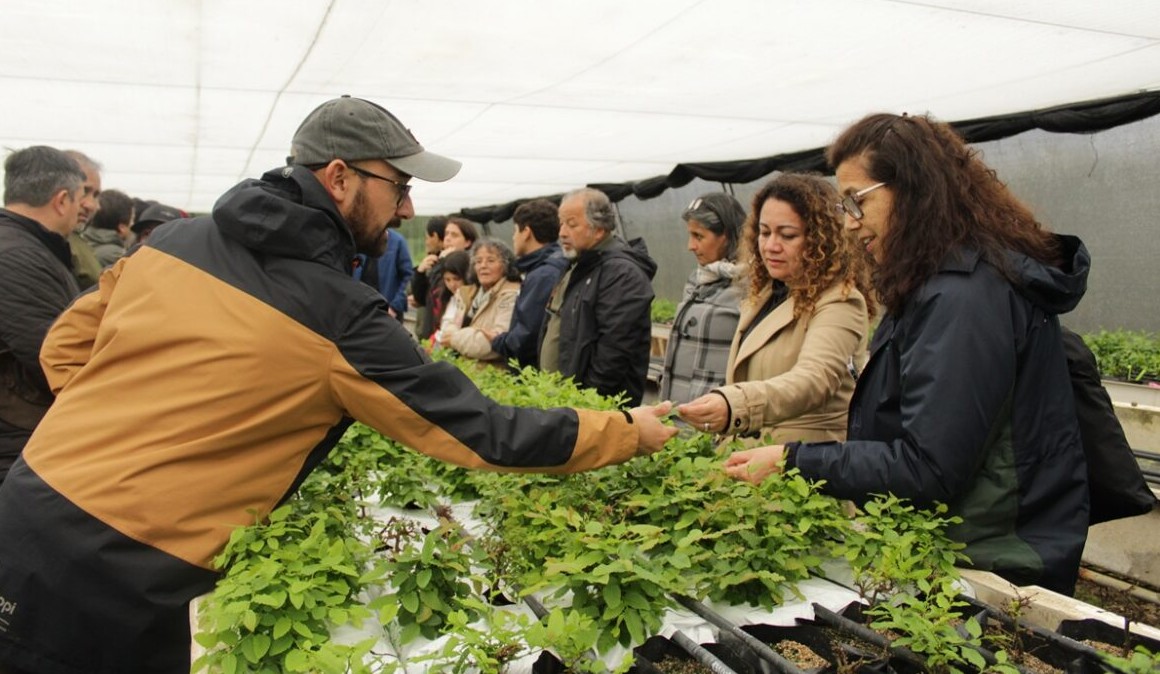
Attendees were able to learn about the development of these plants at the Center for Genetic Development and Propagation of Native Species (CDGP). Here Dr. Droppelmann, together with team members Angélica Tocol and Cristopher Fernández, presented aspects related to the substrate, the type of containers, irrigation, pruning and fertilization, that is, the key management aspects in the nursery to produce this type of plant. Four stations within the production process were visited: mother plants, rooting, acclimatization and shade house. Then, in the field, the Roblería Clonal Trial of Forestal Arauco was visited, where attendees observed the results of hybrids growing under operational conditions after 8 years of being planted.
Leonardo Russo, Innovation Executive of FIA, an agency of the Ministry of Agriculture, noted that "this project is especially relevant for FIA because it responds to the ministerial priority of supporting the forestry sector, an area in which we receive few innovation initiatives. In this second stage, the aim is to advance toward the productive use of the natural oak-raulí hybrid, based on the technological package developed by the Universidad Austral de Chile. One of its main strengths is the joint work with CONAF, forestry companies and nurseries, which allows connecting research with the needs of the sector and opens opportunities for its results to translate into a concrete productive alternative, with potential to contribute to Chile's afforestation commitments and expand the development options of the forestry sector."
This study will continue seeking in the coming stages to expand its production levels and reduce the costs associated with the production and establishment of oak-raulí hybrid plantations in various sites and landowner conditions, since there is an important potential market through which to revalue native forest, plantations with native species, and thereby improve the resilience of productive ecosystems in Chile.




Comments (0)
No comments yet. Be the first to comment!
Leave a comment