

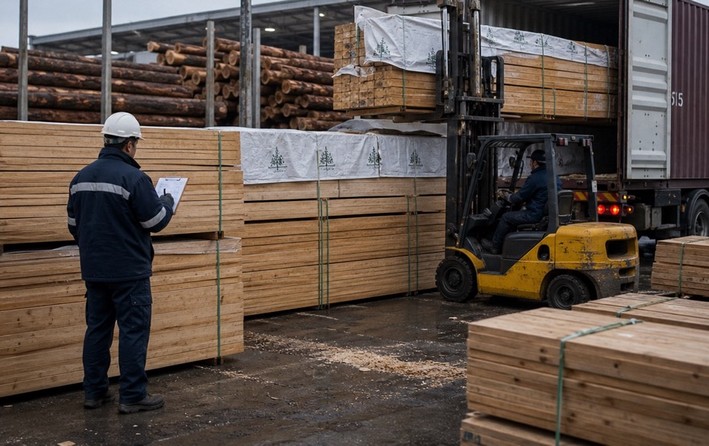
Amid volatility in international markets, price declines in key products and an adverse tariff scenario with respect to the United States —the second-largest destination—, Chilean forestry exports continue to fall this year.
Between January and August 2026, sector shipments totaled US$5,922.5 million, a 7% decrease compared to 2024.
"We are facing a global scenario marked by lower demand and price adjustments across various forestry products. However, the Chilean industry has demonstrated its capacity to adapt and remains a strategic activity for the economic and social development of numerous regions across the country," said Agriculture Minister Jaime Campos.
"The figures show a contraction that responds mainly to external factors, especially the evolution of prices and international demand," added Gabriel Valenzuela, executive director of Infor.
Antonio Minte, general manager of the Chilean Timber Corporation (Corma), added that the lower-price scenario has affected relevant products such as pulp, "which carries significant weight in forestry exports."
Main destinations and the impact of tariffs
An analysis of Infor data shows that the two main destination markets for forestry shipments, China and the United States, recorded declines of 7.2% and 18.7%, respectively.
Minte commented that "China continues to be a determining market, particularly for pulp, and this year it has shown weaker performance, associated with lower economic dynamism, high inventory levels and more contained demand in segments of the paper industry." Regarding the United States, he said it is a relevant destination for wood products. "Demand is closely tied to construction and remodeling, and we have observed mixed signals and some recovery in certain segments. Added to this is the uncertainty generated by the new tariff measures."
Since July 24, 2026, the United States has applied a general additional tariff of 12.5% to products originating from Chile —including forestry products— after attributing forced labor in their production, in a measure that includes other countries. The new rate replaced the previous 10% base in effect since July 2025, although it exempts cellulose pulp.
Infor noted that although "causality cannot be determined," since the imposition of the new tariffs in 2025, "volumes of the three main products shipped to the United States have declined: The quantity of moldings, wood panels and glued products decreased by 7.3%, 17.1% and 34.8%, respectively, between the January-August periods of 2025 and 2026."
"At Corma we have stated that our products should not be subject to these measures, because there is no evidence of forced labor in the Chilean forestry industry, which also has labor legislation, state oversight and international certifications. Moreover, our main products do not compete with local production, but rather complement it, after a trade relationship of more than 40 years," Minte assured.
Sector representatives state that the final export result in 2026 will depend on the evolution of pulp prices, Chinese demand and construction and remodeling activity in the U.S., among other factors.
Source:El Mercurio







Comments (0)
No comments yet. Be the first to comment!
Leave a comment