

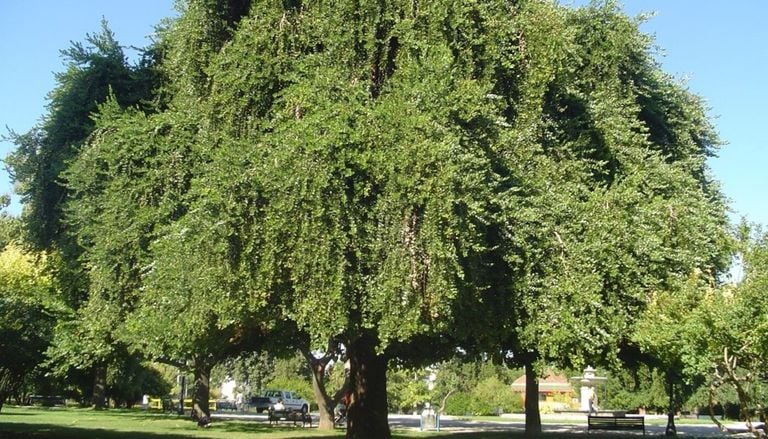
Rising temperatures and water restrictions pose a challenge for urban green space planning: maintaining tree cover capable of providing shade and other environmental benefits without depending on water consumption that is increasingly difficult to sustain.
To achieve this, it is not enough to increase the number of trees; it is also necessary to select species compatible with the climatic and ecological conditions of each location.
The peumo (Cryptocarya alba), an endemic tree of Chile, brings together characteristics that make it an interesting alternative for this task. Its capacity to respond to water scarcity is complemented by its interactions with wildlife and its role in the ecosystems of which it is naturally a part.
The mechanisms that allow it to respond to drought
When water is scarce, plants must adjust their functioning to avoid losing more than they can absorb through their roots. In the peumo, osmotic adjustment has been studied, a mechanism that helps it retain water in its cells even when available moisture decreases.
In trials with young plants subjected to restricted irrigation during summer, a decrease in photosynthesis and transpiration was also observed. This indicates that, faced with a lack of water, the peumo can reduce its activity and limit moisture loss through its leaves. Although these responses contribute to coping with water stress, they do not prevent its effects nor guarantee that the tree can withstand a prolonged drought without available water.
Where it grows naturally and what it needs to develop
The peumo is distributed from the Coquimbo Region to La Araucanía and is part of the sclerophyllous forest, adapted to the marked seasonality of precipitation in central Chile.
In its natural environment it is usually found in ravines and shady slopes, where topographic conditions can favor greater soil moisture availability. This distribution helps to understand why its tolerance to dry periods should not be confused with an exclusive adaptation to arid and exposed terrain.
During the first years, the peumo needs supplemental irrigation while its roots develop and explore the soil. In cities, this process can be hindered by soil compaction and limited soil availability for root growth. Therefore, choosing a location with sufficient underground space and good drainage conditions is essential to favor its establishment and development.
Biodiversity and other benefits of incorporating native species
Urban tree planting fulfills functions that go beyond providing shade: it contributes to regulating the microclimate, offers habitat and food resources, and can favor ecological connectivity between green areas. In this context, native species have particular value because they maintain relationships with organisms from local ecosystems.
The flowers of the peumo offer nectar and pollen to bees and other insects, while its fruits provide food for wildlife. Its evergreen foliage also maintains vegetation cover throughout the year.
The choice of tree species also matters for public health, especially due to its relationship with seasonal allergies. The London plane and some poplars are anemophilous, meaning they are pollinated by wind and release particles that can disperse widely through the air.
The peumo, on the other hand, depends mainly on insects for pollination, which reduces its airborne dispersal. This characteristic can be an advantage when planning urban green areas, although it does not mean it is free of allergenic potential.
In which urban spaces it can work best
Due to its adult size, the peumo is more appropriate for parks, plazas and large gardens, where it has enough space to develop its canopy and roots. It can reach between 15 and 20 meters in height, so it is usually not a good option for narrow sidewalks.
In these spaces, the growth of an adult specimen can cause pavement lifting or interference with pipes and other infrastructure, especially if the available soil volume is insufficient.
Before incorporating it into a tree planting project, it is important to evaluate both the aerial and underground space it will have available. Planting it in a location compatible with its dimensions reduces future conflicts and favors its development.
Thus, the peumo can contribute to urban green infrastructure better adapted to local conditions, provided that species selection is accompanied by adequate planning and the necessary care during its establishment.
Source:Meteored



Comments (0)
No comments yet. Be the first to comment!
Leave a comment