

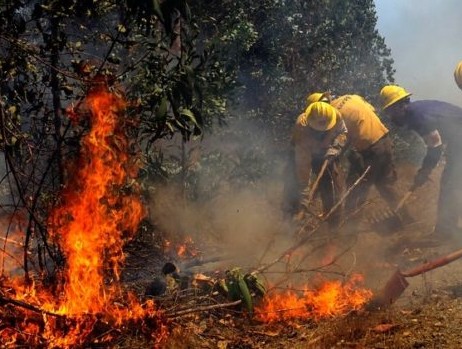
The intense rainfall recorded in recent days in different areas of Chile could create favorable conditions for the spread of forest fires during the next summer season, especially in regions such as Valparaíso, Biobío and La Araucanía.
This was warned by Jorge Leiva, program director of Civil Engineering in Environment and Sustainability at the Universidad Bernardo O'Higgins, in the framework of World Day against Climate Change, who explained that extreme weather phenomena can trigger new emergencies during the following months.
According to the specialist, abundant rains favor the growth of grasslands and vegetation that subsequently dry out due to rising temperatures. This plant material can turn into fuel, facilitating the spread of forest fires.
The risk is especially relevant in wildland-urban interface areas, where homes are located near sectors with abundant vegetation, a situation present in various communes of the central-southern zone, including La Araucanía.
However, the phenomenon can also produce inverse consequences. When a fire destroys the vegetation on a hillside, the land loses part of its capacity to retain water and resist erosion, increasing the risk of mass movements and flash floods in the face of future intense rainfall.
The academic explained that this situation is related to the effects of global warming, considering that for each degree of temperature increase the atmosphere can hold approximately 7% more water vapor, favoring more intense rainfall when the necessary weather conditions occur.
A similar warning was made by Miguel Castillo, academic of the Faculty of Forest Sciences and Nature Conservation of the Universidad de Chile, who has studied the relationship between rainfall and the behavior of forest fires.
The specialist explained that rains favor the regeneration of grasses and scrublands, increasing the amount of vegetation available to feed the fire during the warm months.
Nevertheless, he specified that this phenomenon does not necessarily cause an increase in the number of fires, whose occurrence is strongly related to human activity, but it can influence the speed and intensity with which they spread.
In this context, the specialists also warned about the need to strengthen territorial planning and infrastructure to face the effects of climate change.
Leiva noted that many cities were designed considering climatic conditions of the past, which currently represents difficulties in the face of extreme rainfall, floods and other events associated with global warming.
For this reason, he raised the importance of implementing adaptation measures, improving early warning systems, strengthening urban planning and promoting the restoration of native vegetation.
The warning is especially relevant for La Araucanía, where the presence of rural sectors, forest areas and homes near vegetation makes it necessary to reinforce preventive measures before the start of the season of greatest fire risk.
Source:Temuco Diario



Comments (0)
No comments yet. Be the first to comment!
Leave a comment