

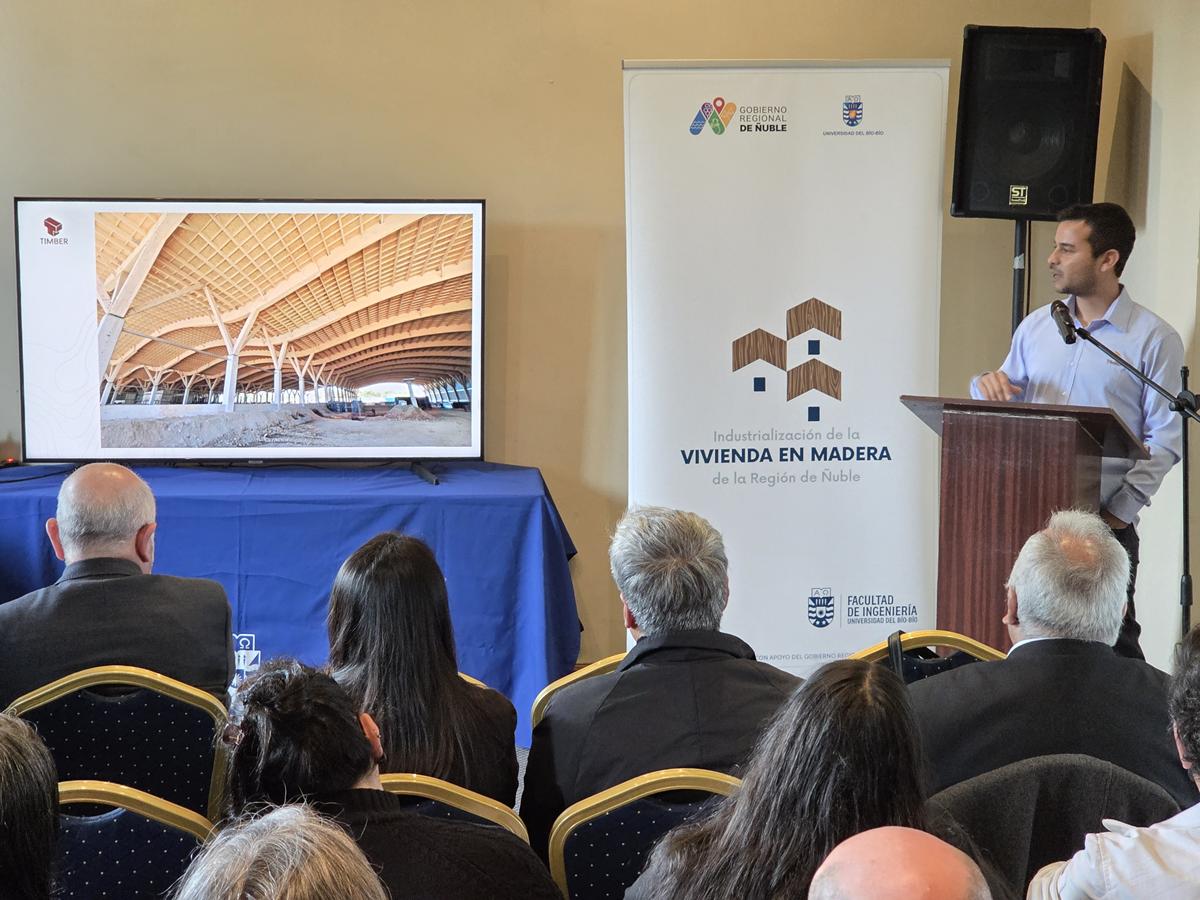
Transforming the productive capabilities, knowledge, and resources present in Ñuble into new development opportunities constitutes one of the challenges addressed by the FIC project "Industrialization of Wooden Housing for the Ñuble Region," an initiative that seeks to strengthen the competencies of small and medium-sized enterprises and favor their incorporation into value chains linked to industrialized construction.
In this context, the seminar "Productive Linkages and Innovation for Industrialized Construction: The Strategic Role of SMEs in the Value Chain" was held, an instance that allowed for the sharing of business experiences, technical requirements, quality standards, and perspectives for greater productive articulation.
The rector of the Universidad del Bío-Bío, Dr. Benito Umaña Hermosilla, highlighted that the initiative gives continuity to an institutional trajectory in areas where the UBB possesses academic, scientific, and technological capabilities that it places at the service of the regions and the country. He also thanked the trust of the Regional Government of Ñuble and emphasized the need to project a short-, medium-, and long-term work agenda. "What we lack today is greater innovation, greater development, and that is done with alliances," said the rector, highlighting the articulation between the public sector, private sector, university, and community. He added that wood industrialization constitutes an area of long trajectory for the UBB and with significant development potential.
In the same perspective, the pro-rector Dr. Carolina Flores Lueg highlighted that the mission of a state, public, and bi-regional university acquires full meaning when knowledge is linked to the needs, capabilities, and aspirations of the territories. "Addressing industrialized construction, innovation, and productive linkages implies transcending the technological dimension to ask how the existing capabilities in Ñuble can become new development opportunities. Therefore, our University seeks to assume an active role in this process, placing its academic, scientific, and technological capabilities at the service of the region, from a relationship of collaboration and mutual learning with those who directly know its productive challenges."
SMEs as protagonists of the value chain
The project director, Dr. Carlos Rozas Mellado, academic of the Faculty of Engineering, explained that one of its fundamental purposes is to strengthen the competencies of small and medium-sized enterprises so that they can effectively integrate into the value chain of industrialized construction. In this sense, he specified that the seminar sought to show the conditions and standards that SMEs must achieve to become suppliers of companies dedicated, for example, to the manufacture of panels and trusses. Among the relevant factors he mentioned wood quality, moisture content, thickness, and reduction of product variability. "We seek that the companies that attended the seminar could understand what the requirements are that those who are going to buy their raw material demand, so that they can be future suppliers," he explained.
Carolina Rodríguez, professional of the Regional Government of Ñuble and counterpart of the program, valued the interest of the companies in continuing to strengthen their capabilities, highlighting the participation of attendees who had also been part of previous training activities. She also highlighted the importance of generating meeting spaces between the public sector, academia, and companies, where SMEs play a fundamental role.
Quality, early integration, and innovation
The session also allowed for learning about business experiences that demonstrate the technical and organizational requirements necessary to advance toward greater industrialization.
Guillermo Salgado, from Timber, Ingeniería y Construcción en Madera, addressed the challenges associated with large-scale wood structures, highlighting the importance of quality control, safety, functionality, and useful life of projects. He also presented aspects related to connection systems and thermal envelopes and highlighted the recent updates to national regulations in areas such as seismic behavior and thermal requirements, advances that would allow raising the standards of wood constructions developed in Chile.
For his part, the general manager of IDV Industrializadora de Viviendas Chile Ltda., Juan Carlos Ortigosa, explained that the company advanced toward industrialization in the face of challenges such as the availability of labor in rural sectors and the need to optimize costs and processes. Among its strengths he highlighted the traceability of materials, standardization, permanent quality control, and the incorporation of electrical and sanitary specialties during manufacturing.
Ortigosa emphasized that expanding industrialized construction means going beyond the acquisition of prefabricated components and advancing toward an early integration of the entire chain, from project design, incorporating tools such as BIM, coordination systems, and artificial intelligence.
Timber potential of Ñuble
From the productive sector, Lorena Vargas Reyes, general manager of Guivar Transforma and national vice president of PymeMad, highlighted that the experiences presented allow visualizing both the challenges and the opportunities that exist to promote industrialized wood construction.
Vargas emphasized the potential of Ñuble, considering the diversity and quality of its timber offer and the presence of companies of different scales. She indicated that PymeMad brings together nearly 100 companies at the national level, approximately 25 of them in Ñuble, and maintained that the region can become an important space for the development of an industrialized construction that combines efficiency and sustainability.
During the session, Tobías Ott, general manager of Patagual Home, also presented, referring to wood quality, criteria, and challenges of suppliers; and Luciano Zatti, manager and founding partner of the Mademape group of Brazil, who addressed collaborative design and the challenges in modular industrialized construction.



Comments (0)
No comments yet. Be the first to comment!
Leave a comment