

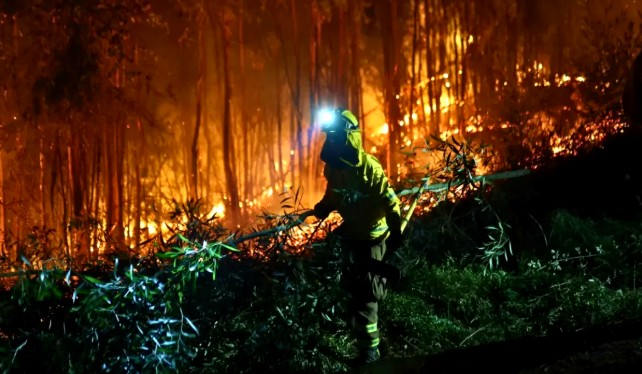
After three weeks of waiting to learn the Executive's formula, the Joint Committee for the Fire Law resolved its points of interest and proceeded to issue the report that must be voted on, first by the Chamber of Deputies and, subsequently, by the Senate.
One of the points of disagreement concerned the simplified procedure for delimiting urban-rural interface zones in communal regulatory plans, which was approved unanimously after receiving support from the Ministry of Housing and Urban Development.
The other concerned the State's obligation to compensate the owners of land located within said interface zone, where the creation of firebreaks will be mandatory. However, said clause was rejected and removed by 5 votes in favor and 3 against.
That said, the Government opened itself to working on creating a fund from which compensation for said lands could arise. This was valued by the president of the Joint Committee, Senator Alejandra Sepúlveda.
"What the minister proposed is the possibility of creating a support fund for precisely that urban-rural interface sector, and we hope that this happens either through a veto or the possibility of another legislative alternative," she said.
Meanwhile, Broad Front senator Diego Ibáñez highlighted that the compensation had been removed, but regretted that the processing of this bill had been so drawn out, to the point that it has already been in the National Congress for more than three years.
"Today we cannot be making a business out of firebreaks, and that is precisely what we were able to approve. So I am satisfied with this work. Unfortunately, it has taken more than three years for a law that should have been processed with immediate urgency to come out," he stated.
The indications submitted by the Government
Meanwhile, the Government presented a battery of indications to the bill that were declared inadmissible by the technical secretariat, since they do not correspond to the controversy entrusted to the instance, nor did they have unanimity to modify other articles of the text.
First, it sought to create a registry of urban-rural interface zones, also as a way to exempt from responsibility for cleanup work and the creation of firebreaks the owners of lands that are illegally occupied, following the corresponding complaint before the judicial system.
Likewise, they planned to authorize the use of fire for the elimination of plant waste for the purpose of creating firebreaks, as long as this was previously authorized by the corresponding Regional Presidential Delegation, together with the technical approval of the National Forestry Corporation.
Third, the Government sought to add two titles to the law regarding emergency combat, seeking to establish a common regulatory safety framework for all aircraft participating in these activities, issued by the DGAC, for which it would be necessary to appoint an aerial fire coordinator for each emergency. Likewise, it sought to regulate public-private cooperation for combat.
The Ministry of Agriculture is still weighing the possibilities for incorporating said articles into the final text of the law. At the moment, sources from Radio Bío Bío confirm that neither an additive veto nor a new law on forest fire combat is being ruled out, especially considering that the current bill deals with prevention.
The Joint Committee's report should be voted on by both chambers in the next legislative week beginning October 19.
Even if this procedure is expedited, parliamentarians and advisors warn of the impossibility of the text entering into force for the upcoming forest fire season, because the corresponding regulations still need to be drafted.
Source:BiobioChile



Comments (0)
No comments yet. Be the first to comment!
Leave a comment