

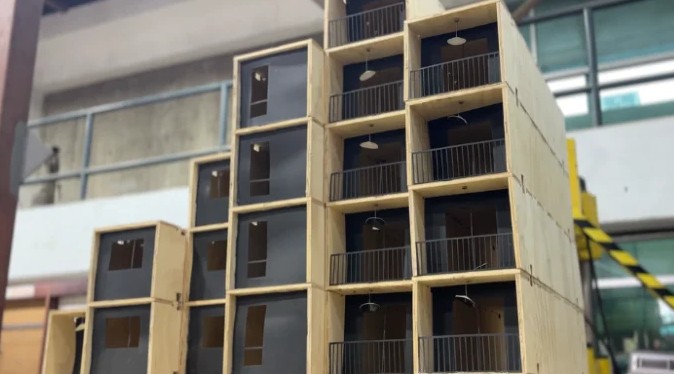
In a seismic country like Chile, mass timber has become established as a sustainable and efficient alternative for mid-rise construction. It allows accelerating construction processes and reducing the sector's carbon footprint, but it faces two challenges that until now have not been resolved together: structural performance against earthquakes and fire safety.
A project led by researchers from the UC Center for Innovation in Wood (CIM UC) and the National Center of Excellence for the Wood Industry (CENAMAD) seeks to develop and validate a resilient construction system for mid-rise mass timber buildings that combines seismic isolation and fire-resistant hybrid connectors, optimizing their structural performance, safety, and economic efficiency, with a view to their future incorporation into regulations and design practices.
"We are developing a construction system that combines seismic isolation with a new type of fire-resistant connector for mid-rise mass timber buildings. The idea is for a timber building to withstand an earthquake equal to or better than a traditional one," explains José Luis Almazán, academic director of CIM UC – CENAMAD and director of the project.
Mass timber buildings allow accelerating construction processes and reducing the carbon footprint.
The team develops and prototypes three typologies of fire-resistant hybrid connectors. Currently, between columns, tension connectors between CLT walls, and shear connectors between CLT slabs. Each one is subjected to an experimental campaign of monotonic and cyclic loading, in parallel with the qualification of the seismic isolators that will be integrated into the system.
The final validation includes a shake table test of a three-story CLT residential module, comparing its performance with and without base isolation.
"Today, seismicity and fire safety are the two main barriers to building taller timber buildings in Chile. Our goal is to solve both at the same time, and we are validating that solution with experimental tests, including a shake table test," adds Almazán.
Moving toward a more sustainable and resilient way of building
One of the expected results of this project is a seismic-resistant design procedure for mass timber, developed in conjunction with the Ministry of Housing and Urban Development (MINVU) and the National Institute for Standardization (INN), as well as a design manual for professional use.
"We are working directly with MINVU and INN so that this system translates into a design procedure, into regulations, that the industry can use to build faster, more sustainably, and more safely," says Almazán.
"This project seeks to respond to the challenges facing construction in Chile (…) and to move toward a more sustainable and resilient way of building, considering the particular conditions of Chilean territory," says José Luis Almazán, academic director of CIM UC – CENAMAD.
The project is executed by CIM UC – CENAMAD, with the collaboration of the University of A Coruña (Spain) and Tongji University (China), with support from Avanza UC, a fund financed with institutional resources to promote frontier research projects driven by the Pontificia Universidad Católica de Chile, as part of its 2026-2030 Strategic Plan to contribute to Chile's transformation.
In that line, this research seeks to contribute to the development of solutions that allow progress in the incorporation of mass timber in Chile, generating knowledge that can serve as a basis for future regulations and design practices, and that facilitates the adoption of this material in mid-rise buildings.
For Almazán, the challenge is that the research developed from the university can translate into solutions with high impact on society and industry. "This project seeks to respond to the challenges facing construction in Chile, contributing with technologies that allow improving the performance of mass timber buildings and moving toward a more sustainable and resilient way of building, considering the particular conditions of Chilean territory."





Comments (0)
No comments yet. Be the first to comment!
Leave a comment