

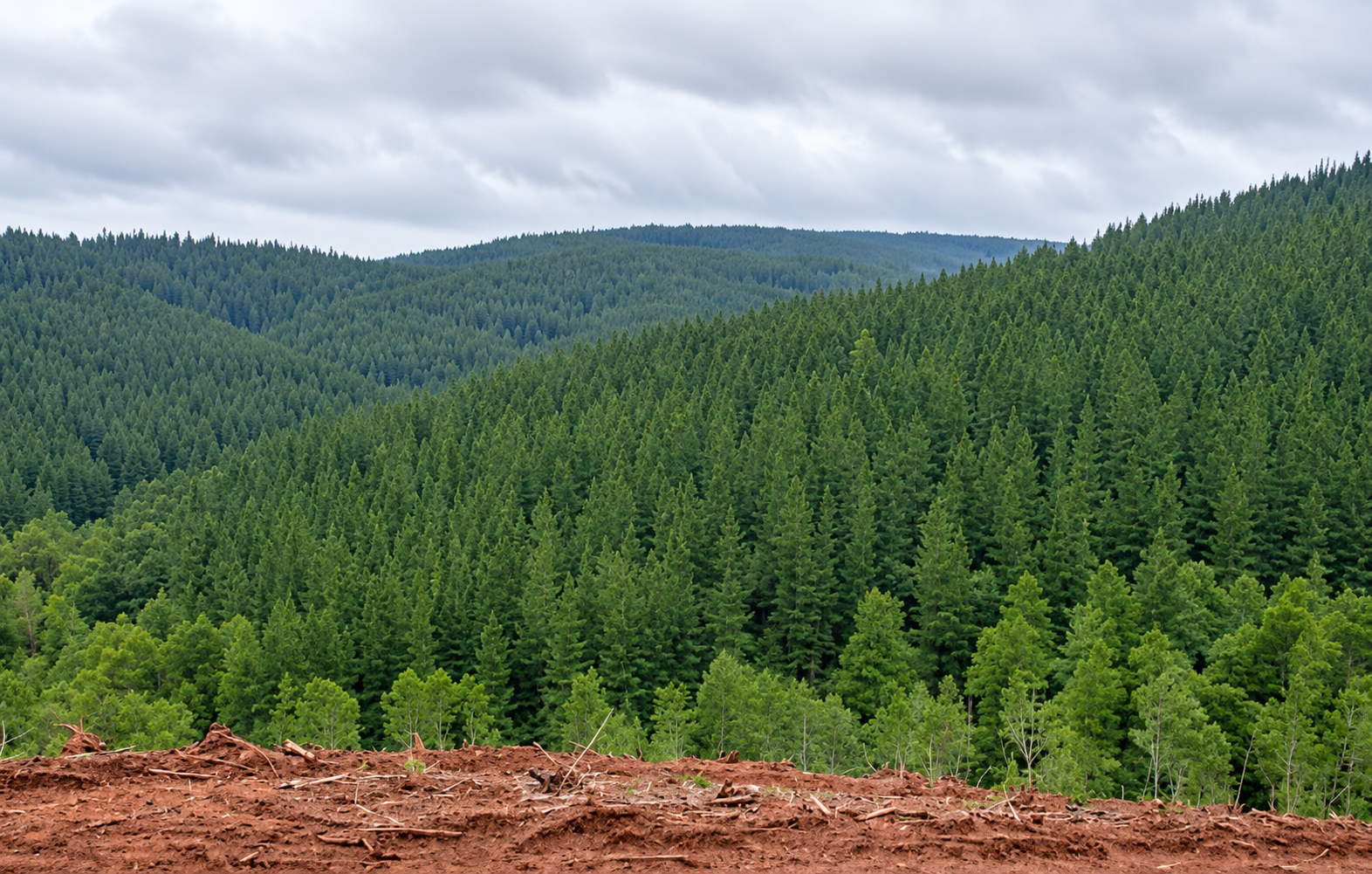
Arauco, a subsidiary of Empresas Copec, adds close to US$ 686 million in forest sales in 2026. And Empresas CMPC, with the operations it announced, would reach about US$ 955 million in asset monetization. Both have a US$ 4.6 billion pulp project in Brazil. But since May 25, Copec's stock has fallen 1.2% and CMPC's, almost 18%.
Analysts agree that neither faces a solvency problem. What separates them is how much they still need to finance. At Copec, the sale would allow it to cover the final stretch of Sucuriú. At CMPC, it is part of a monetization process that Bci Corredor de Bolsa projects between US$ 1.3 billion and US$ 1.5 billion and that, according to the brokerage, would reduce the size of a potential capital increase.
"Given that its plant in Brazil is already more than 80% or 90% physically complete, the idea is to consolidate that structure now that the project is practically finished," says Jorge Tolosa, head of equity strategy at Vector Capital, about Copec. At CMPC, by contrast, "the market is trying to estimate how it will finance a plant that has not even begun and that still faces environmental hurdles."
Arturo Gutiérrez, portfolio manager at Aquelarre, rules out that these are sales due to distress. "They are not forced sales due to financial problems, but rather to face major investments from a better position," he states. In addition, both signed wood supply contracts with the new owners, so that "the asset is sold, the risk and care of the forest are transferred, but access to wood supply in the future is still maintained," explains Guillermo Araya, research manager at Renta4.
A plant that is ahead of schedule
According to Jefferies, Sucuriú already has 84.3% physical progress, "5.9 percentage points ahead of plan," with its start-up scheduled for late 2027. José Ignacio Pérez, senior research analyst at Bci Corredor de Bolsa, estimates that the project will contribute about US$ 800 million additional in Ebitda and Jefferies forecasts between US$ 1,000 and US$ 1,500 million at mid-cycle pulp prices.
Natureza, CMPC's project in Rio Grande do Sul, does not yet have final approval from its board. For Pérez, asset sales would allow the company to "reduce its leverage to more reasonable levels," with net financial debt over Ebitda below 3.3 times, from 4.23 times as of September. Even so, "this would not completely eliminate the risk of a capital increase to finance the eventual Natureza Project, but it represents a significant contribution to reducing its size," he adds.
The price that sales do not resolve
The pending factor is the fiber price. After the recent London Pulp Week, BofA's research department concluded that the industry still has a structural oversupply and that short fiber (the pulp obtained from eucalyptus) will move in a range of US$ 550 to US$ 620 per ton, with Sucuriú and eventually Natureza as part of a new wave of supply.
According to the Bloomberg consensus, 43% of analysts recommend buying Copec, with an average target price of 7,757 and a potential of 22.7% (at Friday's close)[span_1](start_span)[span_1](end_span). At CMPC, 12% recommend buying, although the average target price of $1,310 implies a potential of 39%[span_2](start_span)[span_2](end_span). MBI Corredores de Bolsa, with an overweight rating, maintains that "the forestry base is worth more than the entire company on the stock exchange," because the book value of its biological assets (US$ 4 billion) and land (about US$ 1.2 billion) more than doubles its market capitalization.
"In no case are these companies that will have default problems or anything similar. Their problem is financing growth," concludes Gutiérrez.
Source:El Mercurio



Comments (0)
No comments yet. Be the first to comment!
Leave a comment