

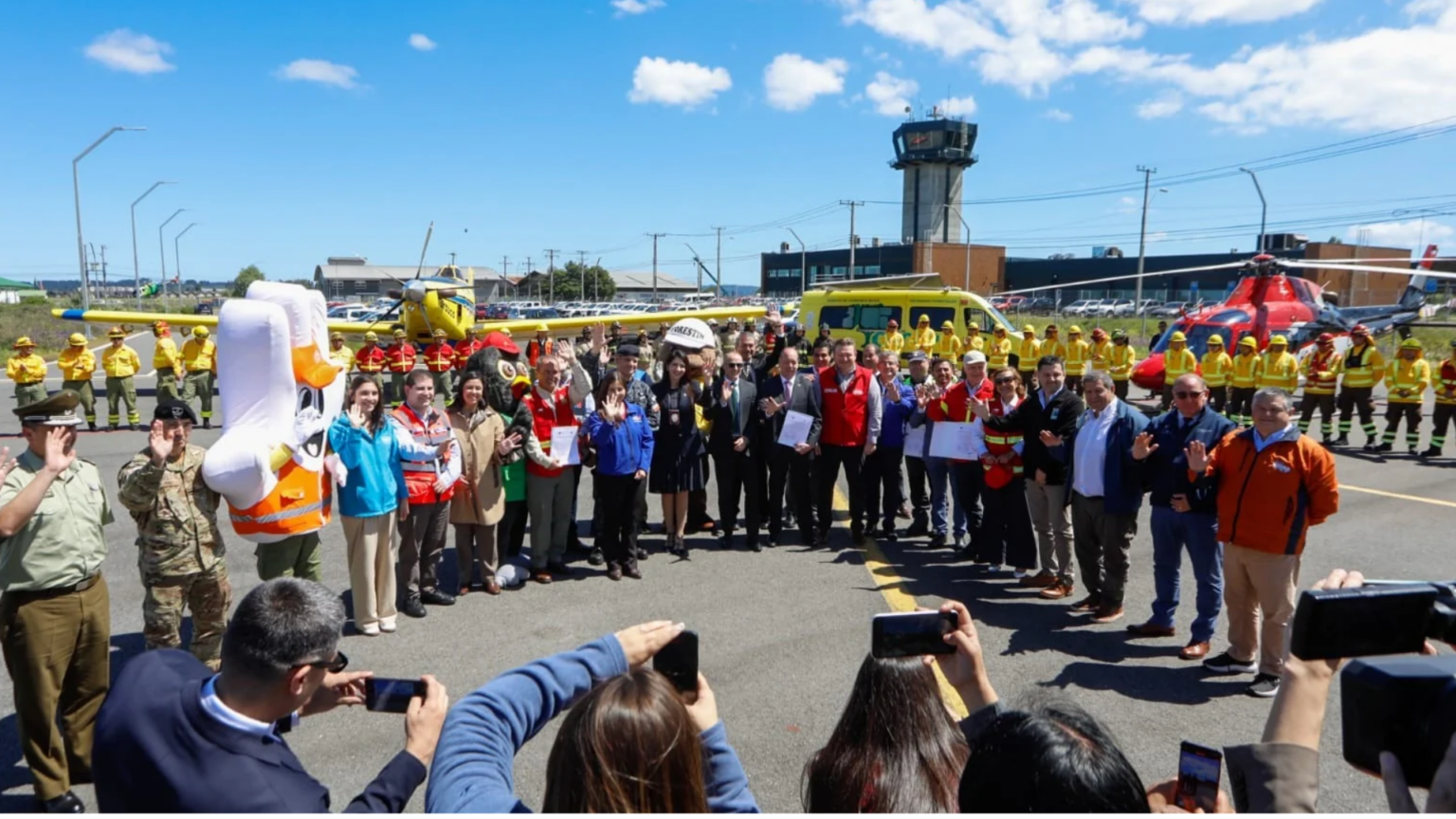
The National Forestry Corporation (CONAF) presented the 2026-2027 Forest Fire Protection Plan for the Biobío Region, which considers an investment of $25.570 billion to strengthen forest fire prevention, detection, and combat capabilities.
The launch was led by the regional presidential delegate (s), Juan Pablo Mellado, who highlighted the importance of having resources and coordinated planning, along with the commitment of citizens to the prevention of these fires.
"What is relevant is the importance of showing that we are organized, showing that we have resources and always calling on citizens to be the first to prevent any type of fire. All the means are there, the information is there, we have technology, we have everything, but the first thing we must have is the commitment and responsibility of each of our neighbors," he stated.
For this season, the region will have 42 forest brigades and nearly 545 brigade members, including four brigades specialized in nighttime combat. The distribution considers 17 brigades in the province of Concepción, 15 in Biobío, and 10 in Arauco.
The aerial deployment contemplates 10 aircraft, including helicopters and AT-802 planes. Added to these resources is the heavy Hércules C-130 aircraft, with national scope, which will be available to operate in the region according to operational needs.
In this regard, CONAF's executive director, Aída Baldini, detailed the capabilities available at the national and regional levels, also highlighting the contribution of forestry companies and the Fire Department.
"The country has more than 156 aircraft at the national level. One of the largest, a tanker plane, will be in the Biobío Region, specifically in Los Ángeles. In addition, CONAF has 319 brigades distributed throughout the country, of which 42 will be in the Biobío Region. Added to this are the combat forces of the companies CMPC, Arauco, and other companies grouped in CORMA. And, of course, the support of the Fire Department is fundamental, as it plays a key role in protecting homes and people in interface areas," he indicated.
Coordination and resources for detection and combat
In terms of early detection, CONAF has access to 106 remote sensing cameras from CMPC and Forestal Arauco, through an agreement with companies grouped in the Chilean Wood Corporation (CORMA). Added to this are four detection towers operated by personnel with knowledge of the territory.
Coordinated work with forestry companies is also part of the planning for this season. In that context, CORMA's president, Alejandro Casagrande, detailed the resources that the private sector will allocate for the prevention and combat of forest fires.
"The companies are preparing intensively for this season, with a clear focus on forest fire prevention. We have a budget of $130.000 billion, 56 aircraft, including helicopters and planes, and a combat force of 5,000 people, of whom 4,000 are brigade members. However, we want to emphasize that our focus is on prevention. We believe that this should also be the emphasis of the Fire Law currently in Parliament," he added.
For its part, the Fire Department will have a fundamental role in emergency combat, especially in urban-rural interface sectors and in the protection of homes. This was explained by Roberto Araya, commander and regional focal point of the Fire Department, who highlighted the institution's capabilities and its participation in coordination instances.
"The Fire Department of the Biobío Region, as throughout the country, is committed to the prevention and combat of forest fires. Of the 7,000 firefighters we have in the region, nearly 3,000 have training and technical competencies for forest fire combat. In addition, we have nearly 70 companies with their respective units available to work in this type of emergency. Undoubtedly, the participation of the Fire Department in the various technical coordination tables, both at the municipal and local as well as provincial and regional levels, strengthens the capabilities of our institution and of the system as a whole to better face this season," he detailed.
Prevention in the region's 33 communes
In the preventive area, between January and October 2026, CONAF developed 2,684 activities in the region's 33 communes, prepared 33 communal forest fire prevention and mitigation plans, and planned actions in 20 educational establishments, within the framework of the Escuela Preparada program.
Likewise, the construction and maintenance of firebreaks and fiscal strips began, with a planning of 1,262.9 kilometers for the 2026-2027 period. These tasks are carried out with machinery contracted by CONAF, personnel from the Emergency Employment Program (PEE), and support from the Roads Directorate.
Regarding preventive work and regional preparation, the Agriculture seremi, Francisco Lagos, highlighted the institutional deployment and coordination to face the season.
"As the Ministry of Agriculture, we are promoting early and coordinated preparation to face the upcoming forest fire season in the Biobío Region. This plan contemplates the deployment of brigades, aircraft, early detection systems, and important preventive work in the region's 33 communes. Our main objective is to protect people's lives, safeguard rural communities, and care for the productive and environmental heritage of our territory," he commented.
Regarding emergency response, CONAF will continue applying the "single strike" strategy, which consists of immediately deploying the greatest possible number of ground and aerial resources upon the detection of a forest fire, with the projection that they begin operating in less than 20 minutes.
Forest fire investigation
During the 2025-2026 season, the Biobío Region recorded 887 forest fires, of which 675 were investigated, equivalent to 76% of regional occurrence. The results determined that 47% corresponded to intentional causes, 41% to negligent causes, 6% to natural causes, 3% to accidental causes, and the remaining 3% to undetermined causes.
Regarding the current season, as of November 4, 2026, at 3:00 p.m., the region had recorded 17 forest fires, with an affected area of 8.14 hectares. These figures represented a 69% decrease in occurrence compared to the same period of the previous season.
The 2026-2027 Forest Fire Protection Plan considers coordinated work among CONAF, municipalities, the Fire Department, forestry companies, and public agencies, with the purpose of strengthening prevention and emergency response capacity, prioritizing the protection of people, their homes, and the natural heritage of the Biobío Region.



Comments (0)
No comments yet. Be the first to comment!
Leave a comment