

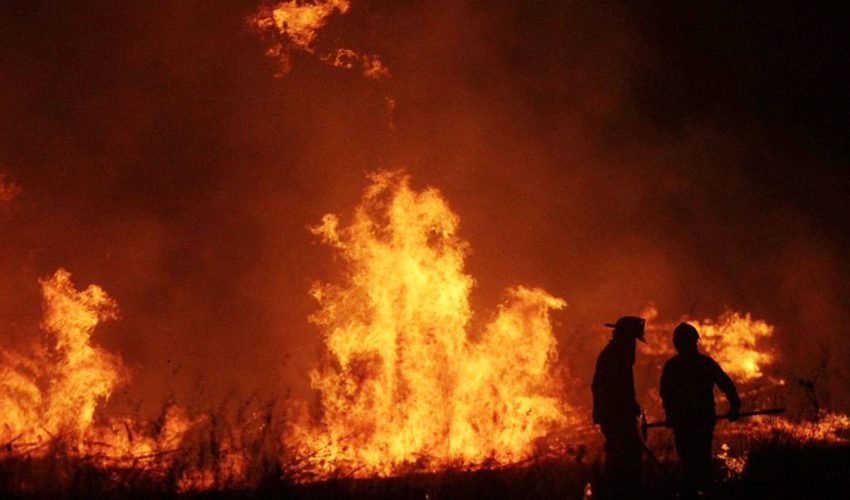
The Government's announcement to submit a substitute veto to the Fire Law, regardless of the outcome of its processing in Congress, generated concern among Biobío mayors, who warn that a new modification could prolong the wait for a regulation they consider urgent.
Among the Executive's arguments, the Minister of Agriculture, Jaime Campos, maintained that the veto will seek to incorporate economic compensation for forest owners who must allocate part of their properties to protection strips, in addition to resource transfers for the municipalities. The Secretary of State questioned that the bill imposes obligations on landowners, especially small and medium-sized owners, without establishing how those measures will be financed.
The announcement came while the initiative was advancing in Congress. The Chamber of Deputies approved the Mixed Commission's report with 77 votes in favor, 51 against and 14 abstentions, and referred it to the Senate. However, two provisions of constitutional organic rank did not reach the required 78 votes.
The differences were also reflected among Biobío parliamentarians. While Deputy José Antonio Rivas (PS) called for approving the initiative and guaranteeing resources for its application in the territories.
Patricio Briones (PDG) questioned the economic burdens it would impose on small and medium-sized farmers. Meanwhile, his party colleague Roberto Arroyo emphasized the need to provide tools to the municipalities and strengthen the State's response capacity.
Mayors warn of urgency
In conversation with Diario Concepción, the mayor of Florida, Rodrigo Montero, maintained that, since it is a commune exposed to a high risk of catastrophes, the priority must be to protect the lives of residents and to have tools to respond in a timely manner. From that perspective, he warned that the veto could delay the enactment of the law right at the start of the highest-risk season.
"I believe the veto delays the enactment of the law right at the start of the highest-risk season, leaving us as a municipality 'unprotected' legally for actions such as, for example, expedited inspection of private properties," he stated.
The communal leader clarified that he is not against improving the initiative or receiving greater resources and powers, especially for municipalities like his. However, he insisted that the discussion must not lose its sense of urgency. "We don't need the matter to be delayed; on the contrary, it needs to be prioritized and not left dormant in Parliament."
A similar concern was expressed by the president of the Association of Municipalities of the Biobío Region (AMRBB) and mayor of Hualqui, Ricardo Fuentes. In his view, the discussion about the cost that establishing buffer zones would entail for forestry companies should not displace the priority of protecting people.
"We see a signal from the Government that reflects a certain protection for large industry, in this case, forestry, and that is why it wants to veto it, because we don't see anything else," he maintained. Fuentes questioned that the economic argument of the owners could prevail over the need to expand protection zones in populated areas.
The mayor also referred to the Executive's proposal to incorporate resource transfers for the municipalities. Although he valued that possibility, he warned that financing must be accompanied by operational capacity and sufficient personnel to assume eventual new responsibilities.
"We have some precautions regarding the responsibility that may be assigned to us," he explained. Along those lines, he added that "it is not only a matter of financial resources, it is a matter of human resources, and in that respect we are limited by our staffing."
From Penco, mayor Rodrigo Vera stated that any modification must ensure public financing and strengthen local tools, but without delaying the entry into force of the regulation. "Modifying the law must strengthen prevention without delaying it," he affirmed.
The communal leader called for concrete powers so that municipalities can inspect and intervene, along with resources for equipment, machinery and preventive work. He also requested that Conaf have clear technical powers to determine intervention areas, protection strips and firebreaks.
Mountain municipalities call for agreements
From the Association of Mountain Municipalities (Amcordi), its president and mayor of Quilaco, Pablo Urrutia, called on the Government and Congress to reach agreements to move the initiative forward. He recalled the effects of the fires in the area, including the loss of vegetation around a lagoon in the commune of Santa Bárbara, and asked that the consequences these emergencies have for communities be considered.
"We cannot be so intransigent. We must be a little more human and put ourselves in people's shoes," he stated. Regarding the protection strips, he acknowledged that the measures entail costs for private parties, but maintained that owners must also understand the need to carry out preventive interventions.
Urrutia considered that the regulation can be improved later, but that this should not prevent the country from having a law. To illustrate the importance of moving forward, he contrasted the cost of prevention with the resources required for reconstruction after a catastrophe.
"Between the spending the Government makes to recover all of that and drafting the bill properly, I'll go with the bill having to move forward," he affirmed. He also announced that the association will seek to send an official letter to the President of the Republic requesting that the initiative be advanced.
What comes next?
After the narrow approval in the Chamber, the Mixed Commission's report was left in the hands of the Senate, which must rule on the proposal.
The outcome of that vote will open a new scenario for the initiative. If the Senate approves the report, the bill will be able to complete its parliamentary processing and be referred to the President of the Republic. At that point, the Executive will be able to formalize the announced observations, within the constitutional period of 30 days.
If the Senate eventually does not support it, it will remain pending to resolve how the legislative processing continues.
Source:Diario Concepción





Comments (0)
No comments yet. Be the first to comment!
Leave a comment