

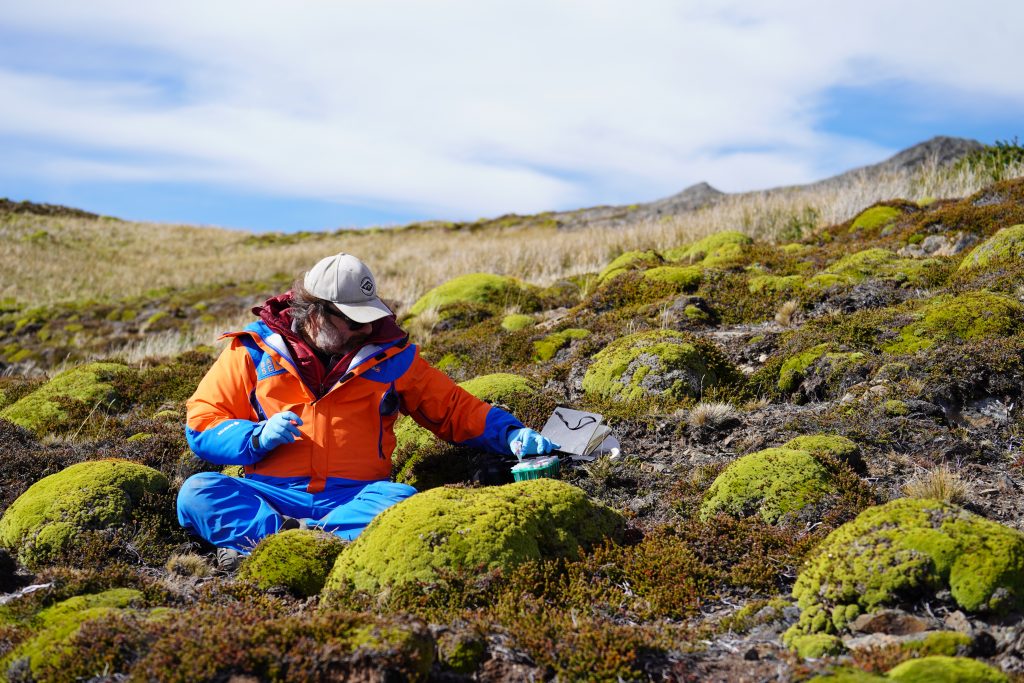
During an expedition, a team of Chilean scientists, led by Dr. Pablo Guerrero Martin from the University of Concepción and Dr. Gastón Carvallo Bravo from the Pontifical Catholic University of Valparaíso, has collected valuable information on sub-Antarctic flora and its response to climate change. The research focused on two plant species, the grass Deschampsia and the shrub Baccharis, which are key to understanding how global change affects sub-Antarctic ecosystems.
The diversity of flora in the Magallanes region is remarkable, despite the extreme climatic conditions. The research team traveled from the commune of Torres del Paine to Cerro Mirador in Punta Arenas, passing through the Karukinka Reserve on the main island of Tierra del Fuego. With over 200 sampling points, specimens of Deschampsia antarctica and Baccharis magellanica, representative species of the region, were collected.
Dr. Guerrero, a researcher at the Millennium Institute BASE and the Institute of Ecology and Biodiversity (IEB), highlighted the importance of D. antarctica, a plant adapted to survive in extreme cold conditions, found from the Magallanes region to the Antarctic Peninsula. The team will study the molecular response of these plants to environmental changes, analyzing their RNA to infer genetic activity in response to the environment.
On the other hand, B. magellanica, with a broader distribution in continental Chile, is a shrub that grows in windy areas and can reach up to 1 meter in height. The collection of samples from this species complements the study on the biogeographic expansion and evolution of functional traits in the Baccharis genus.
The interdisciplinary collaboration between Dr. Guerrero and Dr. Carvallo, with over a decade of joint work, focuses on understanding the evolutionary and reproductive processes of plants in different ecosystems of Chile. The study of D. antarctica also includes analysis of the plant's microbiome, in collaboration with Dr. Julieta Orlando, a microbiologist from the University of Chile.
With this research, the scientists hope to provide new evidence on the response of southern plants to global change and strengthen the scientific knowledge of the sub-Antarctic ecoregion of Magallanes. The results will be key to understanding ecological, reproductive, and evolutionary processes at the southern end of the world and to predicting the future of biodiversity under climate change conditions.






Comments (0)
No comments yet. Be the first to comment!
Leave a comment