

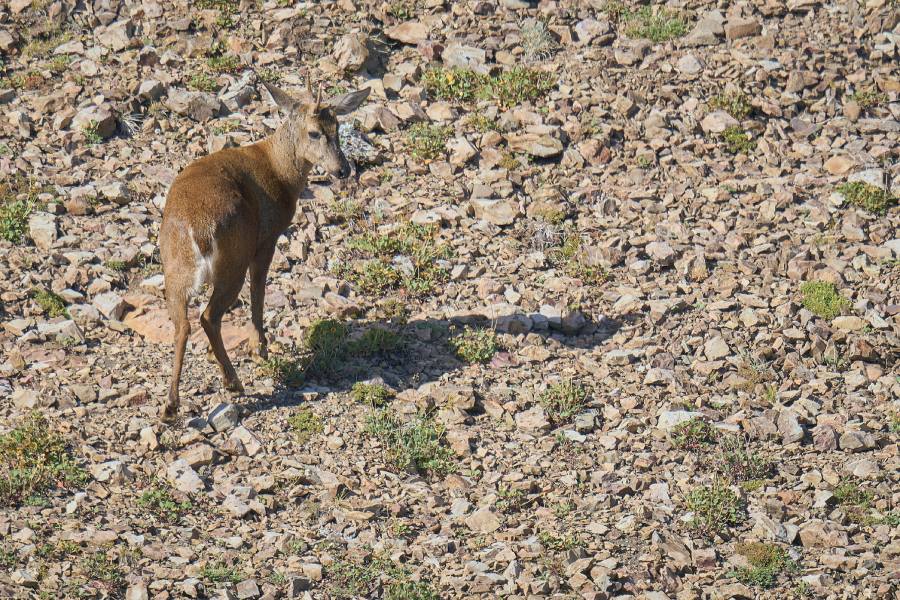
Six camera traps installed in the Nevados de Chillán Biological Corridor have delivered encouraging news for the conservation of one of the most threatened species in the country and our region: the huemul. The devices, located in strategic sectors of the Ñuble mountain range, managed to capture multiple sightings, at least seven individuals including the presence of offspring, which opens a ray of hope for the recovery of this critical population.
The work is led by nature and wildlife photographer Matías Medina, 26 years old and a native of Chillán Viejo, who has spent nearly five years exploring and monitoring the habitat of this deer in the area. "The Ñuble huemul is the most critical population that exists. All this effort seeks to know where it lives, how it moves, and how we can address threats that endanger its survival," he explained.
The records correspond mainly to this past February, although Medina also reported sightings in January. As he detailed, all installed cameras delivered positive results, confirming the active presence of the species in the monitored area. "The most important thing is that we saw several offspring, which indicates the population is reproducing and, potentially, growing," he noted.
The project, however, has not been without difficulties. Medina has independently financed a large part of the work, including the acquisition of cameras whose value exceeds $100,000 pesos each. "No one sponsors us, it's all out-of-pocket money, so that makes it much more complex to advance quickly because a camera that doesn't die in the mountains costs over $100,000 and I need at least five to get good results from an area, so it's quite a lot of money to explore the entire territory," he commented.
"A field trip takes us about 4 to 5 days for each quadrant to prospect, very often without positive results, so it has its complexity. However, in one way or another, this reflects the spirit we have for huemul conservation, where we have been able to learn about the areas where this threatened species inhabits," he added.
The photographer advanced that he has been in conversations with Conaf, Forestal Arauco, and CMPC to materialize future collaborations to work on the conservation of the species.
Ecological restoration
Bastián Díaz, 29 years old from Chillán and a Natural Resources Engineering student, also participates in the initiative and revealed they are working on a strategy to improve connectivity between the groups of huemuls inhabiting the mountain area of Ñuble.
"One of the problems is that, for example, the huemul groups in the Ñuble region are not connecting. So, what we are now considering as a strategy is to generate connections between groups through the ecological restoration of the plants these huemuls feed on. We are taking samples of huemul feces to obtain the DNA of the plants contained in this feces to know the diet, and that gives us a much more rigorous data point on what diet they are having," he explained.
"What we hope with this is to be able to collect seeds from the plants in that place, reproduce them, and help their ecological restoration in areas where connectivity could be improved. All this obviously considering disturbing the huemuls as little as possible, but we can at least give an indication that there is a more winter or autumn season when they lower their altitude, so there we could eventually reintegrate these plants into that ecosystem," added Díaz.
He emphasized that the results obtained so far not only confirm the presence of the huemul in the area but also the existence of a habitat that favors its reproduction. "It is a little-intervened ecosystem, where apparently there is not much human presence or predators, which facilitates the survival of the offspring," said Díaz.
Source:La Discusión





Comments (0)
No comments yet. Be the first to comment!
Leave a comment