

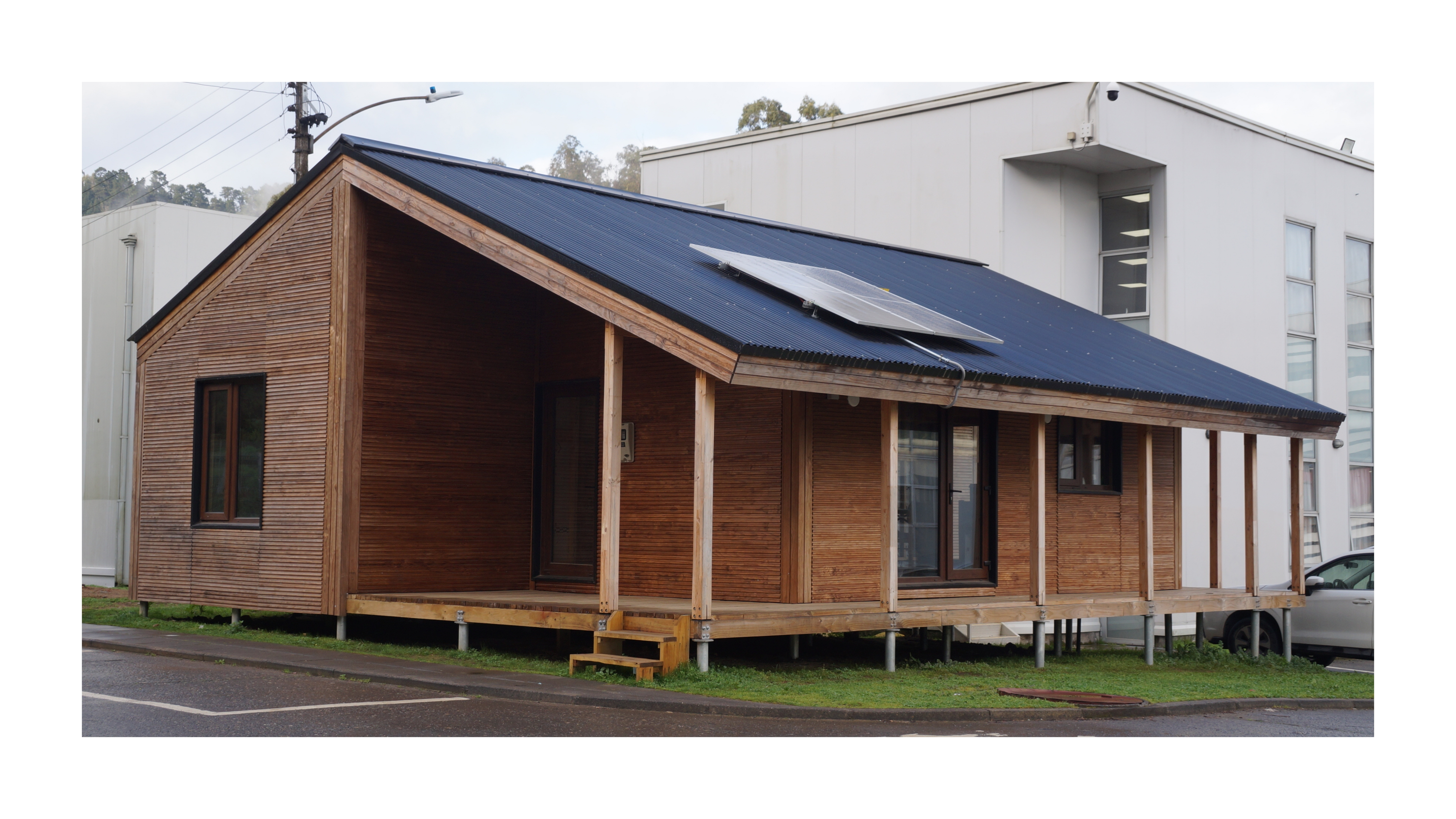
With the housing deficit as one of the country's main social challenges, the project "Design for Manufacture and Assembly: social housing proposal for the Biobío Region" —known as DMM— positions itself as a pilot experience that seeks to transform the way social housing is conceived and built in Chile.
Executed by the Polomadera program of the Faculty of Architecture, Urbanism and Geography at the University of Concepción, and co-financed by Corfo Biobío, the project is mandated by the Ministry of Housing and Urban Planning (Minvu), through its Regional Ministerial Secretariat and the Housing and Urbanization Service (Serviu). Additionally, it has the collaboration of local companies and international partners.
The central axis of the initiative is the application of the Design for Manufacture and Assembly (DfMA) methodology, an approach that proposes designing homes by considering the manufacturing process as part of the design from the start, including how they will be fabricated, transported, and assembled. This logic allows the design to be conceived from optimization and precision, concepts that seek to reduce errors, shorten timelines, and improve the final quality of constructions—key aspects for responding more efficiently to housing demand.
Designing with Construction in Mind
Carolina Machuca, architect and project coordinator, was in charge of the technical development of the homes and explains that one of the main lessons was understanding design as a strategic stage. "We invested more time in design so that execution would be fast, precise, and require less on-site labor," she states.
The project includes six social housing designs: three conceived for urban contexts and three for rural areas. All typologies were developed using a panelized system of light framing made from dry, planed radiata pine wood, a decision based on technical and productive criteria associated with dimensional control, component repeatability, and manufacturing process quality. This system allows working with small and medium-sized enterprises that do not have high levels of automation but can access high-quality prefabricated solutions.
In that context, the company IDV, a panel factory located on the road to Santa Juana, Biobío Region, participated as a co-executing entity of the project. The experience demonstrated that, even with low-tech plants, it is possible to achieve high construction standards through proper planning and improvements in production processes.
Construction Speed
One of the project's milestones was the construction of a prototype in 2024 as a demonstrative experience, whose fabrication and assembly were handled by IDV. The results were conclusive: panel fabrication took between 7 and 10 days, while on-site assembly was completed in one week.
According to architect Machuca, considering an initial learning curve with accumulated experience, a house could be assembled in 3 or 4 days and be completely finished in two to three months, significantly reducing traditional construction timelines.
But the impact of the DMM Project is not limited to reducing construction times. The homes achieve an energy rating of A, with savings of nearly 80% in heating and cooling compared to an average house. Furthermore, they comply with the new thermal regulations in effect since November 2025 and approach international standards such as passive houses.
Thanks to the use of wood and a highly efficient envelope, the prototype even achieves a negative carbon balance when considering its production stage. This aspect positions the project as a concrete alternative in the face of the challenges of the climate crisis and the need to move towards more sustainable construction.
Collaboration and Projection
Valentina Torres, director of the Public Goods project "Design for Manufacture and Assembly: social housing proposal for the Biobío Region" at the University of Concepción, explains that the initiative is aimed at supporting construction companies and prefabricators that wish to offer quality housing solutions but lack robust technical teams to develop projects from scratch.
"The proposal includes the delivery of all necessary technical documentation so these companies can execute the works, both in rural and urban contexts. Although the projects must be reviewed by competent professionals, the available technical material significantly reduces work times and costs associated with initial development in the project stage," she states.
Regarding the use of wood, Torres highlights its strategic and environmental value. More than a current trend, she notes, construction with this material responds to a defined international path, especially within the framework of decarbonization. "Wood is the only material that captures CO₂ during the tree's growth and stores it once incorporated into the building. It is key for Chile to meet its carbon neutrality goals by 2050," she asserts.
Torres also emphasizes the paradigm shift, as wood is now recognized as a material capable of achieving high standards of quality, efficiency, and durability, especially thanks to the development of panelized light-frame systems.
For its promoters, the challenge now is to scale the model, transfer knowledge to more companies, and demonstrate that social housing can be fast, dignified, efficient, and sustainable, anticipating the housing future of Biobío and the country.
From Acoforag, we highlight the project as a key initiative to promote wood construction and advance towards more sustainable and higher-quality social housing solutions. Likewise, we value the articulation between academia, the public sector, and local companies, underscoring its contribution to regional productive development and innovation in social housing.
The feature in Acoforag Magazine





Comments (0)
No comments yet. Be the first to comment!
Leave a comment