

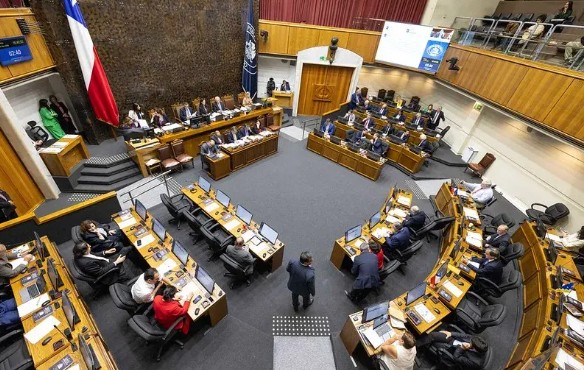
After extensive debate, the Senate backed the first request from the President of the Republic, José Antonio Kast, to renew the state of constitutional emergency for the southern macrozone. This measure, which began in 2022, is now extended for an additional 30 days.
The extension, effective from March 27, will apply in the La Araucanía Region, and the provinces of Arauco and Biobío in the Biobío Region. Despite broad support (40 votes in favor, 1 against, and 2 abstentions), calls were made to "define new future measures," greater "empowerment of the Armed Forces," "protection of victims," "address the root causes," "seek prompt solutions," and "not normalize having a failed state." All this, it was argued, is for a "de-escalation" with measures "to end terrorism," because "the State has the obligation to guarantee people's security."
Prior to the debate, the Interior Minister, Claudio Alvarado, stated that "we have turned to our Armed Forces because what is happening goes beyond the purely police sphere. The previous government understood the seriousness and renewed the measure on 66 occasions." He added that "future decisions will be made based on detailed and serious analysis; for this, we first need to maintain the state of exception to have room for action."
From the ruling coalition, it was emphasized that "this document (the presidential request) is not the plan for how we are going to restore the rule of law." "This is not a problem of the Mapuche people; this is a problem of a small group of criminals, of terrorists, who have taken over La Araucanía."
Meanwhile, opposition representatives urged consideration of, among other things, the Agreement for Peace and Understanding and the Good Living Plan.
Across the board, there were calls to analyze and discuss the "conditions and details of a de-escalation plan."




Comments (0)
No comments yet. Be the first to comment!
Leave a comment