

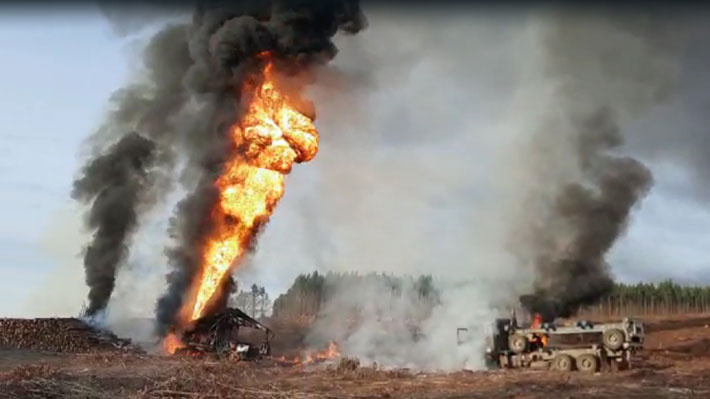
The lowest number of attacks for the first quarter of the year, since the state of emergency has been in effect in the southern macro-zone, was recorded in this period of 2026, with five cases. This is revealed by the "Violence Report" prepared by the Multiguild of La Araucanía.
This figure contrasts with the 72 episodes in the first quarter of 2021, prior to the extraordinary measure; or with the 60 in 2022, when the instrument, which had been in effect since October 12, 2021, was lifted on March 26, due to the change of government. It was then reinstated on May 17, 2022, until today.
The study coincides with the debate about a potential de-escalation of the military presence raised by the Minister of Defense, Fernando Barros. In response, victims and guilds ask to emphasize the dismantling of violent groups.
"This decrease does not imply a proportional reduction in the severity of the events. On the contrary, there is greater intensity and destructive capacity in the actions," states the document.
Asked if these figures are sufficient for a withdrawal of the Armed Forces, the former security coordinator of the southern macro-zone and head of the Organized Crime and Terrorism Observatory (Ocrit) at Andrés Bello University, Pablo Urquízar, says that the State's goal "cannot be limited to the application of an exceptional measure, but must focus on safeguarding the fundamental rights and freedoms of both Mapuche and non-Mapuche families in the southern macro-zone."
He stresses that "although the figures show a positive and sustained trend in the decrease of violent incidents, they are not sufficient on their own to justify a de-escalation." He emphasizes that "in April 2024, in the province of Arauco, low numbers were also recorded, and yet the homicide of three police officers occurred, the most serious attack in the history of the southern macro-zone."
Urquizar points out that "the quantitative reduction does not necessarily imply the dismantling of the organizations, nor the elimination of their operational capacity," and explains that "part of this decrease can be explained by the validity of the state of emergency, so its unconditional withdrawal could generate a rebound effect."
He argues that "these figures must be complemented with qualitative indicators: effective convictions, structural weakening of the groups, and territorial control capacity in a scenario of normality."
Objective Conditions
He states that "the review of the state of emergency should not be based on a temporal criterion, but on the simultaneous fulfillment of objective and sustained conditions over time," and that "a potential de-escalation must respond to a comprehensive strategy: it must be gradual, focused, and reversible, avoiding abrupt decisions that could generate control gaps."
He proposes that, "in a first stage, a reduction of military presence in lower-risk areas could be considered, maintaining it in critical points. Subsequently, progress could be made towards a territorial focus of the state of exception. In a later phase, the leading role should be with the police and the State Intelligence System, strengthening their capacities in a context of normality," and that "the total lifting must be accompanied by monitoring and a rapid response that allows for the reinstatement of exceptional measures in case of setbacks, ensuring the sustainability of the progress."

Source: El Mercurio






Comments (0)
No comments yet. Be the first to comment!
Leave a comment