

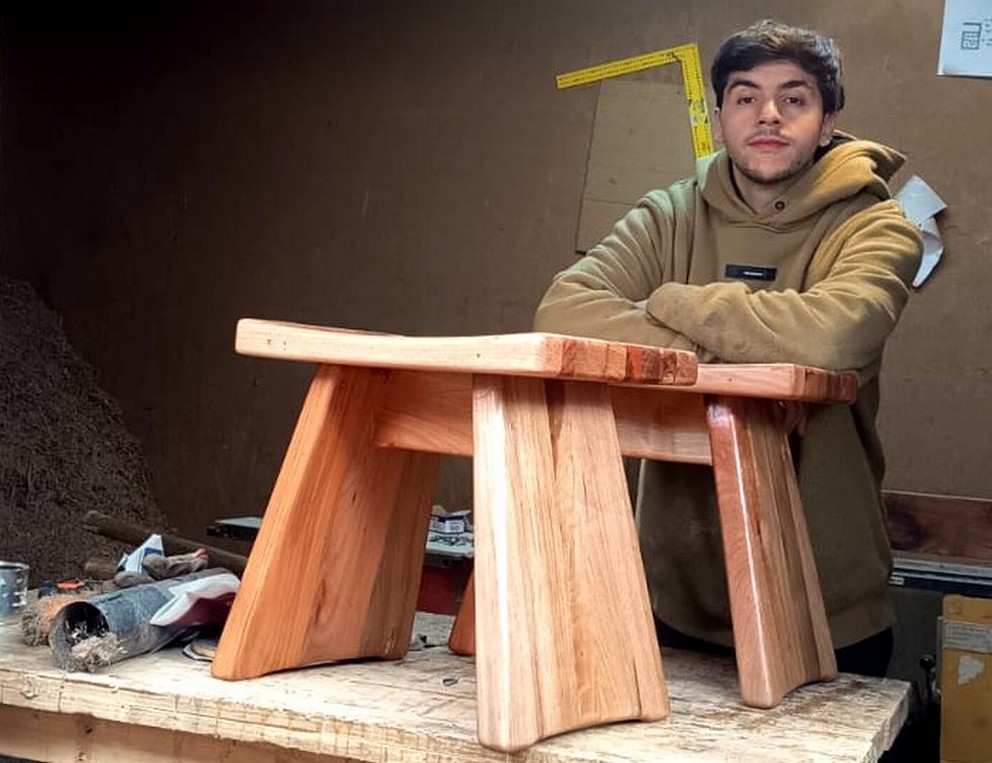
In a small workshop built in the backyard of a house in Labranza, Temuco, one of the pieces of furniture that today identifies Taller de Jade was born: the wedged tenon wanco, a bench made of native wood that started as a test and ended up becoming the most requested product of this family business.
Behind the project are José Suazo and his father Miguel, who after decades of work in carpentry and construction decided to start their own path. What began with basic tools, no capital, and in a space of just 3 by 5 meters, today sends furniture to different regions of Chile and has become a symbol of perseverance and inherited craft.
The name of the workshop has a simple origin: “It was born because my little dog is named Jade,” says José. With that name they christened the project four years ago, when his father retired after a lifetime in carpentry. “He always had the idea of having his own workshop, more as a hobby. When he retired, we saw the opportunity to give it a try,” he recalls.
José had studied civil engineering and programming, although he did not finish those degrees. However, the inherited craft and the desire to undertake were enough to get started. “We started with no resources or tools. The only thing we had was my dad’s experience and the will to work,” he explains.
First steps
At the beginning, they weren’t sure what to make. They tried different materials, but started with something simple: oak cutting boards. That first product allowed them to discover that customers especially valued native wood. With that idea, they ventured into more complex furniture. The first attempt was a table, a process that took four months. Although slow, it marked a turning point.
While trying to sell it, José found online the design of a small stool with a curved seat. They decided to try their luck and made one with the little wood available. They posted it on social media and it sold in three days: it was the workshop’s first wanco. “That’s when we realized it could be a good path,” says José.
Although the model does not exactly correspond to the traditional Mapuche wanco, it is inspired by that aesthetic and the use of native wood. At Taller de Jade, they adapted it with a wedged tenon joinery system, which ensures firmness without visible screws. That detail became the product’s hallmark. “The impact that native wood has inside a home is immediately noticeable,” he comments.
Growth and recognition
Over time, more orders began to arrive, first from La Araucanía and then from other regions, especially Santiago. Today, the wanco is the workshop’s most recognized product. Its standard dimensions are 45 cm long, 35 cm deep, and 45 cm high, although many customers request custom sizes.
Following the success of the wanco, the catalog expanded: coffee tables, dining tables, benches, and countertops, all inspired by the same base design and made by hand. The work is divided between father and son: Miguel focuses on carving and joinery, while José prepares the wood and does the initial dimensioning. They mainly use oak and coihue, purchased from local lumberyards, prioritizing dry wood stored for years to ensure stability.
One of their favorite stages comes at the end, when they apply beeswax or natural sealants. “That’s when you’re amazed by what comes out of the wood,” says José.
Identity and craft
Today, Taller de Jade operates on an order-based system: each product goes into a schedule and is made on a first-come, first-served basis. Despite the increase in demand, the idea is to maintain the artisanal character. “We don’t want to industrialize everything, but rather maintain our own personalized style,” explains José.
The wancos have been placed in homes, interior design projects, and restaurants, where designers integrate them into spaces with a natural and warm aesthetic. For José, the value lies in the process: “Creating something with your hands and seeing how people incorporate it into their home is the most beautiful thing.”
Acoforag highlights precisely that contribution: wood, when it comes from responsible production chains, not only provides cultural and aesthetic identity but also boosts regional economies and promotes renewable materials with a lower environmental footprint.
The report in theAcoforag Magazine





Comments (0)
No comments yet. Be the first to comment!
Leave a comment