

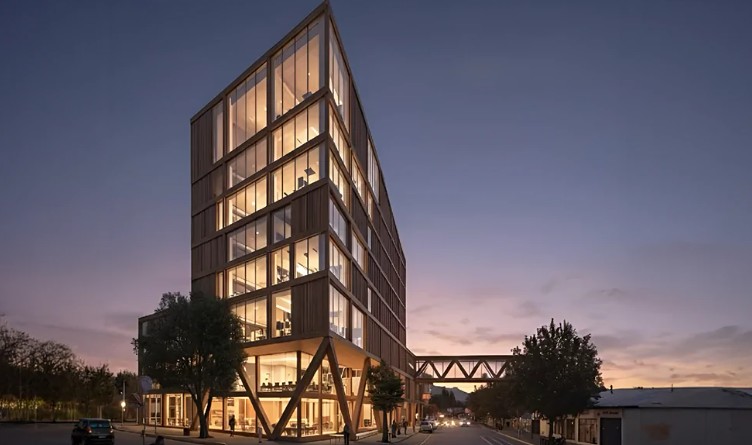
The Municipal Council of Coyhaique gave the green light to an initiative that continues to promote wood construction in Chile. This involves the development of a new city hall building entirely made of this noble material, through the Shared Urban Financing modality (FUC Law). The approval allows progress on a public infrastructure project that incorporates private investment and projects a new scale for wood in municipal equipment.
The future building, which will house the mayor's office, the municipal council, and the main administrative departments, will function as the center of local government and will allow organizing the management of communal affairs in a single space, improving citizen service and the internal functioning of the municipality.
The proposal considers an area close to 3,000 square meters, where municipal offices, public service areas, and spaces for council sessions will be distributed. Its design aims to optimize municipal operations and facilitate the relationship with the community.
The project also includes four levels of underground parking, with nearly 484 spaces, which will expand the supply in downtown Coyhaique and contribute to urban planning.
The initiative will be developed under the Shared Urban Financing Law, a mechanism that allows executing public works with private participation without committing municipal resources. This model encourages investment in urban infrastructure and opens space for efficient solutions in intermediate cities.
Tallwood, a firm specialized in the evaluation and development of tall wood buildings, participated in the development of the proposal, contributing its experience in construction systems and industrialized solutions for this type of project.
From the office, architect Juan José Ugarte highlighted the link between wood architecture and territory. "Coyhaique is a city with a very strong identity, and from the beginning we tried to link this identity to wood, comfortable spaces around wood, with development associated with the climate, territory, and landscape."
The project proposes a wooden building that reaches seven levels in its conceptual development, integrating design criteria that seek to express that identity both in its exterior and interior spaces.
Ugarte also highlighted the project's impact on the national context, stating that "its development will mark a very important milestone for urban development with a local identity for Coyhaique and also for the country's agenda regarding wood construction."
The council's approval corresponds to a first stage. The project will now advance through technical studies, evaluations, and bidding processes, in line with current regulations. This process will allow validating its feasibility and ensuring compliance with the requirements that safeguard the public interest.
The initiative is part of the communal economic development plan, focusing on promoting investment, strengthening municipal heritage, and advancing infrastructure that responds to current needs. At the same time, it positions wood construction as a viable alternative for public buildings in different regions of the country.
Source: Madera 21






Comments (0)
No comments yet. Be the first to comment!
Leave a comment