

Dr. Luis García Santander. Faculty of Engineering. Department of Electrical Engineering.
Dr. David González Lanteri. Faculty of Forest Sciences
Eng. Bastián Rivas Maldonado. Postgraduate Student FCF
Eng. Teodoro Núñez M. (INGEATOB)
For decades, vegetation management around power lines has relied on experience, field observation, and often, intuition. However, this model is now insufficient in the face of a scenario marked by climate change, an increase in forest fires, and growing demands on the continuity of electricity supply. The question is no longer whether we should change how we approach this problem, but how quickly we can do so.
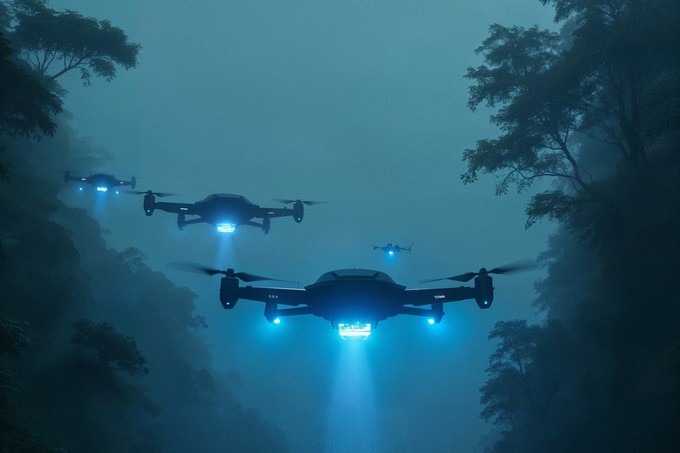
In this context, the incorporation of LiDAR technology and high-definition RGB cameras mounted on drones not only represents a technical improvement but a true paradigm shift. Moving from visual estimates to measurements with maximum error margins of ±40 centimeters and centimeter-level resolutions implies a qualitative leap in how we understand the territory. In simple terms, it means stopping reacting to risk and beginning to anticipate it with precision.
What is relevant about this innovation—driven by researchers from the University of Concepción—is not only its technological sophistication but its concrete impact on decision-making. Being able to classify vegetation cover with over 95% reliability and generate prioritization maps allows companies to optimize resources, reduce costs, and focus their interventions where they are truly needed. In a sector historically pressured by efficiency, this is no small feat.
But perhaps the most significant contribution lies in the shift in approach. For years, maintenance has been limited to the easement strip, as if risk had rigid boundaries. Today we know this is not the case. Trees located outside these areas can, due to their height or condition, become a real threat. Incorporating fall projection analysis not only broadens the perspective but establishes a preventive logic much more aligned with current challenges.
In a country where forest fires have demonstrated their devastating capacity, the relationship between vegetation and power lines can no longer be addressed in a fragmented manner. Here, technology offers a concrete opportunity to reduce risks, comply with regulatory standards, and above all, protect communities.
What comes next is equally challenging. Moving towards the specific identification of species and planning differentiated interventions based on their growth rates opens the door to truly intelligent management. It is not just about cutting down trees, but understanding them, anticipating their behavior, and managing the territory with quality information.
Ultimately, this type of initiative marks the path towards a new standard. One where collaboration between academia, companies, and the state ceases to be an ideal and becomes a necessity. Because if the recent crises have shown anything, it is that prevention is not only more efficient but also more responsible.



Comments (0)
No comments yet. Be the first to comment!
Leave a comment