

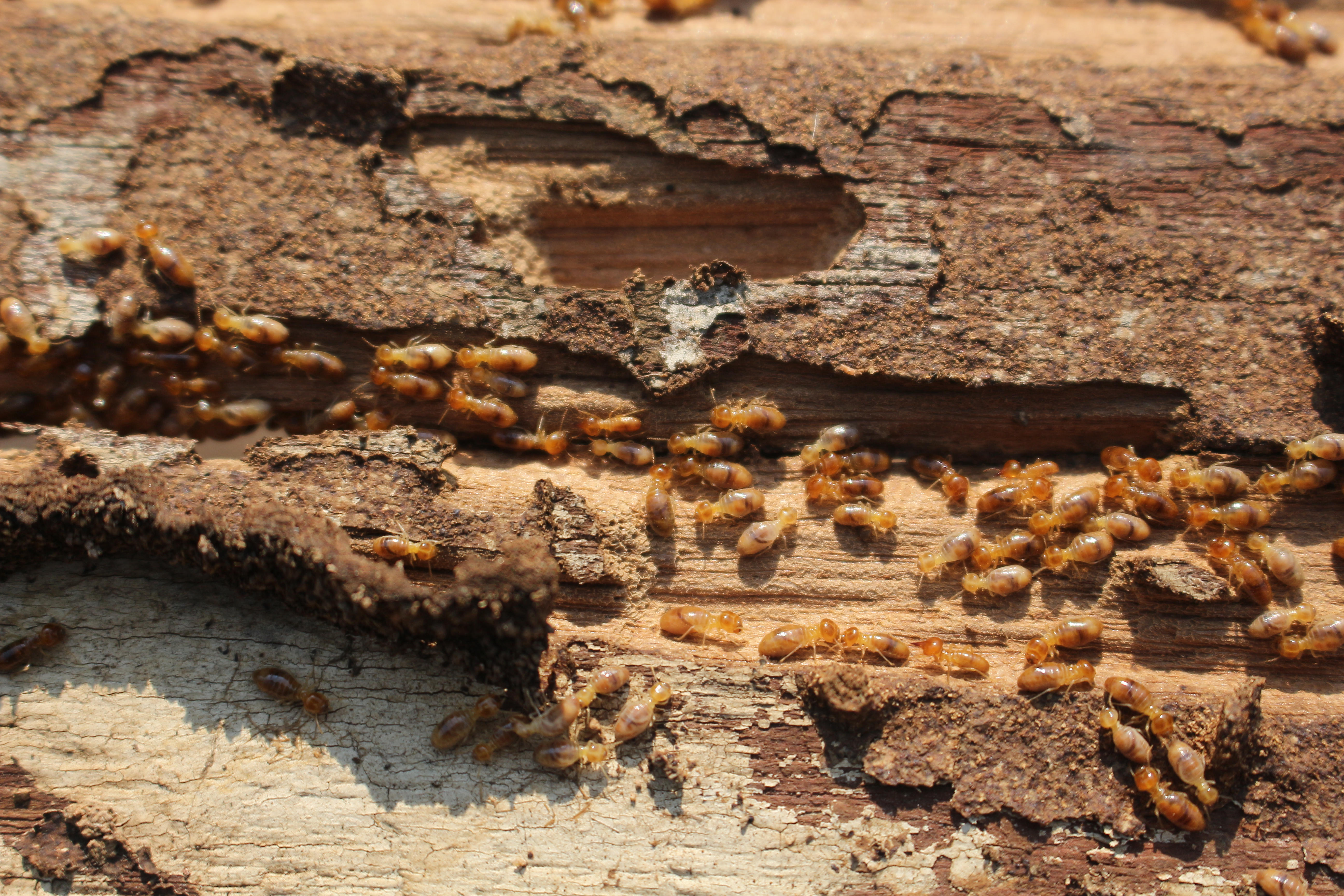
Drywood termites are a silent enemy. They settle inside beams, furniture, or frames without leaving a visible trace for months—even years—until the first signs appear: small piles of dust or pellets that reveal an advanced infestation. By then, the structural damage can already be significant and costly to repair.
A team of researchers from the University of California, Riverside is exploring an innovative alternative to address this problem: harnessing the natural scent of pine to attract termites toward areas treated with insecticide, thereby increasing the effectiveness of control.
A "trick" based on smell
The key lies in compounds called alpha-pinene and beta-pinene, present in many conifers and responsible for the characteristic forest aroma. For termites, this smell is not just pleasant: it functions as a signal associated with food.
In laboratory tests, scientists observed that by incorporating these compounds into treated wood, more termites moved toward the areas with insecticide. The result was clear: mortality increased from around 70% with insecticide alone to over 95% when combined with pinene.
A difficult challenge to detect
The study focused on the species Incisitermes minor, known for its ability to live entirely inside wood, without contact with the ground. This makes it a particularly complex pest, as its colonies can remain hidden in internal galleries without obvious external signs.
In their natural environment, these termites play an important ecological role by decomposing dead wood. However, in urban environments, they do not distinguish between a fallen log and a residential structure.
Fumigation: effective, but with costs
Until now, one of the most common solutions for severe infestations has been structural fumigation with sulfuryl fluoride. While effective, it requires completely vacating the home and sealing it during the process.
Furthermore, recent studies warn that this gas has a long atmospheric lifetime and a high global warming potential, which has raised environmental concerns. Added to this is the fact that it leaves no residual protection, so reinfestations are possible.
More precision, less impact
The new strategy aims to improve localized techniques, such as the "drill and inject" method, where the biggest challenge is reaching exactly the area where the colony is concentrated.
By using pinene as an attractant, the researchers managed to get more termites to move toward the treated points, increasing effectiveness without needing to treat the entire structure. This opens the door to reducing large-scale chemical use.
Of course, the insecticide used—such as fipronil—also requires caution, as it can affect other organisms if not handled properly. In this case, its application inside the wood helps limit environmental impact.
A ready-for-home solution?
For now, this technique remains in an experimental phase and requires validation under real-world conditions. Additionally, its effectiveness could vary depending on the termite species or the type of infestation.
Even so, the approach marks a clear trend: understanding pest behavior can be as important as the product used to control them.
For those facing this problem, the recommendation remains to act early. The appearance of sawdust-like residue, detached wings, or localized wood damage are warning signs. Consulting with specialists and evaluating different alternatives—from localized treatments to fumigation—remains key.
What changes now is the perspective: the future of termite control may not lie in using more chemicals, but in using them better.





Comments (0)
No comments yet. Be the first to comment!
Leave a comment