

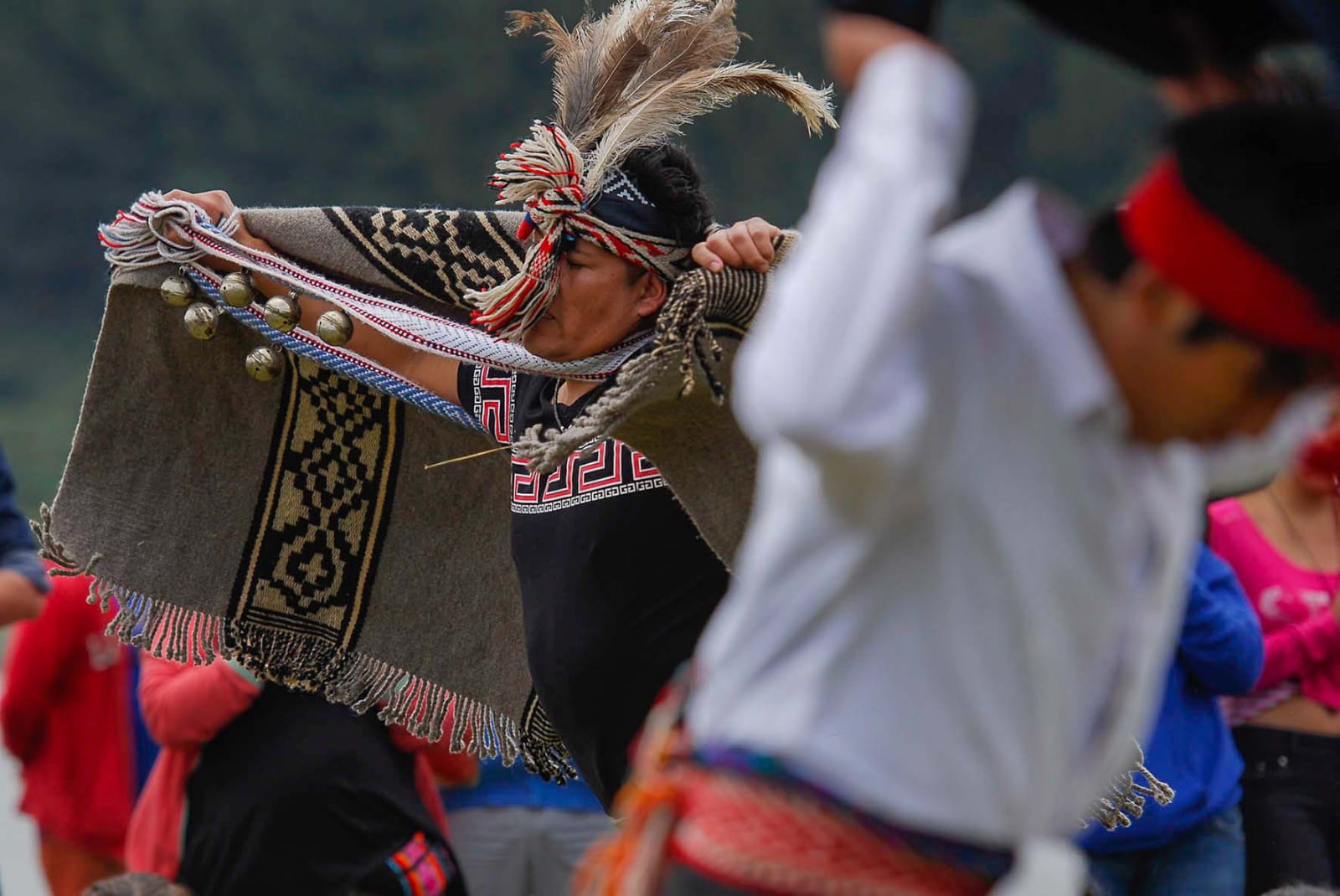
Desiderio Millanao Antilef was born in a community in Loncoche, in the La Araucanía Region, a Mapuche territory in southern Chile. He is a forestry engineer from the Austral University of Chile and complemented his training with studies in education. He is currently a doctoral candidate in sustainability at the University of Córdoba, Spain.
During the early stages of his life — both as a student and at the beginning of his professional career — he did not show an explicit interest in researching the indigenous world from an academic perspective. However, there was an implicit element that marked his experience: his upbringing and education in the codes of Mapuche culture. Even so, he recalls that at that time “I was just another student, focused on getting good grades and advancing in my career, but I was not particularly involved in indigenous issues.”
That interest arose later, when he entered the educational field. For eleven years, he worked as a teacher in the commune of Los Álamos, where he also took on responsibilities in pedagogical management. In this context, he began to observe differences in the ways of learning and relating between Mapuche students and those from other cultural backgrounds.
Based on these experiences, he began to compile observations and reflections on the social and cultural particularities of the Mapuche world. This process deepened when he pursued a master’s degree in education at the University of Concepción. “That’s when I started to have analytical tools. Academia allowed me to look with different eyes at things I had only perceived before but didn’t know how to explain,” he states.
Academic training
His time in the doctoral program in Spain deepened this line of reflection. At the Higher Technical School of Forestry Engineering at the University of Córdoba, he began research focused on Mapuche knowledge, questioning the way it is often defined as “traditional knowledge.”
One of the central concepts of his essay is the Mapuche cultural ethos, understood as the set of values, ways of thinking, and behavioral patterns that are transmitted and recreated over time. From this perspective, Millanao argues that reducing Mapuche knowledge to the category of “traditional” can be problematic, as it tends to place it as something static or exclusively linked to the past.
“Whenever Mapuche knowledge is discussed, it is labeled as traditional. But that knowledge was once modern too. The Mapuche do not live anchored in the past; knowledge is constantly updated,” he explains.
Cultural ethos
The cultural ethos acts as an invisible structure that guides decisions, social relationships, and ways of learning. “It is something that is not seen, but it explains what we see,” he states. In this sense, he recalls an idea expressed by Antoine de Saint-Exupéry in The Little Prince: “What is essential is invisible to the eye.” The true value of things is not always evident at first glance.
To illustrate this, Millanao uses everyday examples: two people can react differently to the same situation because they were raised in different cultural contexts. In the Mapuche case, this ethos has been shaped over thousands of years and continues to influence how communities approach life and, therefore, how they tackle productive projects, relate to institutions, and participate in development processes.
From this perspective, many public policies encounter difficulties in Mapuche territories because they are often designed without considering this cultural dimension that guides decision-making, learning, and collective action.
Territorial development
Millanao argues that there is a mismatch between how institutions design productive projects and how Mapuche communities construct knowledge, legitimacy, and collective decision-making processes. According to him, many interventions fail not due to a lack of resources or technical capacity, but because the processes are often conceived within external institutional frameworks that do not engage with the Mapuche world’s own forms of organization.
One of the main problems is that projects are designed outside the territory and then presented to communities as already defined proposals. “Often the state arrives with a project that is already finished. But the Mapuche want to be protagonists in the process. If they do not participate from the beginning, the initiative is hardly sustainable over time,” he states.
Another key aspect is how knowledge is built. While institutional models are often based on technical transfer from external experts, in Mapuche contexts learning develops through processes of shared experience, conversation, and collective validation. In this context, technical transfer can be a valuable input to enrich the process, as long as it is integrated dialogically with local knowledge.
Millanao recounts that in work with forest communities, he observed how trust and progressive participation generate different dynamics. “At first there was mistrust. But when dialogue is generated and people begin to feel part of the process, capacities that previously seemed hidden emerge,” he comments.
For the researcher, integrating the cultural ethos into public policies does not necessarily mean modifying laws or regulatory frameworks, but rather rethinking how programs are designed and implemented. “Many transformations can be made within the current legal framework. The challenge is methodological: changing the way processes are designed and supported,” he states.
Projections
He is currently continuing to develop his essay, which is part of a dossier built from observations accumulated over years of work and research. His aspiration is that these contents may in the future be projected as a university course dedicated to exploring the encounter between academic knowledge, productive development, and Mapuche culture.
“What matters is not just the academic degree,” he concludes. “What matters is having found tools to better understand my own origins and, from there, contribute to a broader conversation about how we coexist as a society.” In this sense, he raises the need to weigh these perspectives and open spaces for dialogue that make visible the contribution that the Mapuche people can make in building a truly intercultural coexistence.
At Acoforag, we value his contribution, as it opens a space for reflection on the relationship between forestry development and Mapuche communities. Likewise, we highlight the importance of understanding the cultural dynamics of the territories to promote sustainable productive initiatives and build long-term relationships of trust.
The report in theAcoforag Magazine


Comments (0)
No comments yet. Be the first to comment!
Leave a comment