

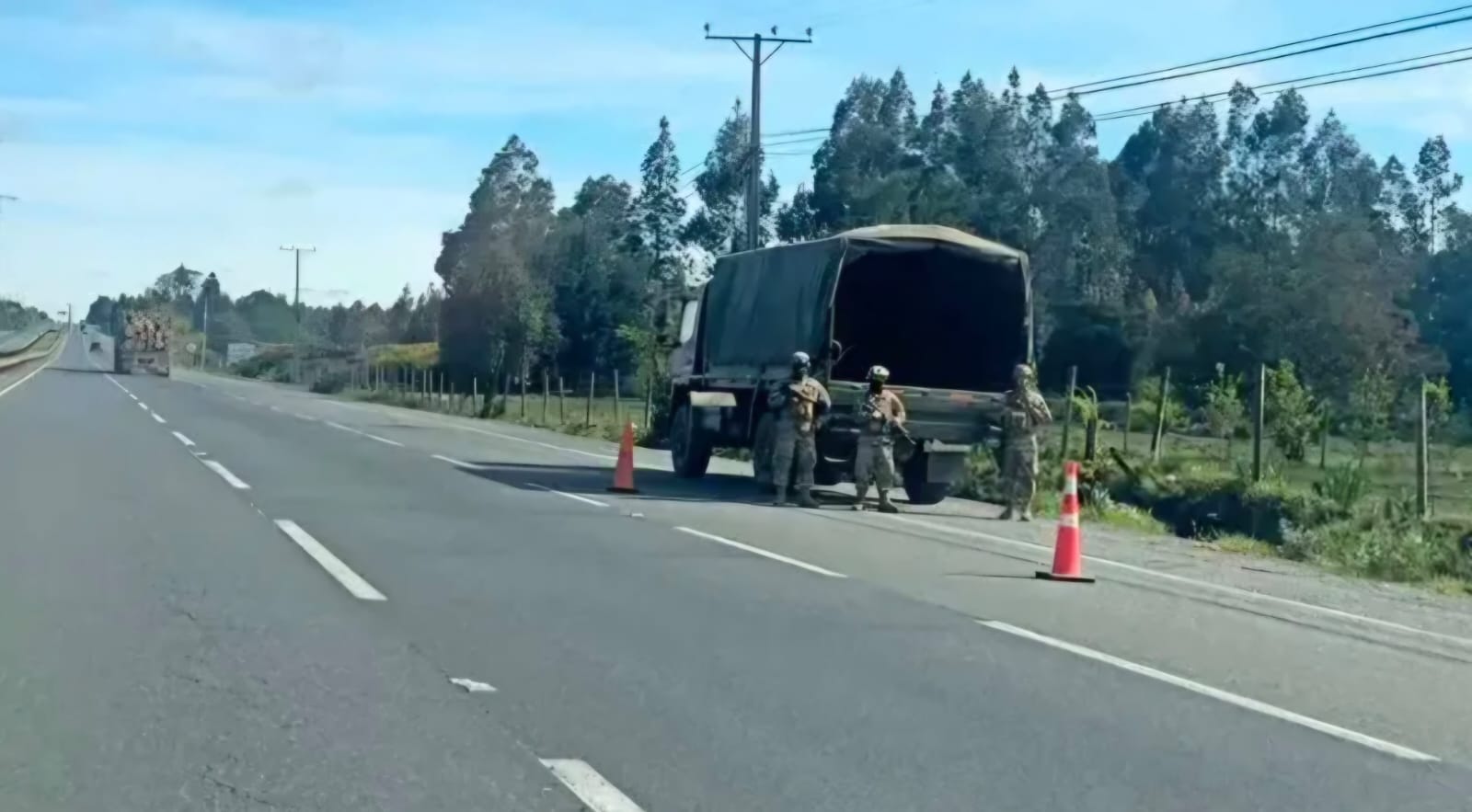
The four years of uninterrupted application of the state of emergency in the 32 communes of La Araucanía and in 21 of Biobío, which will be completed on May 17, occur in a context where the government opened, at the end of March, a debate on a potential de-escalation of the measure and where, in parallel, five attacks have occurred in the last two months. This, added to the fact that victims and unions affected by the violence consider that conditions are not in place to withdraw the Armed Forces until the groups committing the attacks are neutralized.
The forestry contractors' union has recorded 526 attacks between 2014 and 2026. The latest attack occurred on May 7 and affected a forestry operation in the town of Curaco, in Collipulli, north of La Araucanía. When evaluating the four years of the state of emergency, the manager of the association that represents them, René Muñoz, considers that "what we have today must be maintained (...) Carabineros acting alone, and the PDI providing support, are not enough."
He adds that "the fact that the state of emergency has been maintained for four years and violence has decreased, because objectively the figures confirm it, is proof that this measure is necessary and that Carabineros requires accompaniment from the Armed Forces to combat violence."
The contractors' representative states that the exceptional tool requires as complements "the approval of the projects on the Rules for the Use of Force (RUF) and Infrastructure, and continued support with technology and resources for the police, the Armed Forces, and also the prosecutors' offices."
José Miguel Stegmeier, vice president of the National Agriculture Society (SNA) and new leader of the Southern Agricultural Consortium (CAS), states that "the state of emergency has been positive, because it has allowed us to have peace in some areas, although in others, not so much," and emphasizes that, "therefore, it caught our attention when de-escalation was mentioned, although now it is recognized that it was premature to say it." He states that in its application, "it is still necessary to improve some logistical and infrastructure aspects for the Armed Forces."
"Carabineros and the PDI are not enough"
"State failure"
For researcher Gustavo Campos, from the Center for Democracy and Public Opinion at the U. Central, "here we see that an exceptional measure has tended to become normalized over four years, which is a sign of the State's failure in a fundamental role, such as safeguarding order and security in its territory."
According to the academic, "this is a problem that has transcended governments and shows that the public apparatus lacks the capacity to fulfill its most essential role in a significant part of the country."
Asked whether applying the constitutional provision has allowed the State to compensate for its failure regarding security in the southern macrozone, Campos says that "the ultimate purpose of the state of emergency, in terms of management, is the increase in resources, with the deployment not only of Carabineros, but also of the Armed Forces to preserve security."
He states that "if with these resources order and security can be stabilized, the most logical conclusion, in terms of public policy, is that resources must be increased in the southern macrozone."
In the same vein, Campos considers that "today we have a new normal, which requires the deployment of greater force capabilities for order and security, which is also a challenge that could imply a similar demand from different regions with security issues."
Source:El Mercurio





Comments (0)
No comments yet. Be the first to comment!
Leave a comment