

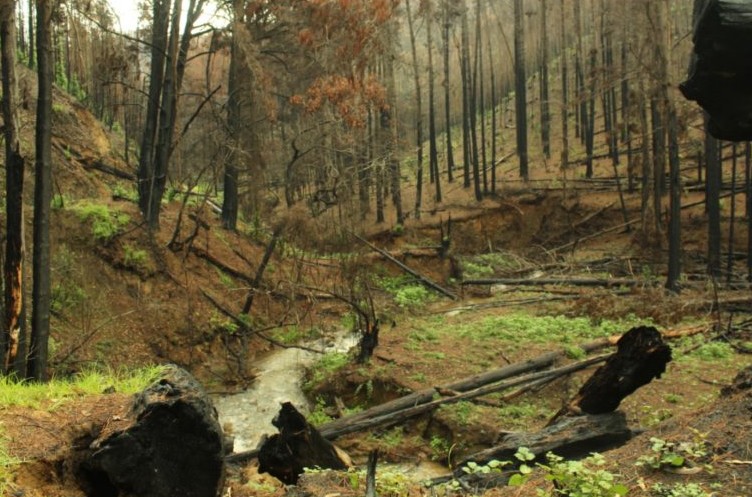
For the inhabitants of Biobío, the night of January 17, 2026, is etched in collective memory as the beginning of a series of wildfires that devastated much of the regional territory's coast.
Today, almost four months after the fires in Penco, the few trees that remained standing in various sectors continue to show regrowth, generating observations, analysis, and also emotions surrounding the regreening of a territory deeply affected by the fire.
This is what self-taught photographer "Tere" observes, who leads guided walks in spaces where nature takes its course. She is the environmental education coordinator at the ReVerdes Foundation and, almost a year ago, promoted the creation of a women's club dedicated to exploring and documenting the biodiversity of Biobío: Bichas del Biobío.
The Tumbes Peninsula, Talcahuano, and Tumbes Park are some of the places they have recently visited. Now it was Penco's turn, specifically in the Parque para Penco sector, where, according to her, they conducted a series of field visits to measure the area's abundance after the disturbance caused by the fires.
"I find it extremely harsh to see the wound left by the fire, such high human ego to realize the latent extractivism existing in every region throughout the country," says Tere, reflecting a critical view of what happened.
And the hopelessness following the wildfires, especially during the reconstruction process, became a daily feeling for many people. "I wonder how the people of that territory manage not to lose hope of re-rooting their hearts and sustaining themselves through adversity," Tere stated.
"And I thought that the best example of resilience is seeing how the native vegetation sprouts despite humans repeatedly wanting to see it as charcoal," she expressed, later adding, "if nature can recover on its own, why should we lose hope."
This was not the first time Tere visited the Parque para Penco sector, close to the area where initiatives related to Rare Earths are planned for installation in the Penco commune.
"A couple of weeks before the fires in the area, we visited the queules with Bichas del Biobío, where we could contemplate the vibrant green of the native forest," she recalled. She also mentions the flowing water, the paths surrounded by trees, and "the micro-world beings that inhabited it," elements that remain alive in the group's memory.
The regreening of naranjillos, queules, and other native species, along with the photographs taken by Tere, leave a sense of hope for the biodiversity of a territory battered by fire. The water continues to flow, and at the beginning of autumn in Biobío, what was once a postcard dominated by orange and yellow tones is beginning to turn green again.
This process would be driven mainly by soil regeneration, along with the appearance of shoots over a meter long and the presence of fungi, considered by experts as positive bioindicators for ecological recovery.
However, Tere views her photographs from a different perspective. "My way of photographing is not based on it being a good record for the viewer, nor on them being perfect or striking to the human eye; quite the opposite, I base it on the harmony of the landscape where I can activate my senses and be nature recording memories."
The process of observing a devastated territory that slowly begins to rise can generate a strong emotional impact. Through photography, however, it is also possible to gauge how Penco's biodiversity is trying to recover after one of the most impactful fires of modern times in the national territory.
Source:Diario Concepción



Comments (0)
No comments yet. Be the first to comment!
Leave a comment