

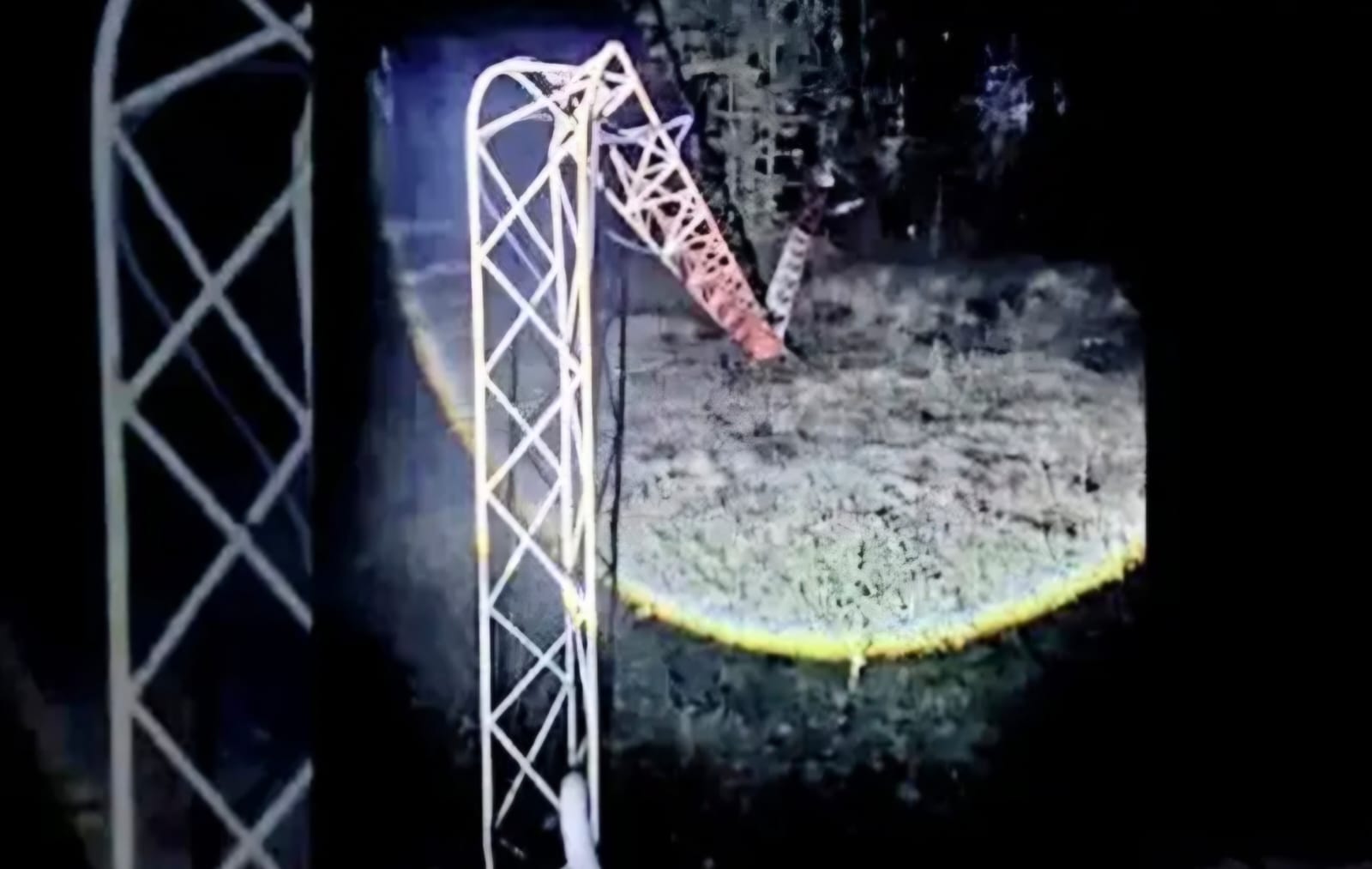
Three attacks against public infrastructure, which caused partial damage or lesser effects than those sought by the perpetrators, were carried out during April in the southern macrozone, according to the “Violence Report” prepared monthly by the Multigremial de La Araucanía.
The study details that the incidents affected a high-voltage tower (April 9) at the San Elías farm, in the commune of Victoria (La Araucanía); a convoy carrying timber (April 22) traveling through the Bannen sector, in the commune of Lota (Biobío); and a telecommunications antenna at Tolhuaca National Park (April 30), in Curacautín (La Araucanía).
According to the document, “the shift of violent actions towards public infrastructure modifies the scale of territorial impact and poses new challenges for the State's response, both in the legal and judicial spheres.”
Among other conclusions, it also states that “April marks this qualitative change in violence, since, in addition to armed attacks and arson attacks, actions against public infrastructure and strategic assets appear, which revives the debate on the need to protect critical infrastructure.”
It also describes that the scope of violent events “has expanded from attacks concentrated on productive industries with local impact to actions with a broad territorial effect that strike infrastructure, connectivity, and strategic services.”
By way of example, it mentions that had it not been for the partial detonation of an explosive device (against a high-voltage tower in the province of Malleco), the effect could have been massive, interrupting the electricity supply between the regions “of Biobío and Los Lagos.”
Attacks in April, from 2021 to 2026
When comparing the most high-profile violent acts perpetrated during each April from 2021 to 2026 in the southern macrozone, the study reflects a downward trend in these episodes, due to the effect of the constitutional state of exception for emergency zones, which today marks four years of uninterrupted application in the 32 communes of La Araucanía and in 21 of Biobío.
The only increase was recorded in 2022, with 56 reports of arson attacks and attacks by armed groups, compared to 33 in the previous year. Subsequently, the figures were as follows: 2023, 25; 2024, eight; 2025, four; and 2026, two.
“Refining the state of exception”
Patricio Santibáñez, head of the Multigremial de La Araucanía, states that in the face of the advance of violence towards public infrastructure, a declaration from the Government is pending “aimed at eradicating terrorism, in all its variants.” He emphasizes that this involves “refining the state of exception” and including among the State's instruments of action “a law on public infrastructure, so that the Armed Forces can contribute to a greater extent to the dismantling of these groups.”
In this regard, the representative of the productive sectors of the area notes that “today the military cannot carry out vehicle checks, even if these vehicles may arouse suspicion, which would help to detain people involved in crimes.”
Santibáñez maintains that “another element that must be improved is the action taken immediately when an attack occurs; for example, carrying out sector closures that allow arrests to be made, as happened when five members of the Coordinadora Arauco Malleco (CAM) were caught in flagrante delicto, including a son of Héctor Llaitul, who are now in an oral trial.”
Antonio Soto, president of the Chilean Wood Corporation (Corma) in La Araucanía, Los Ríos, and Los Lagos, states that the risk of attacks against public infrastructure and critical facilities “is always latent” and the episodes reported during April “confirm this.” He emphasizes that “we have been saying this not only as the forestry sector, but also farmers and all trade associations.”
He warns that in terms of security, “these last few weeks in the southern macrozone have been disastrous” and advocates for “greater intelligence work and more direct work with the National Defense Headquarters in the area.”
Soto emphasizes that “as long as full security is not guaranteed so that we can carry out our forestry operations, there will be no new investments.”
Source:El Mercurio



Comments (0)
No comments yet. Be the first to comment!
Leave a comment