

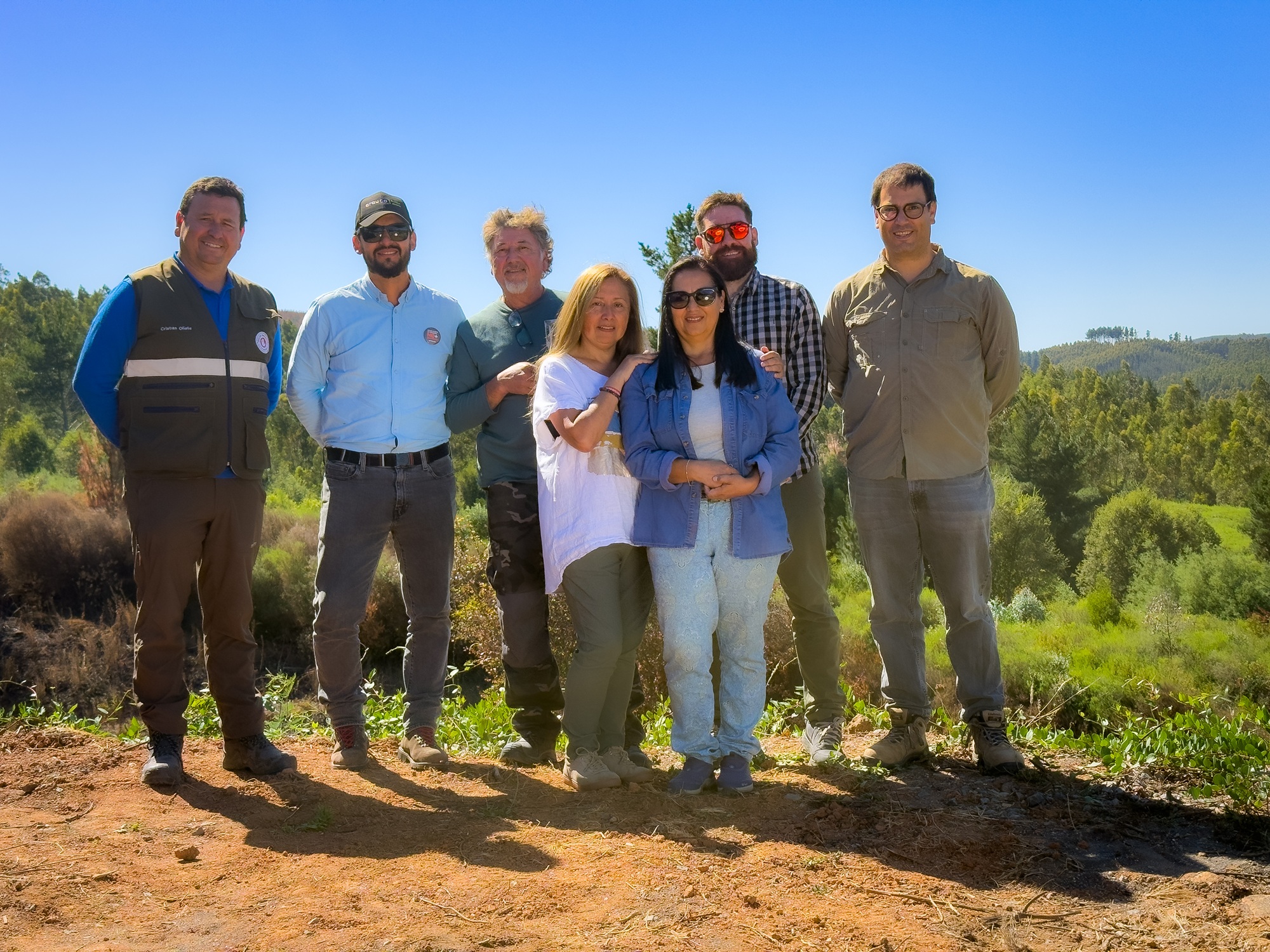
Following the summer emergency in Biobío, recovery in Penco and Concepción has focused on restoring basic services, stabilizing soils before winter, protecting native species, and strengthening community capacities that, in a crisis, can make a difference.
In this scenario, various actions driven by ARAUCO, together with authorities, communities, and organizations in the territory, combine prevention, restoration, and long-term solutions.
Preparing for winter
In Penco, the challenge has been to prevent winter rains from opening a second emergency on the traces of the fire. After the wildfires, slopes and ravines were left without vegetation cover, which favors erosion and sediment runoff.
On the Dichoco property, adjacent to urbanized areas, this risk is addressed with preventive measures carried out by ARAUCO in coordination with the municipality. “We do this surgically: we choose very critical spots before winter arrives,” explained Guillermo Olmedo.
The actions include dikes and containment structures to reduce runoff speed and retain sediments, as well as hydroseeding in more exposed sectors. The mayor of Penco, Rodrigo Vera, valued the approach: “Any mitigation measure in the short term, thinking about winter, will always be well received.”
In parallel, at the Parque Para Penco, there are plans to expand the natural corridor through restoration with native forest. For Vera, this space should be consolidated as “a green lung for the commune.”
Olmedo emphasized that the goal is twofold: to conserve species such as the queule and pitao, along with the local ecosystem, and to consolidate a space for recreation, education, and sports for the communities of Penco and Lirquén. The strategy includes restoration, infrastructure recovery, and work with local organizations, so that environmental recovery also translates into protection for people.
Securing the essentials
Another front is located in El Pino, alongside the route between Concepción and Cabrero, where the focus is on the Rural Sanitary Service (SSR) El Pino 3. The initiative aims to restore infrastructure damaged by the wildfire and ensure a more stable water supply.
The work is coordinated based on a survey by the Directorate of Hydraulic Works, which identified affected systems. With that foundation, a working group was formed, led by the DOH and including the Ministry of the Interior, the Regional Government, the community, and ARAUCO.
The goal has been not only to respond during the emergency but also to advance a replacement with a long-term perspective. According to what was addressed, the work involves two phases: securing the supply after the emergency and, in parallel, replacing the system for a stable solution.
At the community level, Margarita Castro, president of SSR El Pino 3, summarized the urgency: “The main thing for a family is a roof and water.”
A prepared community
In Las Mercedes, a sector near Route 146, the wildfire advanced toward homes but found a better-prepared community. Several neighbors knew what to do: secure water, wet the perimeter, coordinate, and stay calm.
The difference was not chance, but years of work reinforced by the Community Prevention Network, ARAUCO, and the Desafío Agua program. “Today we are no longer alone,” noted Liliana Valenzuela.
That learning was consolidated through operational meetings, identification of critical points, contact lists, and drills. Through Desafío Agua, several families implemented storage systems that proved key. “I was able to water part of the area around my house,” explained Bernarda Muñoz. Ricardo Almonacid added: “Thanks to the water and training, we were able to defend our sector.” Liliana added another key point: “Staying calm, and that is learned.”
Added to this was prioritized infrastructure, such as the widening of the road, which facilitated access for emergency vehicles and acted as a barrier. Thus, the community faced an emergency similar to previous years, but with better tools.
Comprehensive response
The cases of Las Mercedes, Penco, and El Pino show that post-wildfire recovery requires acting on several fronts at once. Preparing communities, stabilizing soils, restoring ecosystems, reactivating social spaces, and replacing water infrastructure are not separate tasks, but part of the same response.
The report in Revista Acofotag



Comments (0)
No comments yet. Be the first to comment!
Leave a comment