

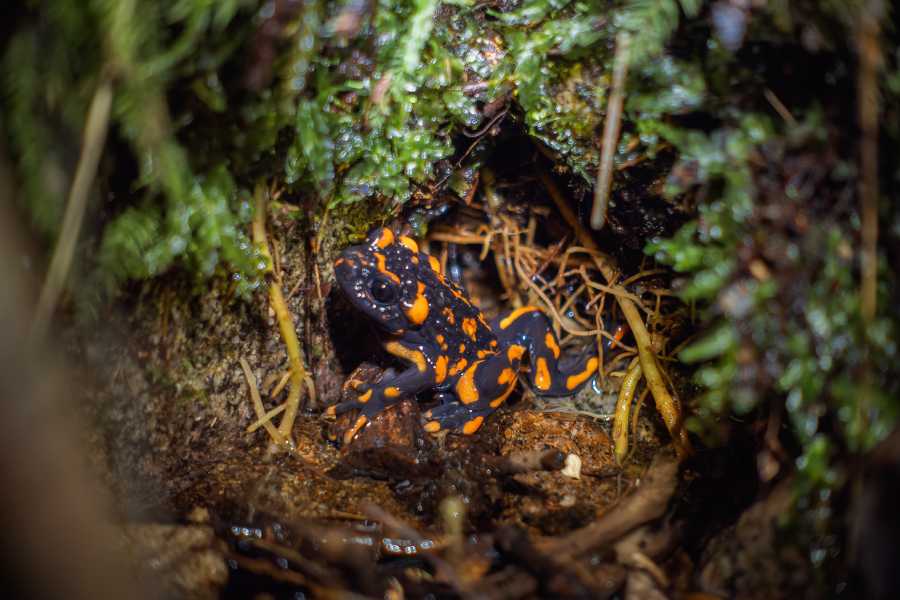
The Beautiful frog (Telmatobufo venustus) is a type of amphibian that inhabits the mountain range of south-central Chile, and its sightings have been located on the slopes of the Andes mountain range, between the Maule and Biobío regions.
In Ñuble, members of the NGO Dosel recently recorded a new finding of the species in the El Caracol sector of San Fabián de Alico, one of the monitoring points of the organization dedicated to recording native fauna by installing camera traps, a task complementary to the work carried out by the National Forestry Corporation (Conaf).
Pablo Espinoza Carbullanca, a member of Dosel and a veterinarian, commented that there are few official records of the Beautiful frog, so its populations are estimated to be small; for this reason, it is in danger of extinction.
“There are very few records in Chile of the beautiful little frog, more like publications in academic articles and scientific journals. There are some records in Altos del Lircay (Maule). There is a record that we also made in 2020, crossing the Ñuble River in the Coihueco commune. This finding that we have just recorded in San Fabián, crossing the �uble River. There are few records in Ralco (Biobío) and not many more. It is very rarely seen, the species is categorized as in danger of extinction,” he commented.
According to scientific literature, this amphibian inhabits areas where there are mountain streams and forests. Its presence has been detected under logs and stones near the banks of watercourses or within them, exposure sites that the professional confirmed.
“Its habitat is mainly associated with swift streams in the mountain range. It is a medium-sized individual, about the size of a walnut with its shell. It measures between 65 to 70 millimeters, that is, 6.5 to 7 centimeters. It's not that big either. On its main layer, it has a blackish-violet color, a very strange, very beautiful color. It also has yellow, orange, and reddish spots. They are like patterns it has on the back of its body,” he detailed.
In females, the maximum snout-vent length reaches 69.2 mm, while in males it is 65.1 mm.
Its behavior is stealthy and it mainly moves under the stillness of the night. Its diet is mainly based, like any amphibian, on insects.
“It moves super slowly, very slowly, very calmly, and is mainly nocturnal. (…) It mainly eats invertebrate insects from the stream water. But they also have an amphibious life, of water and land. They can also eat some terrestrial insects,” he said.
Enemies
The beautiful frog has faced a high risk of disappearing in the central zone due to various environmental threats.
“Since there are so few individuals and the populations are so small, because we find one individual, they are super susceptible to all these threats. So they are in constant danger. We mainly talk about habitat loss and habitat fragmentation. I mean, for example, the change in land use of native forest, displaced by forestry companies or directly by large-scale clearing. People who go to build a house in the mountain range, also due to mega-fires, giant fires that devastate mountain range sectors. They will naturally affect these individuals that are in the small mountain streams,” the veterinarian explained.
Furthermore, the physical integrity of the species is at risk due to the “alteration of aquatic ecosystems, that is, when people divert water or it becomes contaminated, for example, by using detergent in the water or anything that contaminates the entire watercourse.”
Introduced trout have seriously altered the natural dynamics of this amphibian, as these invasive species are predators of both the larvae and their food.
“Predation of larvae by rainbow trout, which is an invasive species introduced to the territory, is also recorded. So often the trout prey on the larvae. In the end, if we talk about climate change, we talk about long periods of drought. Many mountain streams tend to dry up. Streams that used to run all year round now tend to dry up. That can also be affected by climate change,” he added.
Protection strategies
For this reason, the NGO Dosel emphasized that this sighting strengthens the proposal to create new protected wilderness areas and move towards the creation of a National Park in Ñuble, capable of safeguarding the unique biodiversity of the regional mountain range.
“This finding helps a lot to propose and continue pursuing the idea of a National Park for Ñuble. We are talking about a species that is in danger of extinction. The presence of this individual shows that the mountain streams are screaming, crying out for conservation. I mean, this same stream we have here is the same one that sustains the huemul, the pudú, and the monito del monte. There is a group of species, a network of animals that are in this place. They show us that they can still be there, because we found a species that is very rare to see and is already in danger of extinction. So, we must push for the need for more protected areas for Ñuble, a national park for Ñuble,” he stated.
The record was made fortuitously by professional Benjamín Valdivia during a night exploration in a stream near El Caracol. The striking thing, they assured from Dosel, is that the area had been explored for years without previously detecting the species, which opens new expectations about the possible existence of more specimens in still unexplored sectors of the Ñuble mountain range.
“The finding is within the framework of the monitoring campaigns we have been carrying out for over seven years on threatened species in the Biosphere Reserve territory, in the mountain range of the Ñuble region. We were a group of three professionals to check camera traps and explore the area. An area near El Caracol, in San Fabián de Alico, on some private properties. We carry out monitoring, we complement a bit the work that Conaf does within the protected wilderness area. So we went to check the camera traps and did a night exploration of the place, and in that, one of the colleagues, Benjamín Valdivia, found it. It's not even that we looked for it, but we were walking in the stream. It's interesting that it's a place that I, at least, have explored for more than three years, and now it appears. So there is much more to look for. It's three years of research where we have to keep searching. Perhaps how many other specimens could appear,” he recounted.
Source:La Discusión





Comments (0)
No comments yet. Be the first to comment!
Leave a comment