

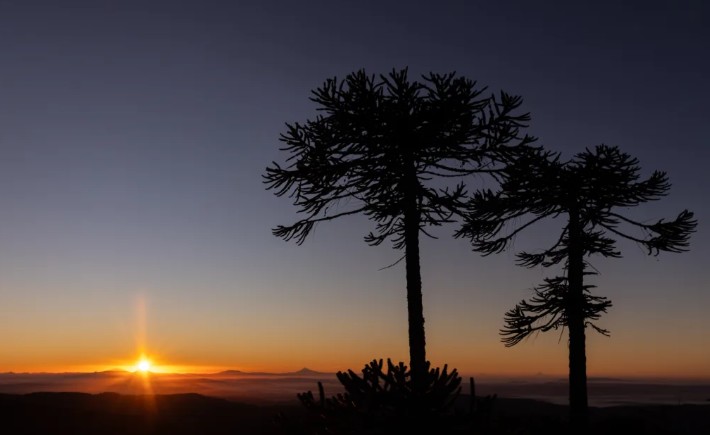
The southernmost population of the pewén or araucaria (Araucaria araucana) in Chile, located in the Villarrica mountain range, has been predicted as a highly vulnerable zone for the species' survival in the future, according to recent studies conducted at the University of Concepción.
The imposing structure of the pewén, with heights that can reach up to 50 meters, contrasts with the current fragility it faces due to threats such as habitat fragmentation, forest fires, deforestation, and exotic plantations.
Added to this is climate change, which tests the adaptive capacity of this emblematic species of southern Chile—and also Argentina—to current and future environmental conditions.
This species, a national monument and sacred tree for the Mapuche people, covers an area of approximately 215,000 hectares—about 1.5% of the native forest—distributed across the coastal and Andean mountain ranges between the Biobío and Los Ríos regions.
Using tools such as species distribution modeling, landscape genomics, and common garden experiments in nurseries, the researchers seek to understand the adaptive potential of this tree in the face of climate change.
The idea is to better understand, from different approaches, the current and future resilience of the araucaria, with the aim of prioritizing conservation actions.
"When we talk about adaptive potential, we refer to the real possibility that a species can face climatic conditions different from the current ones," explains Rodrigo Hasbún Zaror, an academic from the Faculty of Forest Sciences.
The leader of the Plant Epigenetics Laboratory stated that "several species are showing the effects of global change, including very long-lived trees that are beginning to show signs of decline." One of them is the araucaria.
Sometimes the impacts are expressed mildly, and trees "adapt locally" to alterations in their habitat; but there are cases where the damage is so severe that it can cause local extinction.
It's not that the species goes extinct: it disappears in certain places, Hasbún detailed.
The specialist recalled the alarm that occurred 10 years ago with araucaria foliar damage (AFD), a then-unknown pathology, apparently caused by pathogenic fungi, as demonstrated after several years of research.
The disease, which manifested as necrosis and drying of branches and affected up to 85% of the country's trees, had among its causes environmental variables attributable to climate change.
That is why it is important to understand the adaptive capacity of this conifer, considered a "living fossil," due to its origins dating back some 240 million years, when dinosaurs were beginning to populate the Earth.
"In species that can live for hundreds or even thousands of years, the effects of climate change accumulate slowly and can take decades to become evident," he noted.

Future scenarios
In this context, modeling allows anticipating future scenarios, identifying especially vulnerable populations, and guiding conservation measures before the effects become irreversible.
The Villarrica population stands out as one of the areas that will require special attention in the short term, because the isolation situation reduces genetic variability and, with it, its repertoire of responses to changes.
In cases of greater vulnerability, science offers solutions such as gene flow, which involves moving alleles (gene variants) of interest to potentially more vulnerable areas, for example, through seeds that contain the necessary aptitudes to establish themselves in the place and grow under projected environmental conditions.
Another possibility is assisted migration, where individuals from the at-risk population are moved to places with conditions that may be optimal for their growth in the future. There is already an experience of araucarias taken to Aysén, where they do not occur naturally, the academic recounted.
The last alternative is ex situ reproduction (outside its natural habitat), with cultivation in protected conditions such as greenhouses or botanical gardens.
Seed transfer
Within the research, experts developed seed transfer maps, with bands establishing compatibility between "donor" and "receiver" zones that, in general, reduce the risk of using genetic material poorly adapted to the destination site.
In the case of Villarrica, the possibilities of donor zones are restricted or null, partly due to its lack of historical connectivity with other populations, which has reduced the supply of alleles necessary for the future.
And thus, just as there are highly vulnerable zones, there are also areas of high diversity, known as glacial refugia, because they constitute a reservoir of gene variants that allow a population to better adapt to environmental changes or diseases.
The populations of the Nahuelbuta coastal range are in this category, but that does not mean the genetic material it holds is a solution for every event, because coastal araucarias are not the same as Andean ones. In fact, they have notable characteristics that distinguish them.
In common garden experiments in nurseries with seeds taken from araucaria populations of different origins, it was observed that, despite being subjected to the same environmental conditions, the plants expressed their morphological and physiological particularities.
This suggests that this tree has strong local adaptation and, therefore, has limited plasticity to modify its characteristics in response to changes in its environment.
"This helps us confirm that moving seeds and plants from one area to another is not a trivial decision. A population may be adapted to very specific conditions and lose performance if moved to a different environment to which it is not adapted," Hasbún noted.
For decades, many initiatives used seeds as a conservation strategy, mainly considering geographic proximity or availability; but today it is known that this may not be sufficient under climate change scenarios.
"Restoration strategies must incorporate genetic and climatic information. It is not enough to plant trees; we must think about which populations will have the greatest chances of surviving in the future," Hasbún explains.
The academic indicated that this type of study helps project the effects of environmental stress on the araucaria, always with the challenge of continuing to advance knowledge of the species.
At this point, the specialist refers to the situation of araucaria foliar damage, where—in his opinion—a kind of competition arose among institutions to be the first to determine the cause of the problem, and the opportunity to create a permanent infrastructure to study this type of problem was lost.
"The idea is to approach these studies in a multidisciplinary and interinstitutional way, uniting the capacities distributed in different parts of the country behind a single objective," he concluded.




Comments (0)
No comments yet. Be the first to comment!
Leave a comment