

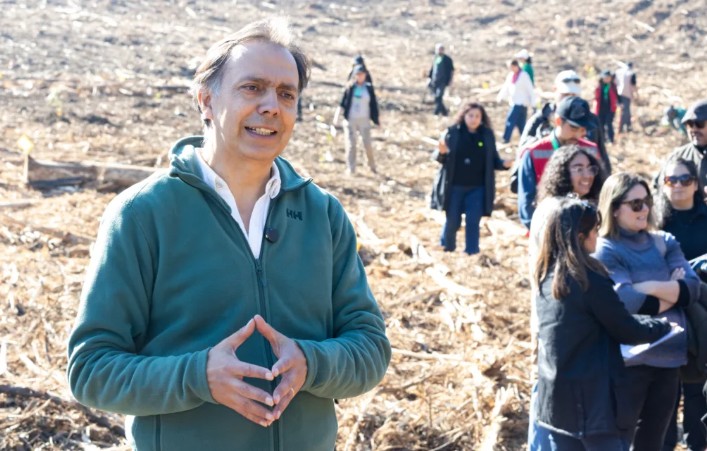
How can scientific evidence be transformed into concrete decisions for territories? This was one of the central questions of the second talk in the "Ideas that move the world" cycle, an initiative promoted by the Graduate Studies Directorate of the University of Concepción as a prelude to the thirteenth edition of the UdeC 2026 Virtual Graduate Fair.
The activity, titled "From crisis to solution: how landscape science transforms territories" (see video), was led by Cristian Echeverría Leal, a professor at the Faculty of Forest Sciences and one of the most relevant Latin American voices in ecological restoration, landscape ecology, and biodiversity conservation.
Ph.D. from the University of Cambridge, director of the Landscape Ecology Laboratory and Campus Naturaleza UdeC, global vice president of the International Association for Landscape Ecology (IALE), and selected by WWF in 2022 among the 20 leaders for nature conservation in Chile, the researcher has developed a broad career connecting science and territorial action.
From the University, he has contributed to positioning Chile on the international agenda, leading widely cited research on land use change, native forest fragmentation, forest fires, and ecosystem services.
Throughout his presentation, the professor of the Master's and Doctorate in Forest Sciences explained how landscape science allows understanding the relationships between biodiversity, ecosystem services, and human well-being, integrating remote sensing tools, geographic information systems, and spatial modeling to address phenomena such as forest fires, ecological degradation, and the climate crisis. "The environmental crisis is not just a sum of ecological problems; it is a crisis of relationships between nature, territory, and society," stated Echeverría.
One of the examples addressed was the transformation of the landscape in the Maule Region, where research from the Landscape Ecology Laboratory evidenced the progressive decline of native forest and the advance of exotic forest plantations over recent decades. Additionally, he presented the consequences these changes have had on threatened species such as the ruil and the pudú, highlighting how fragmentation alters fundamental ecological processes and decreases ecosystem resilience.
The researcher also addressed the impact of forest policies on biodiversity and carbon storage, emphasizing that "planting trees does not always increase total carbon. From a public policy perspective, it is very important to understand that," he stated. Another central point of the talk was the need to build bridges between academia, public institutions, companies, and citizens. In this context, Echeverría argued that academia should contribute not only by generating knowledge but also by bringing it closer to different actors and decision-making spaces.
"It is important to persist, generate more information, and also contribute to environmental education at different levels," he stated, adding during the Q&A session that it is key to "deliver the right message, the translated message, not at a confusing academic level."
The leader of Campus Naturaleza UdeC also addressed the work of the institutional project that recently turned three years old, which seeks to restore 186 hectares adjacent to the Concepción Campus and the Cerro Caracol Metropolitan Park, integrating axes of conservation, ecological restoration, environmental education, and comprehensive health.
Finally, Cristian Echeverría outlined various research opportunities for future graduate generations, linked to geographic Big Data, territorial resilience, ecological restoration, environmental governance, and ecosystem services.
"The challenge is no longer just to describe the crisis, but to train researchers capable of designing solutions for living, functional, and sustainable landscapes," he concluded.
The "Ideas that move the world" cycle is part of the activities prior to the XIII UdeC 2026 Virtual Graduate Fair, which will take place on August 6 and 7.



Comments (0)
No comments yet. Be the first to comment!
Leave a comment