

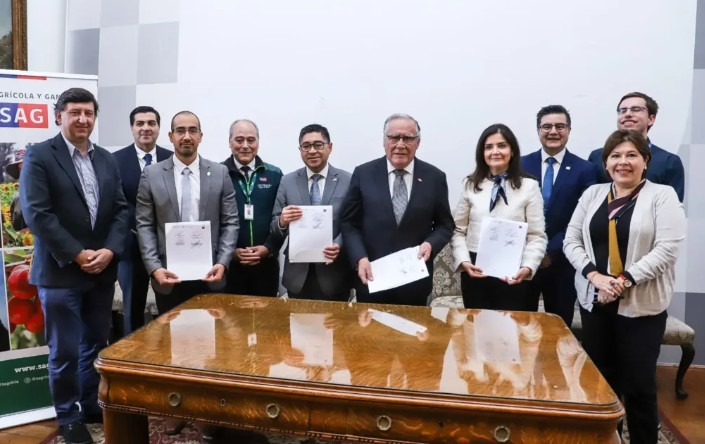
The strengthening of regional capacities to face environmental, productive, and technological challenges was the focus of a meeting led by the Minister of Agriculture, Jaime Campos Quiroga, which brought together universities, public agencies, and representatives of the forestry sector in the Biobío Region.
The Secretary of State, along with the presidential delegate of Biobío, Julio Anativia Zamora, led the signing of a collaboration agreement between the Agricultural and Livestock Service (SAG) and the consortium of universities of Cruch Biobío-Ñuble, which will enable the development of a tool based on Artificial Intelligence aimed at the pre-diagnosis of egg masses of Lymantria dispar.
The initiative is part of the project “Advanced Human Capital in Artificial Intelligence for Biobío” and will allow the implementation of actions that strengthen the protection and management of the forestry and agricultural sector.
The Minister of Agriculture highlighted the “importance of the agreement signed today, since, by uniting all the universities of the Biobío region, they have committed to advancing a diploma in artificial intelligence that aims to incorporate these new technologies, this new knowledge, into something very specific, such as the control of pests and diseases that could eventually be brought by ships arriving in the region, as in practice they can be a vector for the transmission of these.”
As a representative of the University of Concepción, the Director of Postgraduate Studies, Sandra Valenzuela Suazo, detailed that the project ‘Computer vision system for the early detection of quarantine pests on ships arriving at Chilean ports’ seeks to develop and implement a system based on computer vision for the early detection of pests on the decks and superstructure of ships arriving at Chilean ports.
“This has a double implication. On one hand, everything related to safeguarding Chile’s agricultural, forestry, and ecological heritage, with the risk of introducing these exotic pests facilitated by globalization and increased maritime traffic. But, on the other hand, it has to do with everything that the port sector means, where in the Biobío region we are leaders in port movement due to the Talcahuano port. So, it is a project that contributes to that and was valued within this agreement between the four universities,” she explained.
The technological solution will analyze images captured during inspections, facilitating a quick and accurate preliminary identification, which will help reduce response times for maritime agents and support the continuity of their operational processes.
The UdeC director highlighted that academia contributes to the scientific and technological development of the territory through the generation of knowledge and the application of artificial intelligence in strategic areas. She explained that this work is based on three main pillars: strengthening research and innovation; improving processes, indicators, and value generation for public and private institutions through technological solutions with territorial relevance; and transferring knowledge beyond the academic sphere, promoting collaboration between universities, public services, and productive sectors to respond to concrete challenges in the region.
Likewise, the Vice-Rector of the Catholic University of the Most Holy Conception, Ana Narváez Dinamarca, stated that “this agreement starts with this project, which is about pests on ships, but it will extend to other types of projects that we also have in the sector. This is the first step to test a technology at a certain level and then scale it up, to be able to use that information and have good prediction models in the future.”
Finally, the initiative has an allocated budget of $15 million, financed through funds from the Doctorate program in Artificial Intelligence, the first of its kind in the country and developed by universities of the Biobío-Ñuble Consortium of the Council of Rectors.




Comments (0)
No comments yet. Be the first to comment!
Leave a comment