

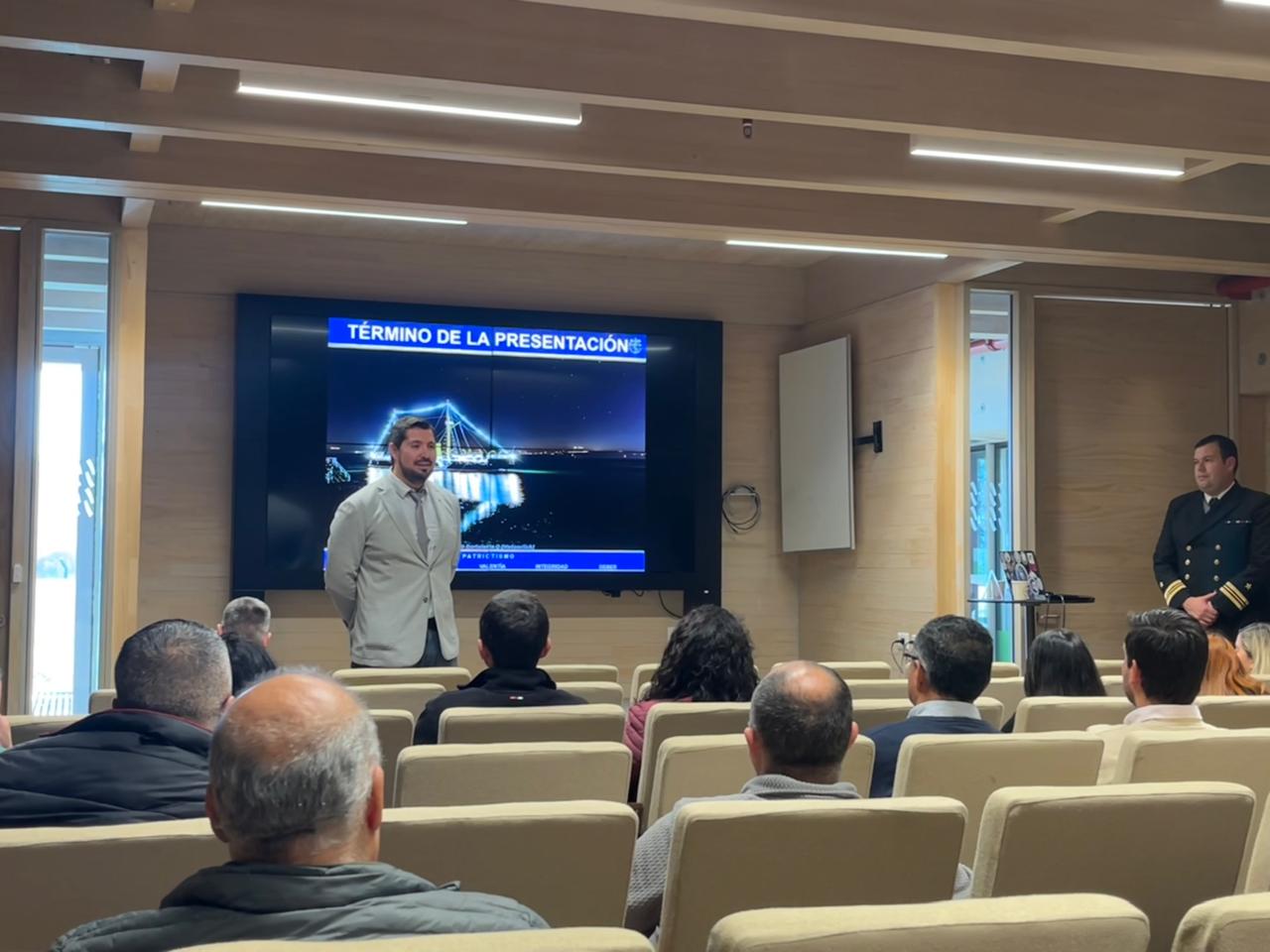
The increasing frequency of extreme weather events has made emergency preparedness a priority for municipalities. With this goal in mind, professionals in charge of Disaster Risk Management from various communes in the Biobío Province participated in a specialized training session held in Los Ángeles, aimed at strengthening their capacities to anticipate and address risk situations associated with climate phenomena.
The activity was organized by Senapred Biobío, the Maritime Meteorological Center of Talcahuano of the Chilean Navy, the General Water Directorate (DGA), and Cmpc, institutions that joined forces to bring technical knowledge and practical tools to those responsible for coordinating the local response to emergencies.
Understanding risks to act in time
During the session, participants covered topics related to basic meteorology, frontal systems, hydrological monitoring, river channel behavior, and risk communication. The objective was to provide knowledge that allows for better interpretation of available information and its transformation into concrete prevention and preparedness actions.
Alejandro Sandoval, regional director of Senapred Biobío, highlighted that strengthening municipal capacities is essential to protect communities from increasingly complex events.
“We aim for communal teams to have tools that allow them to understand hydrometeorological risks and properly use technical information to make timely decisions. Coordination between institutions is key to strengthening risk management in the territories,” he stated.
One of the most valued aspects was the opportunity to analyze real scenarios and learn about tools that facilitate preventive planning, especially in communes exposed to floods, river overflows, and other threats associated with winter.
Collaborative work for more resilient territories
The training also served as a meeting space between public agencies and municipal representatives, promoting the exchange of experiences and the strengthening of collaboration networks.
From the Chilean Navy, Frigate Captain Gonzalo Bertolotto, head of the Zonal Center for Marine Meteorology in Talcahuano, emphasized that technical knowledge helps reduce uncertainty when facing emergencies.
“Providing tools in meteorology and hydrology to those who must make decisions on the ground helps improve preparedness and avoid improvisation in the face of events that can have significant impacts on communities,” he indicated.
This view was shared by Estefanía Saldías, director of Disaster Risk Management for the Municipality of Antuco, who highlighted the practical value of the content covered.
“These instances allow us to better understand meteorological information and strengthen the preventive work we carry out alongside our communities, improving our response capacity to different emergency scenarios,” she stated.
Within the framework of this initiative, Cmpc provided its facilities for the development of the activity, reinforcing its commitment to strengthening local capacities and promoting a preventive culture in the territories where it operates.
Cristóbal Palazuelos, deputy manager of Northern Relations at Cmpc, stated that collaboration between institutions is essential to face the challenges posed by natural phenomena.
“Creating spaces for training and coordination allows municipalities to have better tools to prepare and respond more effectively to emergency situations, directly benefiting communities,” he noted.
The session is part of an ongoing strategy to strengthen disaster risk management, promoting greater coordination among public agencies, technical entities, and private actors to build more prepared and resilient territories in the face of the effects of climate change.



Comments (0)
No comments yet. Be the first to comment!
Leave a comment