

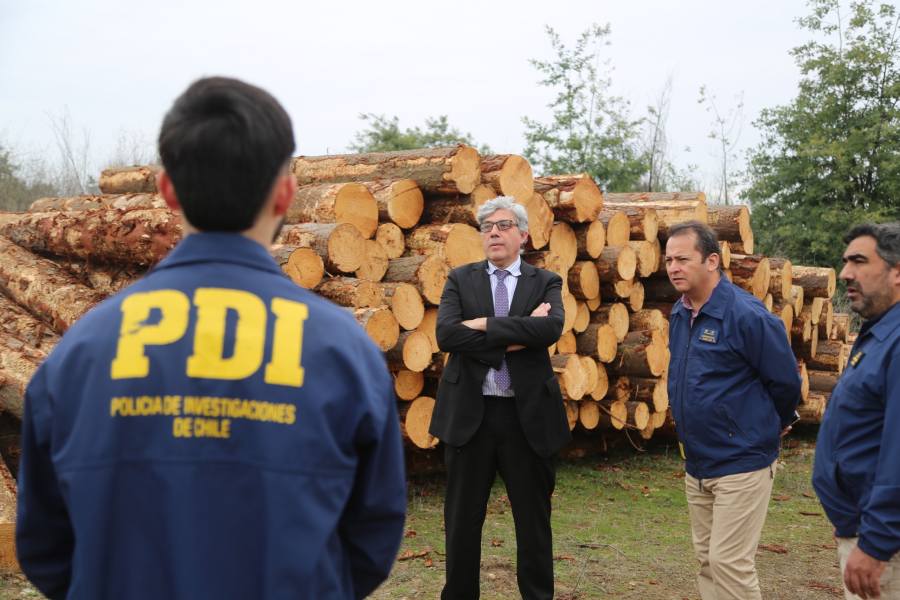
The assets that the Investigative Police attributes to the organization dismantled in the so-called Operation Hormiga could approach $10 billion, according to the latest estimates made by the investigative teams.
One week after the formalization of 17 people accused of being part of a network dedicated to the theft and illegal commercialization of wood stolen from Forestal Arauco properties, in the commune of El Carmen, the asset calculations continue to increase.
While initially the assets allegedly obtained through illicit activities were valued at around $3 billion, updates made by the PDI have already raised that figure to over $5 billion.
However, for the Public Prosecutor's Office and the Investigative Police, the main result of this case lies not only in the arrests or the amount of seized assets, but in an investigative strategy that has been gaining ground in recent years: pursuing criminal organizations through their assets and their sources of financing.
The regional prosecutor of Ñuble, Nayalet Mansilla, explains that "there is a new perspective that, in addition to prosecuting the crimes themselves, we must also prosecute the criminal association behind them and the assets it has obtained as a result of its illicit activity," she said.
Among these resources, the use of systems for extracting and analyzing information contained in cell phones seized during investigations (UFED) stands out, in addition to the exchange of information with the Financial Analysis Unit (UAF), the Commission for the Financial Market (CMF), the Treasury, and other public agencies capable of providing relevant asset and financial information.
For the prosecutor, experience has shown that imprisoning certain members does not always mean the end of an organization. "Members of criminal organizations are fungible. One person is not there and can be replaced by another who does exactly the same job," she explained.
For this reason, the current focus is on dismantling the economic structures that sustain these activities. "If you manage to dismantle the resources they obtain through organized crime, which function as true criminal enterprises, that allows you to put an end to that activity," she added.
The work in La Hormiga
The head of the Bicrim, subprefect Jaime Rubilar, explained that in the dismantled organization there were people in charge of providing strategic information, drivers of high-tonnage vehicles intended for transporting stolen wood, machinery operators in charge of moving the logs, and even a group dedicated to providing security for the organization.
"It also had its security team. That's why we seized weapons," he specified.
For the investigators, this structure confirms that it was an organization that operated under a business logic, with distributed roles and a production chain that began with the illegal extraction of wood and ended with its commercialization in sawmills.
Precisely for this reason, the precautionary measures were not limited to the formalized individuals. The investigation also reached the assets that allowed the illicit business to function.
In addition to the seized wood, the police confiscated nearly 40 vehicles, including trucks, vans, and specialized machinery. Added to this are properties, sawmills, bank accounts, and large quantities of wood already processed and ready for commercialization.
"The important thing in these cases is to dismantle the entire organization. To leave everyone out of participation. Even the sawmill was banned from operating. It will no longer operate," Rubilar explained.
For the officer, preventing those involved from being able to finance new operations again is as relevant as the sentences that may eventually be imposed in court.
"With resources, these gangs can even continue operating from within prisons. Without assets or money, they can't do anything," he concluded.
From the Regional Prosecutor's Office, they maintain that Ñuble is not immune to phenomena observed in other areas of the country.
And precisely for this reason, they consider it essential to intervene early in the economic structures of these organizations before they reach higher levels of development and dangerousness.
Source:La Discusión





Comments (0)
No comments yet. Be the first to comment!
Leave a comment