

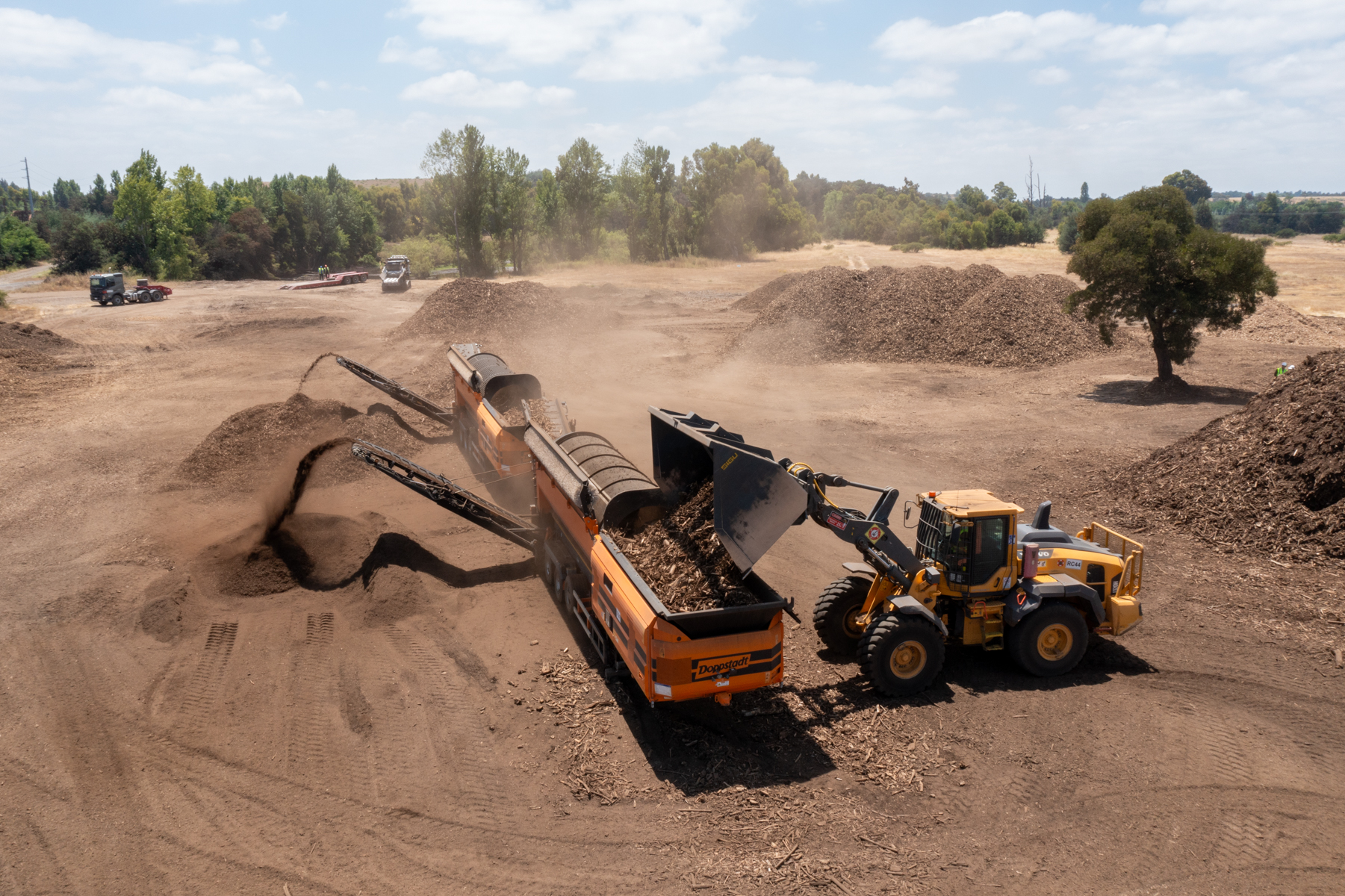
In a forestry operation in the Biobío Region, forest resources that for years remained accumulated in the forest are being recovered and reintroduced into production processes through a refining initiative driven by RC Bioenergía.
What was once considered a low-value resource or a liability associated with forest management can now become an input for various industrial and energy applications.
The model developed by RC Bioenergía seeks to recover fiber contained in degraded biomass or biomass with high levels of inerts through processing and classification technologies that improve its quality, homogeneity, and utilization potential. More than a waste recovery operation, the initiative aims to reintegrate underutilized forest resources into higher-value-added production chains, under increasingly demanding standards.
Capacity Development
The development of this capability has been the result of a long-term vision regarding the evolution of the forestry industry. In recent years, RC Bioenergía has made investments in technologies and processes aimed at the recovery, classification, and valorization of forest resources, incorporating capacities to respond to new development opportunities for the sector.
An important part of this process has involved observing international experiences and learning from companies and specialists leading such developments in more advanced markets. Notable among these is the work carried out alongside John O'Ryan Surveyors, a firm with extensive international experience in the forestry industry, whose expertise has been a relevant contribution to capacity development and understanding the opportunities associated with forest resource valorization. Likewise, it has reinforced the importance of having reliable information and consistent measurements, which are fundamental for identifying value creation opportunities and guiding improvement decisions.
This learning has strengthened the conviction regarding the potential that exists to capture greater value from available forest resources and develop capacities that can accompany the future evolution of the industry.
Beyond Energy Use
Currently, the main application of the refined materials is the production of fuel for industrial energy uses. However, the development of these capabilities also opens opportunities to advance the recovery and valorization of resources that have historically had limited utilization.
“Historically, the fiber used by different industries has come mainly from logs and roundwood destined for pulp or sawn timber production. The possibility of recovering fiber contained in residues and biomass opens a new source of supply and an opportunity to capture greater value from available forest resources,” says Cristóbal Corral, General Manager of RC Bioenergía.
Although these applications are part of a long-term vision, they represent an opportunity to expand the utilization alternatives for available forest resources and generate new development options for the industry.
A New Perspective on Forest Resources
For Cristóbal Corral, initiatives like this reflect an evolution in how the forestry industry understands and utilizes its resources. “For decades, a large part of forest biomass was considered primarily a source of energy or a byproduct of forestry operations. However, today there is a much broader opportunity: understanding these resources as a potential source of raw materials capable of supplying different value chains,” he states.
In his view, one of the main challenges in the coming years will be to move towards more comprehensive utilization models, where each forest resource can be allocated to the use that generates the greatest value.
“The bioeconomy is not just about replacing fossil fuels. It also involves developing new applications, materials, and products from renewable resources, making better use of the capabilities that already exist in our forests,” he stated.
Experiences in countries like Sweden and Finland show how forest resources can be transformed into the basis for new industries associated with biomaterials, bioproducts, and other bio-based solutions.
“Chile has the forest resources, industrial capabilities, and technical knowledge to move in that direction. The challenge is to capture a greater proportion of the value contained in our forest resources and develop new capabilities to transform them into higher-value-added products,” added Corral.
From Environmental Liability to Strategic Resource
The possibility of recovering and valorizing resources that have historically had limited utilization opens an opportunity to expand fiber supply sources and capture greater value from available forest resources.
“What could once be considered an environmental liability can today be transformed into a strategic resource for the forestry industry. The challenge lies in developing the capabilities, knowledge, and partnerships necessary to turn that opportunity into a reality,” stated Cristóbal Corral.
At Acoforag, we value the work developed by RC Bioenergía and highlight that initiatives like this contribute to a better utilization of available forest resources, promoting new opportunities for valorization and development for the Chilean forest bioeconomy. Likewise, they reflect the importance of contractor companies continuing to incorporate new capabilities, technologies, and business models that allow them to actively participate in the challenges and opportunities facing the forestry sector in the coming years.
The report in theAcoforag Magazine


Comments (0)
No comments yet. Be the first to comment!
Leave a comment