

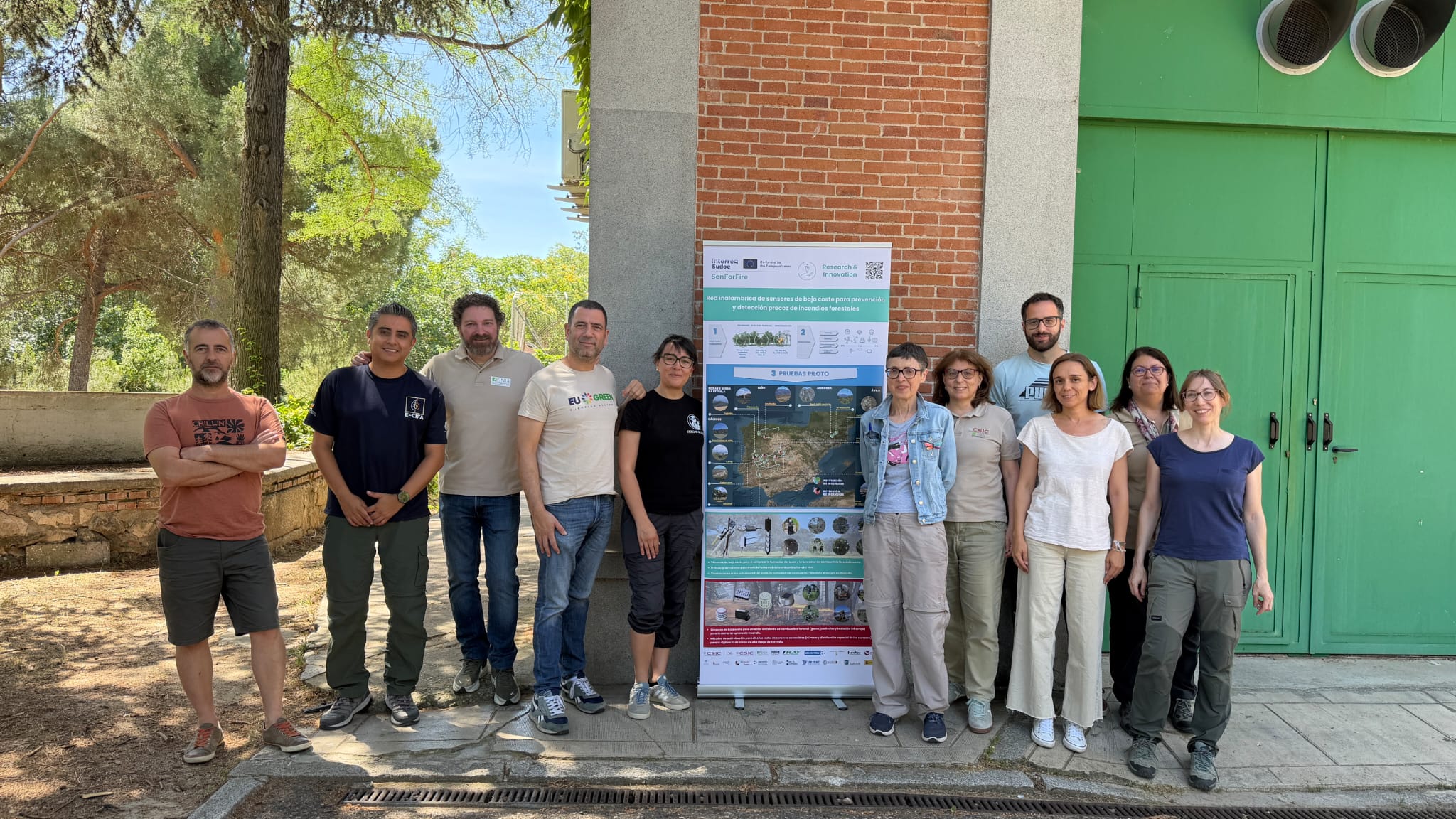
Scientific collaboration between Chile and Europe in the field of wildfire prevention continues to expand its reach with the participation of Dr. Fabián Guerrero, a researcher from the Department of Mechanical Engineering at the Federico Santa María Technical University.
The academic is part of the joint work between the AIRIS project (Intelligent Air Quality Alert for Fires), led by USM and funded by the Regional Government of Valparaíso, and the European project SenForFire, coordinated by institutions from Spain, Portugal, France, and Andorra.
The initiative was recently highlighted on the official platform of the European project and the Interreg Sudoe program, following a meeting held at the ICIFOR-INIA-CSIC center in Madrid, which brought together teams from both initiatives to share scientific and technological advances.
The central objective of the collaboration is the development and refinement of low-cost wireless sensor networks, capable of monitoring environmental variables and detecting the presence of wildfires at an early stage.
“In Chile, the AIRIS project aims to implement a network of smart sensors to monitor air quality and generate early warnings for potential fire outbreaks. Meanwhile, SenForFire is developing complementary technologies for fire detection and monitoring using gas and particulate matter sensors, also incorporating experimental tests in wind tunnels and controlled burns to validate their performance under real conditions,” explained Dr. Fabián Guerrero.
The principal investigator of SenForFire at ICIFOR-INIA-CSIC, Dr. Mercedes Guijarro, highlighted that “this collaboration between both projects is especially relevant because it allows for the development and validation of technologies with high applicability to improve alert and risk indices, as well as strengthen fire detection and monitoring through low-cost solutions, both in Europe and Chile.”
One of the main points addressed during the meeting was the possibility of integrating technologies from both projects, which would strengthen early warning systems, especially in scenarios where traditional sensors have limitations in detecting fires in their initial stages.
This collaboration opens new opportunities for technology transfer between Europe and Latin America, consolidating joint work in applied research for wildfire management and prevention.



Comments (0)
No comments yet. Be the first to comment!
Leave a comment