

Security has once again become the main concern of the forestry sector. For the Association of Forestry Contractors (Acoforag), the recovery of productive activity in the Macrozone Sur depends, before any other factor, on the State successfully reestablishing the necessary conditions so that workers, contractors, and companies can carry out their tasks without threats or acts of violence.
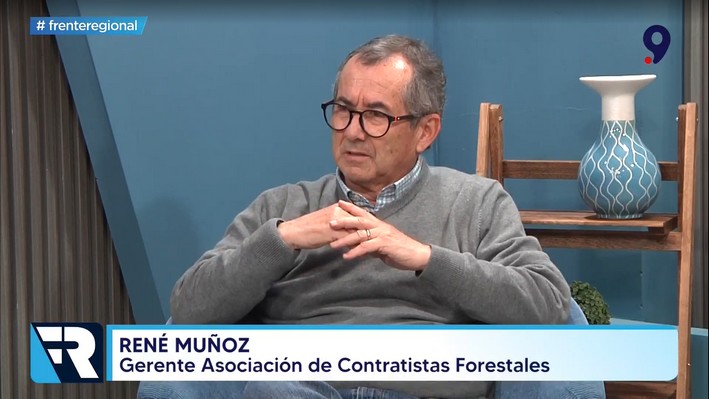
This was stated on the program Frente Regional of Canal 9 Biobio TV by Acoforag's manager, René Muñoz, who affirmed that the crisis facing the sector is not solely due to economic or market factors, but is the result of nearly three decades of insecurity, attacks, and the weakening of the rule of law in the Biobío and La Araucanía regions.
"The main problem is security," emphasized Muñoz, who explained that the concept not only refers to the occurrence of attacks, but also to the State's ability to guarantee fundamental rights, such as working, undertaking, and moving freely through the affected territories.
In the opinion of the union leader, the lack of an effective response over the last 29 years has allowed a scenario to consolidate where violent organizations, organized crime, and various crimes converge, which today form part of the same criminal phenomenon.
Among these, he mentioned arson attacks, arms trafficking, drug trafficking, livestock theft, vehicle theft, extortion, and other illicit acts which, according to him, have turned violence into a difficult-to-dismantle business.
"When there is a business that is also profitable, obviously those who participate in it have no incentive to abandon it," he stated during the interview.
Meetings with the Government
In this context, Muñoz confirmed that Acoforag has already held meetings with the President of the Republic and subsequently with representatives of the Ministry of Security, led by the head of the Strategic Unit, Eduardo Bennett.
According to him, both instances allowed them to present the reality faced by the sector and the effects that violence has had on productive activity in the Macrozone Sur. However, he specified that so far there is no concrete proposal from the Executive.
"We met last week in Santiago and we still don't have any concrete measures. We are waiting for a plan to be presented so we can review it, analyze it, and make our observations," he stated.
The leader added that he understands the complexity of the scenario facing the new administration, noting that during the campaign many solutions seemed simpler to implement, but reality demonstrates the magnitude of the existing problem in the area.
Victims and Reparation
One of the aspects that Acoforag hopes to see incorporated into the future government plan is a support program for victims of rural violence.
Muñoz stated that for years numerous people have lost family members, machinery, infrastructure, sources of employment, and life projects, without there being a public reparation policy commensurate with the magnitude of the problem.
"We hope there will be a plan that considers everything that has happened in the area. There is something that has been overlooked here, and that is the victims. We are not aware of a support plan for those who have lost family members, property, or their life projects as a result of violence," he stated.
The New Forestry Law
Alongside security measures, the union leader expressed that the sector is watching with anticipation the future forestry promotion law promoted by the Government.
In his opinion, the initiative represents an opportunity to reverse more than a decade of low afforestation and recover the country's productive capacity.
Muñoz recalled that Chile has gone about 15 years without an effective policy to incentivize forest plantations, a situation that could affect the supply of raw materials in the coming decades, considering the long growth cycles of forest species.
Likewise, he indicated that the new regulation should give owners greater freedom to define which species to plant and promote the recovery of degraded lands, estimated at around one and a half million hectares nationwide.
Fire Prevention
During the conversation, he also addressed the need to strengthen legislation on forest fires.
In this regard, he valued that the new proposals aim to strengthen the prevention, combat, and investigation of these crimes, preventing the economic burden of preventive measures from falling exclusively on small forest owners.
Furthermore, he insisted that the low rate of clarification of both intentional fires and attacks represents another element that fuels the feeling of impunity in the Macrozone Sur.
Impact on Activity
Although security was the central axis of his statements, Muñoz acknowledged that the deterioration of the scenario has also had economic and labor consequences.
He indicated that in the last decade the forestry sector has lost around 4,000 jobs, of which approximately half disappeared during the last year and a half.
However, he insisted that job loss must be understood as a consequence of a much deeper problem.
"Activity begins to suffer when the minimum conditions to work safely no longer exist. That's when operations start to be paralyzed, investments decrease, and finally, jobs are lost," he stated.
For Acoforag, the recovery of the sector will depend on two fundamental pillars: an effective plan to recover State control in the Macrozone Sur and the approval of a forestry promotion law that encourages new plantations and provides certainty to invest again in the country.



Comments (0)
No comments yet. Be the first to comment!
Leave a comment