

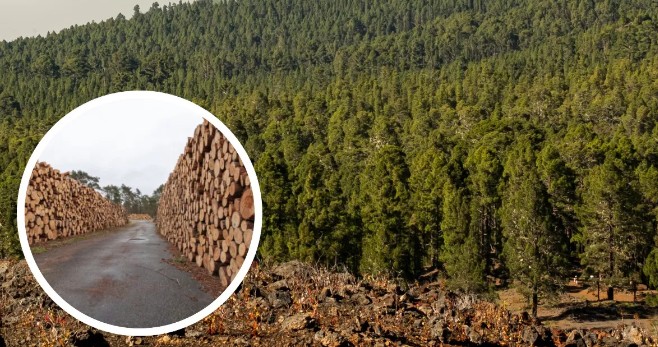
The forestry sector lamented the new tariffs imposed by the United States on Chilean forestry products, which in this case amount to 12.5%. While they represent a new challenge for the industry, they are also seen as an opportunity to make decisions that will strengthen the sector.
The Association of Forestry Contractors (Acoforag) expressed its concern over the measure. Its manager, René Muñoz, stated that he hopes the commitments made by the Government regarding reforestation will be fulfilled.
"Without a doubt, replanting is one of the milestones that must be achieved. We need to replant and generate a forestry resource that allows for the establishment of new industries and improves our supply," he stated.
He added that "we hope this will happen during this Government, because both the Minister of Agriculture and the President of the Republic have stated so."
For his part, the president of Corma, Rodrigo Oryan, regretted the United States' decision and assured that there is no forced labor in the Chilean forestry sector, one of the arguments put forward by the U.S. administration to justify the tariff increase.
"This tariff is, without a doubt, bad news for the Chilean forestry sector and also for the United States. I want to be very clear about this: there is no evidence of forced labor in the Chilean forestry sector. We demonstrated this throughout this entire process, with very clear technical and legal evidence," he stated.
Likewise, he highlighted that the Chilean forestry industry complies with strict labor legislation.
Senator Gastón Saavedra of the Socialist Party expressed his concern over the situation and stated that, while he hopes the sector can overcome this scenario, it is necessary for the Government to investigate the allegations regarding possible cases of forced labor.
"It is a concerning issue and we must be very precise. If this exists, it must be sanctioned and prohibited, because it affects the country's image and it is not acceptable for us to have that type of practice in Chile, much less in our region," the parliamentarian stated.
UDI Deputy Flor Weisse also lamented the tariff increase and expressed her hope that the Government will implement measures to mitigate the impact this decision may have on the forestry industry.
"The Biobío Region concentrates nearly 40% of the country's forestry exports, being the main national forestry hub," she highlighted.
This situation represents a new blow for a sector that already faces a complex scenario in the Biobío Region, marked by a decrease in investments and the migration of projects towards countries like Brazil, which offer more favorable conditions for the development of forestry activity.
Source:Channel 9





Comments (0)
No comments yet. Be the first to comment!
Leave a comment