

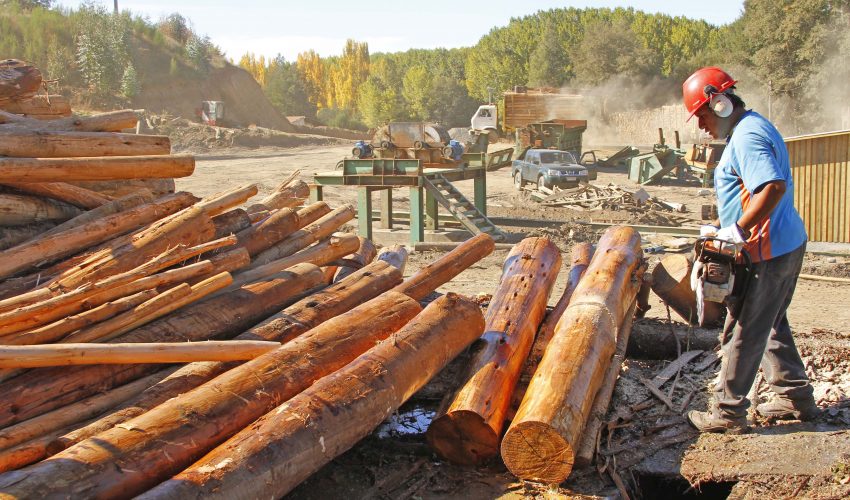
A complex labor scenario affects nearly 2,000 workers in the forestry sector in the Biobío Region, who lost their main source of income in recent weeks.
The Association of Forestry Contractors (Acoforag) warns of an employment crisis in a sector that currently supports around 50,000 families in the area.
The contractors' analysis
From Acoforag, its manager, René Muñoz, stated that the crisis stems from a "state abandonment of the forestry sector, not of a particular government. Let's consider that we have been subjected to a level of violence and insecurity in the southern macrozone for almost 30 years that prevents us from working, launching new projects, investing, and developing."
"Not having the capacity to face the problem, the consequences are paid by the workers and the sector in general: investments have left, there is no legal certainty, and the concept of security was lost a long time ago," added Muñoz.
To the local reality, the leader added international uncertainty: "The scenario of tensions in the Middle East, for example, has lowered the value of commodities. Pulp is the main export product of the Chilean forestry sector; if international prices fall, the entire system suffers. Territorial insecurity is not sustainable over time, and 30 years is too long for a productive sector to stay afloat."
Snapshot of the layoffs
According to Acoforag's figures, the contraction of 2,000 jobs this year includes both workers from contractor companies and plant personnel from the sector's large firms.
Given this outlook, Muñoz announced that he will meet this Friday, July 10, with the provincial delegate of Arauco, Pedro Marileo. "He has been the only authority that has approached to talk with the association," he noted.
For its part, the Table for the Defense of Employment and Industry requested urgent actions to prevent the situation from becoming a "Huachipato II," alluding to the cessation of steel operations at the Talcahuano plant and its massive layoffs.
Juan Sáez, president of the "Rodrigo Cisternas" Federation of Forestry Workers and who was laid off two years ago, stated that a complicated situation is currently being experienced in the province of Arauco. "Here in the area, due to the layoffs that have not stopped in the forestry sector and because several contractor companies have also been let go, more and more people are being left unemployed. There must be about 2,000 affected people, in a process where layoffs have been happening consecutively for two years."
"Today we have cases of pending negotiations (…) There are principal companies that are asking contractors, within the framework of collective bargaining, to lower workers' wages by 10%... that is, in a collective negotiation, when income should be increased, they are asking for a reduction of between 5% and 10%, which would be like negotiating against the workers," stated Sáez.
Iván Montes, spokesperson for the Table for the Defense of Employment and Regional Industry — an entity that brings together more than 30 unions — confirmed the diagnosis.
Montes detailed that the impact is evident in the recent layoffs reported by large companies: "At CMPC we recorded around 700 workers laid off; in March, the company Mininco laid off 400 workers; and at Arauco, the latest figure accounts for 300 layoffs. This adds up to nearly 2,000 affected families in the last two years in the region, considering own staff and subcontractors."
"For us, the forestry sector is becoming a potential 'Huachipato II' and we must look at it with that level of concern," warned the union leader.
Reactions from Corma and the Government
From the Chilean Wood Corporation (Corma), its regional president, Rodrigo O'Ryan, stated that each lost job is a warning sign. "Concrete and urgent measures are required to sustain activity and protect SMEs. We need a decisive policy to promote wood construction, capable of energizing the sector. Additionally, it is essential to strengthen security so that contractors can continue operating," he emphasized.
On behalf of the Executive, the Regional Minister of Labor and Social Security, Camila Álvarez, asserted that the situation is being addressed directly with key actors in the field to consolidate a shared diagnosis.
Álvarez explained that factors such as increased labor costs, low sector growth, fluctuations in pulp prices, logistical and security demands, rising fuel costs, and forest fires have shaped the current scenario.
The regional authority detailed that she has already met with Union No. 1 of Celulosa Arauco and with mayors of the province of Arauco to seek investment alternatives that absorb labor. "Furthermore, together with the Regional Training Council, we approved courses aimed at the labor reconversion of workers from companies in crisis or in the process of closing, prioritizing communes heavily hit by this contingency, such as Curanilahue," concluded the regional minister.
Logistical and operational challenges
On the operational side, the complex scenario forces remaining companies to seek comprehensive solutions to ensure their continuity efficiently. Experts in the transportation and logistics fleet area explain that in the forestry and pulp sectors, efficient mobility and permanent technical support are critical due to the geographical distribution of operations. Given current high costs, the industrial market projects a growing demand for services that incorporate preventive maintenance and specialized vehicle management to avoid costly stoppages in the field.
Consulted by Diario Concepción, Dr. Luis Méndez, academic at the Faculty of Business Sciences of the University of Bío-Bío (UBB) and director of the Biobío Labor Observatory, explained that the sector's crisis responds to two main factors: "First, there is a drastic drop in investment. We went from an average of 40,000 hectares planted annually between 2010 and 2020, to barely 1,500 hectares per year currently. Added to this is the damage caused by forest fires, which have strongly affected contractor companies."
As a second factor, Dr. Méndez pointed to a 21.4% decrease in forestry exports, mainly in the industrial and pulp sectors during the last year. "To these supply and demand problems, we should add the increase in production costs, especially in fuels and transportation," added the director of the Biobío Labor Observatory, warning that the crisis globally compromises the 43,000 workers who make up the total labor force of the sector in the Region.
Regarding how to reverse the trend, the UBB specialist stated that the solution must respond to a medium and long-term strategy aimed at incorporating greater technological development. "Pulp and wood are considered raw materials; their value does not lie in the quality of the product, but in the volume. Exporting only volume does not significantly contribute to regional income," he argued.
Source:Diario Concepción





Comments (0)
No comments yet. Be the first to comment!
Leave a comment