

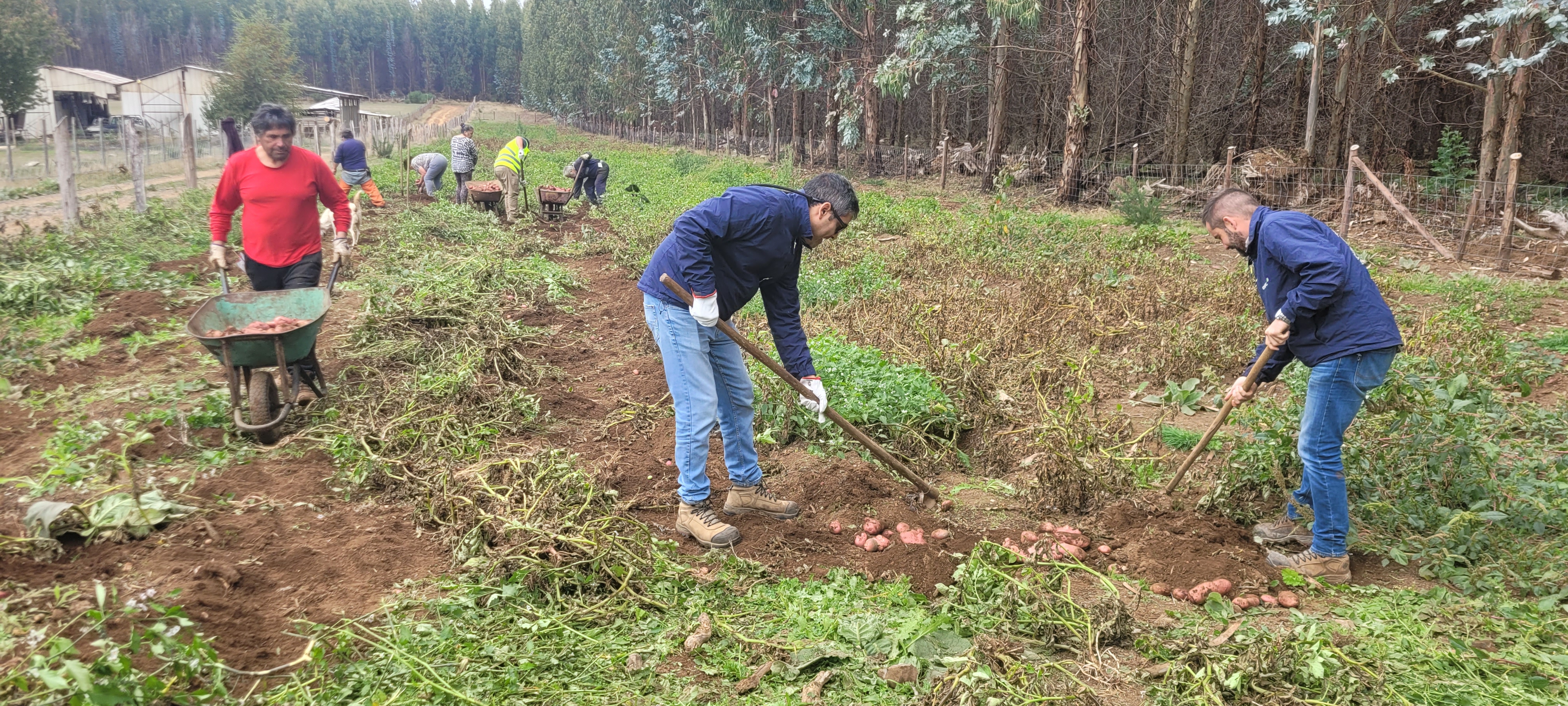
In the midst of the rural landscape of Ercilla, where productive forests coexist with communities historically tied to the land, an innovative form of fire prevention is bearing fruit—literally. These are the so-called green firebreaks, an initiative that today shows concrete results in the Sara Malleco sector, through a potato harvest that combines safety, collaboration, and local development.
Since noon, neighbors began gathering around an activity deeply rooted in rural life: the harvest. But this time, it was not just about collecting food, but about showcasing a model that transforms traditionally passive spaces—such as firebreaks—into active, productive, and community-oriented zones.
Interface zone
Claudio Cid Bascur, head of the Territorial Relationship Area of the Victoria Area at CMPC, explained that this experience is taking place in an interface zone between forest plantations and communities, where more than half a hectare was enabled for potato cultivation. "The main objective is to make this surface available for a productive activity for the community, but also to maintain a green firebreak in an area that had not been used before," he stated.
The initiative is part of a network of 46 orchards distributed across different company properties, all under the same concept: strategically using these spaces to reduce the risk of forest fires, while strengthening ties with neighboring communities.
For the Sara Malleco Neighborhood Association, this project not only represents an improvement in the safety of the environment, but also a concrete development opportunity. Its president, José Jara, valued the impact the harvest has had on the motivation of the sector's residents: "This is an incentive for the neighbors. Today we are already seeing results, with a very nice production. In the future, we want to keep growing and add more projects like this one."
Collective work
The process has also been an experience of collective work. Through mingas—traditional collaborative workdays—neighbors, leaders, and CMPC teams have worked side by side from planting to harvest. Cristian Parra, manager of the Community Prevention Network, highlighted the value of this coordination: "This is a social innovation project where there is real collaborative work. It not only benefits from a productive point of view, but also allows interrupting the spread of fire in the event of a wildfire."
Thus, what was once a safety strip without use, today becomes a living space that produces food, builds community, and protects the territory.


Comments (0)
No comments yet. Be the first to comment!
Leave a comment