

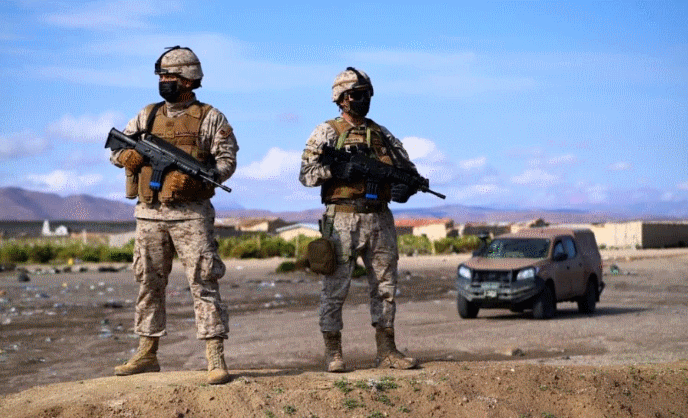
The Government submitted to Congress a constitutional reform that modifies the current regime of states of exception and proposes the creation of a new figure called "State of exception for public security," designed to respond to scenarios of serious disruption or threat against security in specific territories.
The initiative establishes that this mechanism may be decreed when there is a "serious and imminent threat" to public security or when it has already been seriously affected. The declaration will correspond to the President of the Republic, who must also determine the specific areas in which it will be applied.
One of the main changes compared to the current state of emergency is its duration. The proposal contemplates an initial period of up to 120 days, with the possibility that the President may extend it for another period of equal length. For subsequent extensions, the agreement of the National Congress will be required.
Once decreed, the areas included will fall under the immediate authority of the General Officer designated by the President. The authority must also inform Congress about the measures adopted during the validity of the exceptionality.
The project establishes that an organic constitutional law must specify the powers and duties of the authority responsible for the affected areas, along with the faculties that the Order and Public Security Forces will have and the potential collaboration of the Armed Forces.
New powers
The reform incorporates a new paragraph into Article 43 of the Constitution, through which specific powers are established to address situations of serious impact on public security.
During the validity of this state of exception, the President could order the suspension or restriction of personal freedom and freedom of movement, limit the right of assembly and the right of association, as well as authorize the interception, opening, or inspection of documents and communications.
The possibility of ordering requisitions of goods is also contemplated, within the powers established by legislation.
A figure distinct from the state of emergency
According to the presidential message, the new tool seeks to intervene in scenarios that may progressively deteriorate before reaching levels that make it more difficult to regain territorial control.
The Executive states that certain expressions of organized crime can advance gradually, affecting public security, controlling territories, and intimidating communities, without necessarily fitting from the outset the hypotheses that currently allow recourse to states of exception.
The proposal aims, therefore, to have a more focused mechanism adaptable to certain criminal dynamics.
The Minister of Security, Martín Arrau, explained that the instrument would be designed for particularly complex situations, such as rural areas that could be under the control of organizations linked to terrorism or drug trafficking.
The Secretary of State noted that there are simulations of territories where the new figure could be applied and highlighted that the intention is to work with much more limited areas, defined as "polygons," depending on the type of criminal phenomenon.
The reform must now begin its legislative process in Congress, where its scope, duration, and powers will be part of the parliamentary debate.







Comments (0)
No comments yet. Be the first to comment!
Leave a comment