

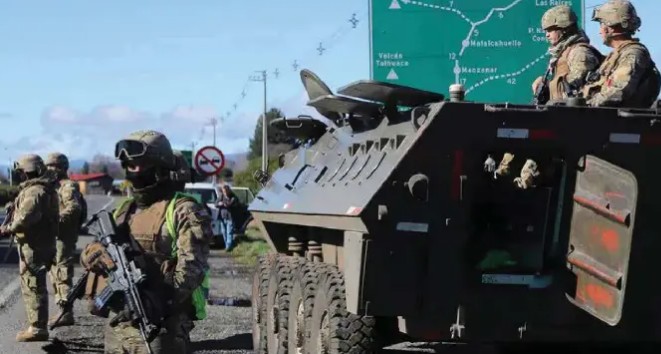
Despite stating that he could not continue with "the same recipes" to combat rural violence, alluding to his predecessor, former President Sebastián Piñera, on May 17, 2022 - 66 days after taking office - Boric signed the decree ordering the Armed Forces to take charge of security throughout the La Araucanía Region and in the provinces of Arauco and Biobío, in the Biobío Region.
The military deployment in the south, which has had the support of Congress through its constant approvals, has been maintained until now. In fact, on August 17, Parliament again approved another 30-day extension. "I am not here to request an administrative extension; I am here to report on a decision that has yielded results and to be allowed to continue. In matters of security, convictions without data are merely opinions," said Security Minister Martín Arrau that day.
It is precisely in this context that the Observatory of Organized Crime and Terrorism (OCRIT) of Andrés Bello University conducted a study to analyze how effective the measure has been after four years of implementation in that area. The study - by authors Pablo Urquízar, Vicente Abrigo, and Francisca Adasme - was based on data from Carabineros (the Chilean police).
The study compared levels of violence recorded in the regions of La Araucanía, Biobío, Los Ríos, and Los Lagos during two symmetrical periods of 1,419 days: before and after the measure came into effect. The work took into account that between October 13, 2021, and March 26, 2022,
there was a prior state of emergency decreed by Piñera, which was not extended. "During the 51 days in which said measure was absent, acts of violence increased by 53%, which motivated the declaration of the second state of emergency," the study states.
Likewise, it was also considered that during the second analyzed period, at least six relevant security laws came into effect, police operations were carried out, and the conviction of Héctor Llaitul, leader of the Coordinadora Arauco Malleco, occurred, which could, the report says, "influence the results independently of the state of exception."
"The purpose of the study was to evaluate the impact that the state of emergency, in force since May 2022 in the Southern Macrozone, has had, from both a legal and empirical perspective, considering the macrozone, regional, provincial,
and communal levels. The objective was not only to determine whether violence decreased, but also to examine the legal limits of an exceptional measure, the role played by the Armed Forces, and the institutional challenges posed by its use over a prolonged period," explains Pablo Urquízar - who was former security coordinator for the Southern Macrozone during the Piñera administration.
Among the initial results, it is noted that there was a "substantial" decrease in most violence indicators. "Total reports of criminal acts fell by 42.6%, going from 4,840 to 2,779 cases, with reductions in all four regions of the Southern Macrozone: Biobío (49.4%), Los Lagos (50.8%), Los Ríos (46.2%), and La Araucanía (38.9%), the latter with the most moderate percentage drop, despite concentrating the highest absolute volume of incidents," the text states.
Reduction and Increase
The study shows that, in the analyzed period, violent crimes fell. For example, homicides fell from 36 to 15 cases (58.3%), with the largest decreases in Arauco (73.3%) and Malleco (61.5%), and a more moderate reduction in Cautín (25%). Injured persons also decreased significantly, with particularly marked declines in Biobío (65.8%) and La Araucanía (44.8%).
Other crimes that decreased were arson and usurpations. The former fell from 1,097 to 598 cases (45.5%), concentrating the largest absolute reduction in Biobío, while the latter fell from 656 to 216 cases (67.1%), with a particularly pronounced drop in La Araucanía, "where this crime practically disappeared after the measure, except for a specific spike associated with the entry into force of Law No. 21,633 on illegal occupation of properties."
A contrast was recorded regarding property damage crimes. For example, there was a general decrease in destroyed vehicles at the Southern Macrozone level (34.7%), with the largest drops in Biobío and La Araucanía. However, there were significant increases in regions not covered by the measure, such as Los Ríos (64.7%) and Los Lagos (71.4%).
There was also a contrast in the actions of radical groups. In that sense, a decrease was recorded in the activity of groups such as the Coordinadora Arauco Malleco (around 20.5%), the Weichán Auka Mapu (39.5%), and the Resistencia Mapuche Lafkenche (62.5%).
However, the study indicates that Resistencia Mapuche Malleco increased its claimed actions by 87.1% after the state of emergency came into effect, "consolidating itself as one of the most active actors of the period, with strong territorial roots in areas such as Temucuicui." Likewise, others emerged, such as Resistencia Kunkowiwilliche and Resistencia Mapuche Pehuenche.
Conclusions and Challenges
In the final section, the study proposes several challenges that should be considered regarding the measure. One of them, the most criticized from the academic world, is the normalization of the measure presented as "exceptional."
"The prolonged use - four years - and the more than 70 extensions of the state of emergency reflect its consolidation as an ordinary security management tool, despite its constitutionally exceptional and subsidiary nature. This raises the need to clearly define the limits of its application and strengthen sustainable institutional alternatives over time," the study states.
Another criticism is the absence of structural measures. "Challenges persist for designing policies that, along with security, address structural factors of the problem. In this regard, for example, there is the debt concerning land that the State has, which, according to estimates from the Presidential Commission for Peace and Understanding, under current regulations could take between 80 and 162 years to settle."
Finally, for the conclusions, the study states that the state of exception has had "a significant impact on reducing acts of violence, although with disparate results depending on region, province, and type of crime."
"The measure has generated a notable deterrent effect on the most serious crimes, such as homicides and arson, substantially reducing their occurrence. However, challenges persist related to the reappearance of violence in non-intervened areas and the activity of emerging radicalized groups that have adapted their strategies," the study adds.
Urquízar adds a nuance. He maintains that the reduction in homicides, arson, or usurpations does not necessarily imply the disappearance of the structures that sustain violence, "since these have the capacity to adapt, move territorially, or adopt new forms of organization."
On the other hand, he says that lifting the measure could be a threat. "There is a precedent that forces us to consider that risk: after the end of the state of emergency decreed during President Piñera's government, there were 51 days without the measure, a period in which acts of violence increased significantly again."
Source:La Tercera




Comments (0)
No comments yet. Be the first to comment!
Leave a comment