

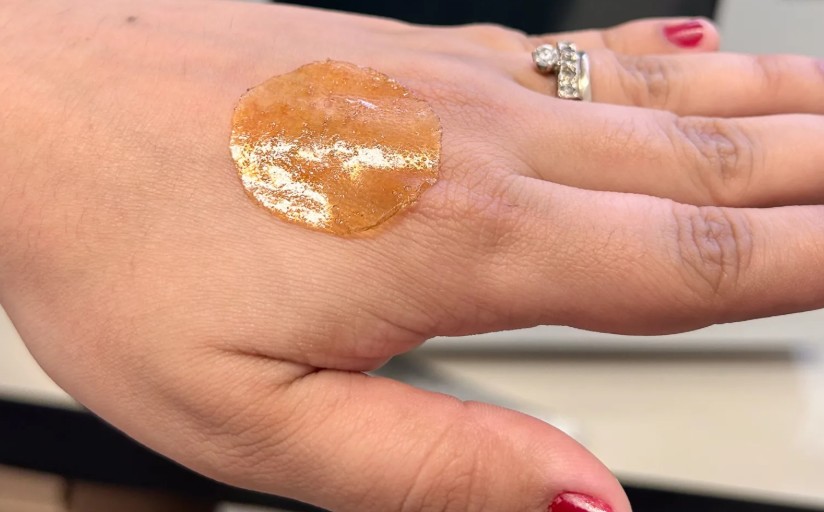
A significant advance in biomaterials for health was developed by researchers at the University of Concepción. The team designed a multipurpose hydrogel that not only protects injuries and absorbs fluids, but also actively participates in healing by combining mechanical support, antioxidant capacity, and natural electrical conductivity.
Unlike traditional dressings that only cover the wound, this development integrates three components into a single matrix: collagen, which provides cellular structure; reduced graphene oxide, which provides electrical conductivity; and condensed tannins from pine bark, an abundant resource in the forestry industry of Biobío.
"The skin generates small natural electrical signals toward the injured area. The patch does not require batteries, but rather helps maintain and better transmit those signals inherent to the body," explained Luisbel González Pérez de Medina, author of the research developed as part of his doctoral work at the Faculty of Engineering.
For their part, pine tannins not only act as antioxidants against cellular stress, but also play a key structural role. "Tannins help bind and stabilize the other components of the hydrogel, preventing the conductive particles from separating from the collagen matrix," detailed González. In the laboratory, tests showed that this design achieved more than 95% closure in simulated wounds at 48 hours.
The research was guided by academic Katherina Fernández (Faculty of Engineering) along with her colleagues, Claudio Aguayo (Pharmacy) and Jorge Toledo (Biological Sciences), in collaboration with the universities of Seville and NOVA Lisbon.
High-quality regeneration
The development was evaluated in biocompatibility and skin irritation tests (ISO) and subsequently in a porcine model of deep wound, whose skin has characteristics very similar to human skin.
At 21 days of treatment, both the commercial control patch and the UdeC hydrogel achieved complete wound closure. However, the decisive difference was in the architecture of the regenerated tissue.
"The absence of visible scarring was observed in a porcine model and not yet in humans. Furthermore, all treated groups, including the commercial dressing, achieved wound closure at 21 days. The most notable aspect was the quality of the tissue regenerated with our hydrogel: the skin presented a uniform surface and, when analyzed under the microscope, an organization more similar to healthy skin was observed. In contrast, the commercial dressing managed to close the wound, but the internal tissue remained less organized and with a greater presence of inflammatory cells," he said.
He highlighted that "the main difference was in how the skin regenerated: with the hydrogel, a more organized dermis was observed, a fully formed epidermis, and a lower presence of inflammatory alterations." Under the microscope, the tissue presented a uniform structure similar to healthy skin, without the formation of disorganized scars.
Response to chronic wounds
From the UdeC Biomaterials Laboratory, Katherina Fernández explained that the initiative was born after confirming that there were no dressings with multiple integrated capabilities on the market.
"We have been developing bio-based materials for some time. The traditional offering does not have enhanced properties; our goal was to bring together different functions in a single application and we have obtained very promising results," noted the academic.
Along those lines, the supervising professor emphasized that the development seeks to respond to chronic injuries, such as diabetic foot ulcers or bedsores. "These wounds do not heal because their biochemical environment is imbalanced. There are many people affected by these lesions that can become fatal; our goal is to develop real solutions for them," she added.
The project is at an advanced preclinical stage. To reach healthcare centers, the team will move forward with standardizing manufacturing, validating sterilization methods, determining shelf life, and the regulatory studies required before initiating the first clinical trials in humans.






Comments (0)
No comments yet. Be the first to comment!
Leave a comment