

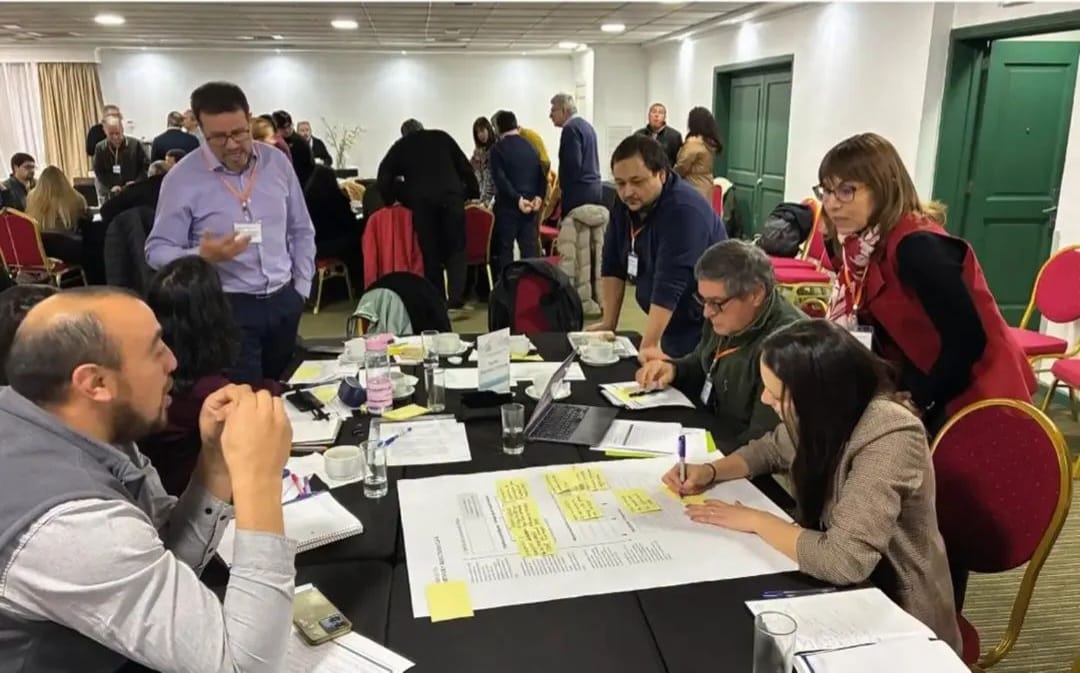
With the challenge of strengthening the supply chain of structural timber for construction and contributing to a more sustainable economy, the Forest Institute (INFOR), through its Research Area of Forest Information and Economics, held in the Biobío Region the Strategic Workshop of the project "Supply Plan for Structural Sawn Timber for Mass Timber Construction," an initiative funded by CORFO Biobío through its 2024 Public Goods line: Decarbonization for Construction.
The activity brought together representatives from the public, private, academic, and productive sectors, who participated in a collaborative process aimed at identifying gaps, validating diagnoses, and defining priority actions to strengthen the availability of structural timber intended for construction in the country.
The session included the participation of the executive director of the CORFO Biobío Committee, James Argo; the deputy director of the CORFO Biobío Committee, Ximena Riffo; the executive deputy director of INFOR, Hans Grosse; the regional director of CONAF Biobío, Álvaro González; and the manager of the INFOR Biobío Headquarters, Oscar Larraín, as well as representatives from forestry companies, sawmills, technology centers, and universities.
During the meeting, attendees worked in three thematic tables focused on Timber Construction, the Forestry Industry, and the Silvicultural Forestry Sector, addressing the main challenges facing the supply chain and generating proposals to ensure a sustainable and competitive supply of structural timber.
In this context, the executive deputy director of INFOR, Hans Grosse, highlighted the strategic relevance of advancing a shared vision to respond to the growing demand for sustainable construction solutions. "Timber construction represents a concrete opportunity to move toward a low-carbon economy, but to achieve this, it is essential to have a robust, efficient, and well-coordinated supply chain. This workshop allowed us to bring together the main stakeholders in the sector to build a common plan that strengthens the availability of structural timber and contributes to the country's sustainable development," he stated.
The authority added that one of the main values of this initiative lies in the articulation of capacities and knowledge from different sectors. "The challenge is not only to increase the supply of timber for construction, but also to generate the conditions for the entire value chain to evolve in a coordinated manner, incorporating innovation, efficiency, and sustainability. The active participation of industry, academia, and public bodies is essential to achieve that goal," he affirmed.
Meanwhile, representatives from CORFO Biobío valued the instance as an opportunity to promote concrete solutions that contribute to the decarbonization of the construction sector, while CONAF highlighted the importance of linking these challenges with sustainable forest management that ensures the future availability of the resource.
The contributions gathered during the working tables will be incorporated into the preparation of the final version of the Supply Plan for Structural Sawn Timber for Mass Timber Construction, a document that seeks to become a strategic tool to strengthen the competitiveness of the forestry sector, promote sustainable construction, and support national climate change mitigation goals.
With initiatives like this, INFOR reaffirms its commitment to generating knowledge, articulating key stakeholders, and developing solutions that allow harnessing the potential of timber as a renewable material for more efficient, resilient, and sustainable construction.



Comments (0)
No comments yet. Be the first to comment!
Leave a comment