

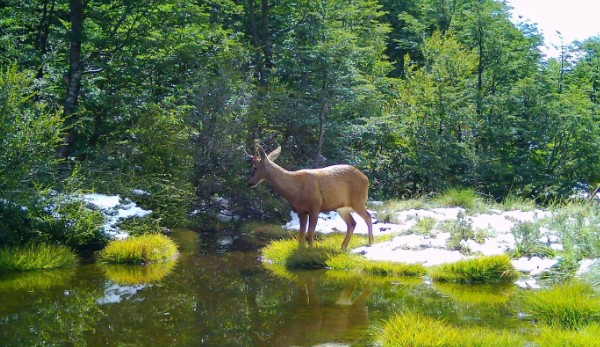
Camera traps installed within the future Puchegüín protected area, in Cochamó, recorded the same male huemul (Hippocamelus bisulcus) in two different valleys, separated by approximately six kilometers of mountain terrain. The research was conducted between January and April 2026 in the Manso River basin by Puelo Patagonia.
Currently, the NGO comprehensively manages this property —acquired in December 2025 thanks to contributions from people in Chile and around the world— and leads the process to turn it into a protected area that permanently safeguards its natural and cultural values.
The organization noted that understanding how a species in serious danger of extinction moves within this place is essential to design a protected area that responds to its real needs and strengthens the connectivity of a biological corridor of 1.6 million hectares of protected ecosystems that includes Puchegüín.
"This information allows us to prioritize sectors, guide conservation and public use decisions, and protect essential ecological processes for its survival," said Guillermo Sapaj, Conservation Director at Puelo Patagonia.
The huemul that revealed the corridor
Based on 5 images, researchers compared distinctive markings of huemuls in the records, managing to identify 11 different individuals: eight males and three females.
Among them was the male that made it possible to demonstrate connectivity between both sectors. In his case, the shape of the antlers was key to recognizing him: he had a small additional tine on the upper part of the right antler, a unique characteristic that allowed him to be identified in nine records obtained between January 13 and February 26 by cameras located at a distance of approximately 5.97 to 6.24 kilometers in a straight line, but since these are mountain valleys with steep slopes, the actual route could have been even longer.
Additionally, the same male was recorded following a female in three of the five events in which huemul pairs were observed, a behavior associated with the species' reproductive period. This record suggests that the movement between both valleys could have been linked to seeking a mate.
"The record demonstrates that a functional connection still exists between these habitats. Maintaining it is essential for huemuls to move, meet, and reproduce, reducing the isolation of this subpopulation," explained Fernando Novoa, Wildlife Researcher at Puelo Patagonia.
A key finding for a species in danger of extinction
Although the record provides an encouraging signal, the situation of the huemul remains critical. These 11 individuals identified during monitoring do not represent an estimate of the total size of this subpopulation.
The huemul is a deer endemic to the southern Andes of Chile and Argentina, classified as Endangered by the IUCN. It is estimated that fewer than 2,000 individuals remain, distributed in small, fragmented, and vulnerable populations.
In Chile, the distribution of the huemul is highly fragmented. Although the species currently extends from the Ñuble Region to Magallanes, it does not do so continuously, but rather through small subpopulations isolated from each other. This lack of connectivity hinders the movement of individuals and genetic exchange between different groups.
"In this context, Puchegüín acquires strategic value for the conservation of the species, since it is surrounded by protected areas and is part of a biological corridor of more than 1.6 million hectares that connects protected ecosystems between Chile and Argentina, where connectivity between habitats is still maintained," commented Sapaj.
This finding represents a new step in Puelo Patagonia's research, which since 2019 has been answering increasingly specific questions about the huemul in the region. First, it allowed confirming through images the presence of the species in the Cochamó commune; then expanding its northern distribution range in Chilean Patagonia; and now, for the first time, demonstrating the movement of the same individual between different sectors of Puchegüín, advancing from confirming its presence to understanding how it uses the landscape.
Achieving this result also required combining scientific tools with the knowledge of those who inhabit the mountain range. The location of the cameras was defined based on satellite imagery, vegetation mapping, field observations, and information provided by local residents about the areas with the highest probability of huemul presence.
From Puelo Patagonia, they indicated that the next challenge will be to sustain monitoring over time, expand research into new areas, identify the routes used by the huemul, and strengthen collaboration with researchers and communities on both sides of the mountain range, transforming that knowledge into new conservation actions and thus being able to protect this iconic and threatened species.






Comments (0)
No comments yet. Be the first to comment!
Leave a comment